




Key Takeaways
- A home can feel overpriced emotionally before buyers analyze it logically.
- Presentation, maintenance, lighting, and trust signals all influence pricing perception.
- Online shortlisting shapes buyer value opinions before showings happen.
- Homes that feel easy, clean, and predictable often feel more valuable.
- Buyer confidence often strengthens perceived value and pricing acceptance.
“A home can feel overpriced emotionally before buyers analyze it logically.” — Kevin Flaherty
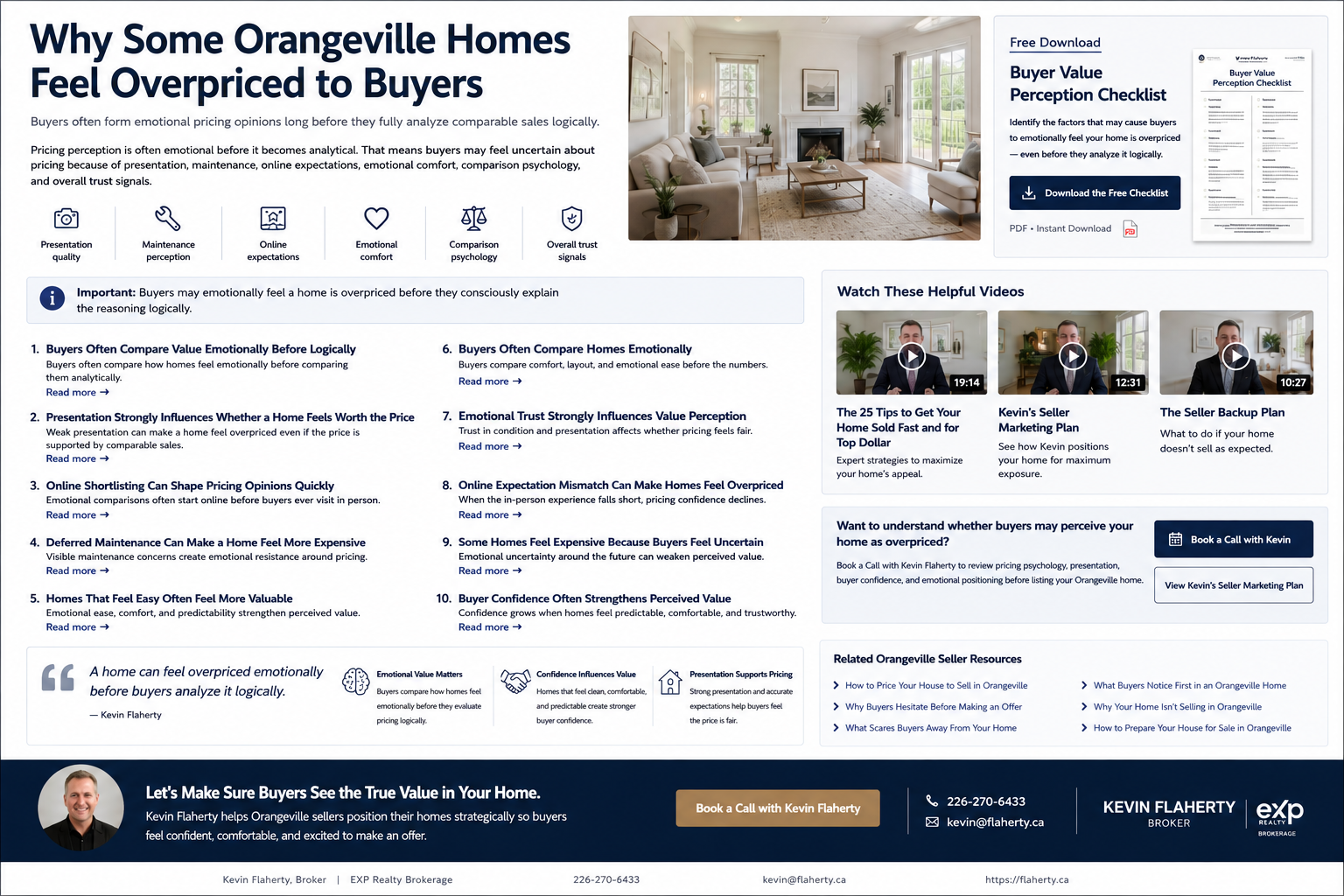
Click the image to download the Buyer Value Perception Checklist and understand what may affect pricing confidence.
Buyers Often Compare Value Emotionally Before Logically
Most buyers begin forming opinions about value emotionally while browsing listings online and touring homes in person.
That means buyers may subconsciously evaluate comfort, cleanliness, light, layout flow, maintenance, presentation quality, and overall emotional ease.
Even before reviewing comparable sales, buyers may already feel whether a home appears fairly priced or emotionally expensive.
Key insight: Buyers often compare how homes feel emotionally before comparing them analytically.
Presentation Strongly Influences Whether a Home Feels Worth the Price
Pricing perception is often connected to how the home feels during online browsing and in-person showings.
Buyers may feel uncertain when photos feel dark, rooms appear cluttered, maintenance concerns are visible, lighting feels poor, or spaces feel emotionally stressful. This is also why staging before selling in Orangeville can influence value perception.
Even when pricing is technically supported by comparable sales, weak presentation can still weaken emotional value perception. This connects closely with what adds the most value before selling in Orangeville.
Important: Buyers often compare asking price against emotional comfort — not just square footage.
Online Shortlisting Can Shape Pricing Opinions Quickly
Most buyers compare multiple homes online at the same time.
That means buyers may quickly compare photo quality, brightness, layout clarity, presentation, condition, and perceived lifestyle fit.
If competing homes feel emotionally stronger online, buyers may begin viewing another property as overpriced even before scheduling a showing.
Key insight: Emotional comparison often starts online before buyers ever visit in person.
Deferred Maintenance Can Make a Home Feel More Expensive
Visible maintenance concerns can create emotional resistance around pricing. Sellers deciding whether to fix issues first may also want to review whether to renovate before selling in Orangeville.
Buyers may begin wondering what repairs will happen after closing, whether hidden problems exist, whether ownership will feel financially stressful, or whether the home feels risky.
Even relatively small maintenance issues may weaken emotional pricing confidence.
Important: Buyers are often evaluating emotional predictability as much as the actual repair cost itself.
Homes That Feel Easy Often Feel More Valuable
Many buyers are balancing financial pressure, lifestyle decisions, moving stress, and emotional uncertainty simultaneously.
Homes that feel clean, organized, bright, move-in ready, and emotionally comfortable often create stronger emotional value perception. Sellers can support this by reviewing how to prepare your house for sale in Orangeville.
Homes that feel stressful, confusing, cluttered, or uncertain may feel overpriced even if the asking price is supported analytically.
Key insight: Emotional ease often strengthens perceived value.
Buyers Often Compare Homes Emotionally Instead of Mathematically
Most buyers do not compare homes using spreadsheets or perfect analytical logic.
Instead, buyers often compare how comfortable homes feel, whether layouts feel stressful or easy, how emotionally inviting spaces feel, whether presentation supports confidence, and how predictable ownership feels.
That emotional comparison process may influence whether buyers feel pricing seems reasonable or emotionally excessive.
Key insight: Buyers often compare emotional comfort before comparing detailed pricing metrics.
Emotional Trust Often Influences Whether Pricing Feels Fair
When buyers trust the presentation, condition, and consistency of a home, pricing may feel more emotionally reasonable.
However, uncertainty may increase when buyers notice unfinished repairs, clutter, poor photography, pricing inconsistencies, confusing room usage, or maintenance concerns.
Even subtle trust erosion may weaken perceived value during the comparison process.
Important: Buyers often associate emotional trust with pricing confidence.
Want to understand whether buyers may perceive your home as overpriced?
Book a Call with Kevin Flaherty to review pricing psychology, presentation, buyer confidence, and emotional positioning before listing your Orangeville home.
Book a Call with Kevin Flaherty View Kevin Flaherty’s Seller Marketing PlanOnline Expectation Mismatch Can Make Homes Feel More Expensive
Many buyers emotionally shortlist homes online before ever booking a showing.
If the in-person experience feels less impressive than expected, buyers may quickly feel pricing resistance.
Expectation mismatch may happen because of overedited photography, wide-angle distortion, lighting differences, clutter, unexpected maintenance issues, or layout disappointment.
Key insight: Buyers often lose pricing confidence when the showing experience feels inconsistent with the online presentation.
Some Homes Feel Expensive Because Buyers Feel Emotionally Uncertain
Buyers may hesitate when the home creates emotional uncertainty around future maintenance, long-term comfort, layout functionality, financial predictability, resale confidence, or overall emotional ease.
Even when the asking price may be supported analytically, uncertainty can still make the home feel emotionally overpriced.
Important: Emotional uncertainty may weaken perceived value before buyers fully explain their reasoning logically.
Buyer Confidence Often Strengthens Perceived Value
Homes that create stronger emotional confidence often feel more valuable during the comparison process.
Buyer confidence may increase when the home feels well maintained, clean, emotionally comfortable, easy to understand, properly positioned, and consistent with the asking price.
Homes that feel emotionally predictable and trustworthy often generate stronger buyer engagement and pricing acceptance.
Key insight: Emotional confidence frequently strengthens perceived value.
What Makes a Home Feel Overpriced to Buyers?
Buyers often feel pricing resistance when they notice weak presentation, deferred maintenance, poor lighting, clutter, pricing inconsistency, layout frustration, online expectation mismatch, or emotional discomfort.
Even when buyers cannot fully explain their hesitation logically, emotional value perception may still influence whether the home feels overpriced.
Why Buyers Sometimes Struggle to Explain Why a Home Feels Overpriced
Buyers do not always clearly explain why a home feels expensive emotionally.
Instead, buyers may simply feel uncertain, emotionally disconnected, less excited, less confident, or less comfortable moving forward.
That emotional hesitation may influence value perception even before buyers consciously identify the exact reason.
Key insight: Buyers may not always say “this feels overpriced,” but their hesitation can still reveal that perceived value is not strong enough.
“Buyers often decide whether pricing feels reasonable emotionally before they fully justify the decision logically.” — Kevin Flaherty
Orangeville Buyer Context Matters
Many Orangeville buyers are balancing affordability, commute expectations, lifestyle priorities, and long-term comfort while comparing homes across multiple communities.
That means a home’s price is rarely judged in isolation. Buyers may be comparing Orangeville homes against other local options, nearby Dufferin County communities, and what they believe the lifestyle value should feel like.
Important: Local buyer expectations can influence whether a home feels fairly priced, emotionally competitive, or harder to justify.
What Buyers Often Remember After Comparing Homes
Buyers rarely remember every feature or statistic from each showing.
However, they often remember how the home felt emotionally, whether the layout felt stressful or easy, whether the home felt cared for, whether pricing felt emotionally justified, and whether the experience felt predictable and comfortable.
This matters because perceived value often comes from the total emotional impression buyers carry with them after comparing multiple homes.
Example: Why Buyers Felt the Home Was Overpriced
One Orangeville seller may initially believe buyers are rejecting the price because the market has slowed.
However, buyer feedback can reveal that pricing resistance is being created by dark listing photos, unfinished repairs, cluttered presentation, maintenance uncertainty, or online expectation mismatch.
When presentation and emotional comfort improve, buyer confidence and showing momentum can improve significantly.
Watch: 25 Tips to Help Sell Your Orangeville Home Faster
Small presentation details, pricing strategy, buyer psychology, and emotional confidence can all influence whether buyers feel the price makes sense.
Watch: Kevin Flaherty shares practical tips to help sellers improve buyer response, showing momentum, and perceived value.
How a Seller Marketing Plan Can Support Perceived Value
Buyer value perception is often shaped before the showing ever happens.
Kevin Flaherty’s seller marketing plan focuses on positioning, presentation, exposure, and buyer confidence so sellers are not relying on price alone to create interest.
Next resource: Review Kevin Flaherty’s seller marketing plan to see how listing strategy and presentation work together.
Watch: Why Sellers Need a Backup Plan
Pricing strategy and buyer confidence can change quickly once a listing is live.
This video explains why having a thoughtful backup strategy can help sellers reduce stress and make better decisions if buyer response is weaker than expected.
Watch: Kevin Flaherty explains how seller preparation, backup planning, and market response work together.
Download the Buyer Value Perception Checklist
Want a printable checklist? Download the Buyer Value Perception Checklist before listing your Orangeville home.
The checklist helps sellers evaluate pricing alignment, presentation, maintenance perception, online expectations, and buyer confidence.
📄 Download the Buyer Value Perception ChecklistFAQ: Why Some Homes Feel Overpriced
Homes may feel overpriced when buyers do not feel the presentation, condition, layout, emotional comfort, or perceived value supports the asking price. Kevin Flaherty helps Orangeville sellers evaluate pricing through both market evidence and buyer perception.
Yes. Comparable sales matter, but buyers also react emotionally to presentation, maintenance, online expectations, and competing listings. A home can be analytically supported but still feel emotionally expensive to buyers.
Buyers may think a home is overpriced when photos feel weak, rooms feel cluttered, repairs are visible, lighting is poor, pricing feels inconsistent, or competing homes feel stronger. This connects closely with why buyers hesitate before making an offer in Orangeville.
Yes. Presentation can strongly influence whether buyers feel a home is worth the asking price. Cleanliness, lighting, staging, photography, and maintenance signals all affect emotional value perception.
Yes. Maintenance concerns can make buyers feel uncertain about future expenses. Even small visible repairs may cause buyers to question whether the price fairly reflects the home’s condition.
Buyers compare homes online through photos, price, condition, brightness, room flow, presentation, location, and emotional appeal. Kevin Flaherty focuses on how buyers emotionally shortlist homes before showings happen.
Better marketing can help buyers understand the home more clearly and feel more confident before showings. Review Kevin Flaherty’s seller marketing plan to see how positioning and presentation support perceived value.
Sellers can improve perceived value by aligning pricing, presentation, cleanliness, lighting, maintenance, photography, and buyer expectations. This also connects with how to sell your house fast in Orangeville. Book a Call with Kevin Flaherty to review your best strategy.
Final Answer: Why Homes Feel Overpriced
Final answer: Some Orangeville homes feel overpriced because buyers evaluate value emotionally before they analyze pricing logically.
Presentation, maintenance signals, online expectations, trust, and emotional comfort can all influence whether buyers feel the asking price makes sense.
Next step: request your Orangeville home evaluation or Book a Call with Kevin Flaherty before listing your home.