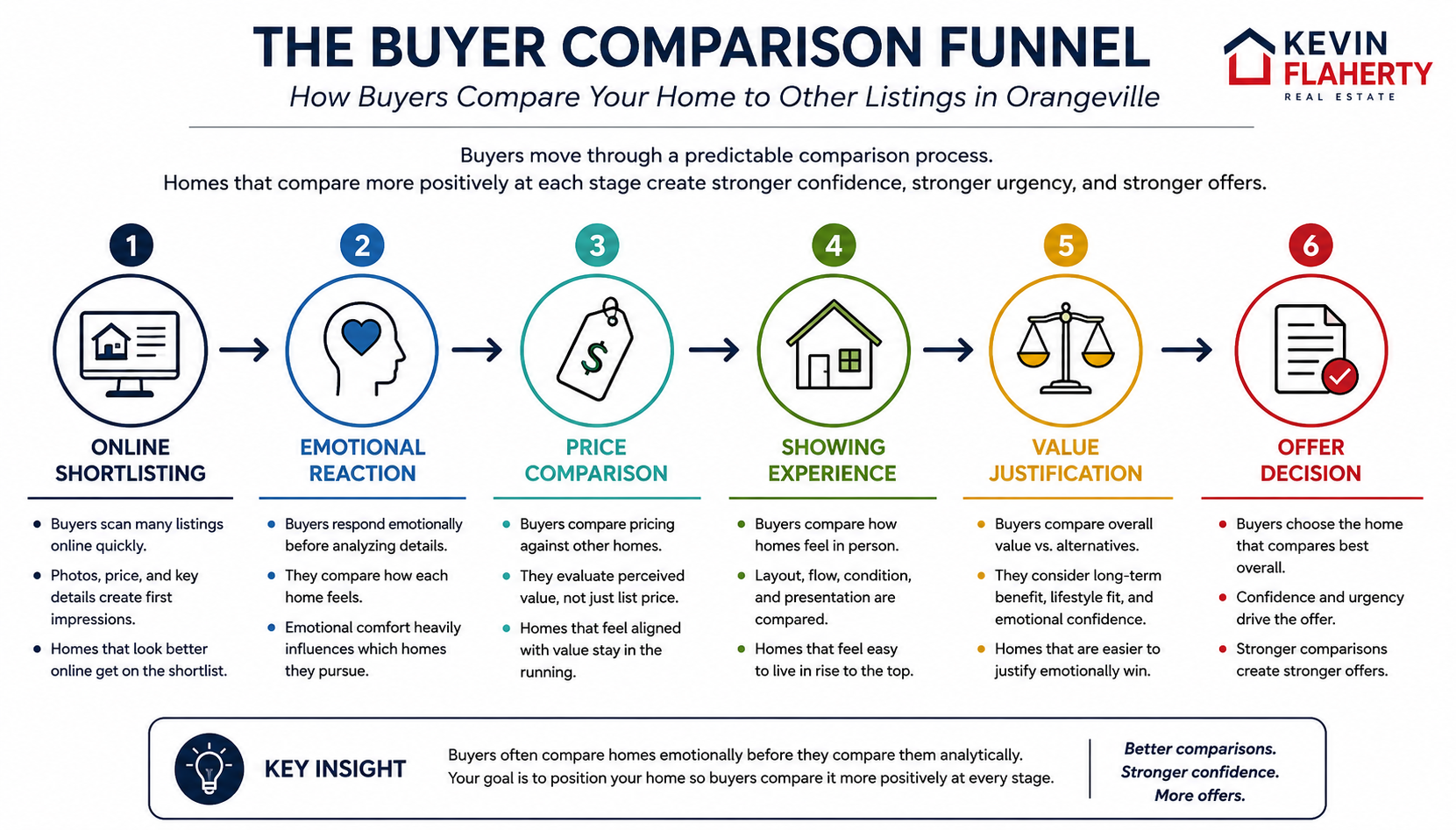
What is the first thing buyers compare?
They usually compare the online impression first: price, lead photo, room brightness, apparent condition, and whether the home looks worth a showing.





Buyers compare your Orangeville home against every other reasonable choice they can see online and in person. They weigh photos against reality, price against evidence, condition against risk, neighbourhood against daily life, and marketing quality against confidence. The home that feels clearest, safest, and best positioned usually earns the next showing, the stronger offer, or the faster decision.
This guide is written for Orangeville homeowners around the centre coordinate 43.919739, -80.095202, including Downtown Orangeville, Hospital Hill, Montgomery Village, Settlers Creek, Browns Farm, and the South End. For current advice on your property, call Kevin Flaherty at 226-270-6433.
Orangeville buyers compare your home by ranking it against the alternatives that feel most similar in price, size, location, condition, and effort required after closing. They do not evaluate your home in isolation. They ask whether the listing looks better, worse, safer, riskier, cleaner, more expensive, more flexible, or more believable than the other homes available that week.
The most important comparison is not always the home with the same bedroom count. It may be the home with clearer photos, a better documented renovation, a lower perceived repair burden, a more convenient neighbourhood, or a price that makes the trade-offs easier to accept. A seller wins the comparison when buyers understand the value quickly and believe the listing will hold up after a showing, inspection, financing review, and negotiation.
This guide is based on 38 years of listing homes in Orangeville. For broader market context, see CMHC and OREA. If you'd rather skip the general guide and get feedback on your specific home, start with a free home evaluation.
They usually compare the online impression first: price, lead photo, room brightness, apparent condition, and whether the home looks worth a showing.
They compare both. Sold homes influence value expectations, while active listings are the choices buyers can actually book and offer on today.
Yes. Clear photos, floor-plan explanation, video, and a buyer-focused description can make a home easier to trust and easier to choose.
Unclear pricing, weak photos, deferred maintenance, poor showing condition, missing documentation, and a better-presented competitor can all redirect attention.
Compare your property with the homes buyers will see in the same price range, neighbourhood cluster, condition bracket, and lifestyle category.
The first showing is no longer the front door. It is the listing page. Before a buyer visits your Orangeville home, they compare the lead image, price, map location, room count, square footage, taxes, description, video, floor plan, and visible condition against every other listing in their saved search. If your home loses that online comparison, you may never receive feedback because the buyer simply books another property.
This is why the gap between photos and reality matters. Photos should make the home look its best, but they should not create a promise the showing cannot support. When buyers arrive and the home feels darker, smaller, more worn, or less functional than expected, trust drops. When the in-person experience confirms the online story, trust rises. That trust is what moves a buyer from browsing to serious consideration.
In Orangeville, buyers may compare a character home near Downtown Orangeville with a more conventional layout in Montgomery Village, or a detached family home in Settlers Creek with a property near Browns Farm. The listing must help them understand why your home deserves the showing appointment.
Buyers do not need every home to be perfect. They need the listing to be honest, clear, and strong enough that the trade-offs feel worthwhile.
Bright, accurate, well-composed images help a buyer understand the home quickly. Weak images make even a good home feel risky because buyers assume the best features would have been shown if they existed.
A strong description explains layout, upgrades, storage, outdoor use, parking, neighbourhood convenience, and buyer benefits. Generic copy forces buyers to guess.
Video and floor-plan clarity help buyers understand flow before visiting. That is especially useful when rooms connect in ways still photos cannot explain.
After the online impression, buyers ask whether the price makes sense. Some use price per square foot as a quick filter. Others compare bedroom count, lot size, basement finish, garage space, renovation level, age of major systems, and location. The danger for sellers is assuming buyers will compare only the feature that flatters the property. Buyers compare the entire package.
Price per square foot can be helpful, but it can also mislead. A smaller home with excellent upgrades, strong light, low maintenance, a finished basement, and a better yard may feel more valuable than a larger home that needs work. A property near Hospital Hill, Parkview Acres, or the West End may attract buyers for different practical reasons than a similar square footage near Outer Downtown or South End. The price has to explain those differences before buyers create their own discount.
Kevin's pricing conversation usually starts with the buyer's point of view: what else can this buyer purchase, what recently sold, what active listings are still available, what objections are obvious, and what premium can be defended. For more detail, review how to price your house to attract buyers in Orangeville and Orangeville home value.
| Buyer comparison | What they are really asking | Seller response |
|---|---|---|
| Price per square foot | Does this look expensive or efficient compared with similar listings? | Show why the space is more useful, updated, better located, or easier to own. |
| Recent sold prices | Can the asking price be justified by evidence? | Use relevant solds and explain meaningful differences honestly. |
| Active competition | Would I rather buy this home or book the one down the list? | Position the listing so its advantage is obvious in the same search bracket. |
| Cost after closing | How much will I need to spend immediately? | Document maintenance, remove visible objections, and price known work realistically. |
Buyers compare condition faster than most sellers realize. They notice the front step, door hardware, odours, wall marks, lighting, flooring, caulking, closets, basement corners, mechanical areas, exterior trim, and yard maintenance. Each signal either increases confidence or adds another reason to negotiate harder. A buyer may not say, “this home feels risky,” but that is often what their offer reflects.
Move-in readiness does not mean everything is new. It means the home feels cared for and the remaining work is understandable. A home with older finishes can still compare well if it is clean, bright, maintained, documented, and priced with the condition in mind. A recently renovated home can compare poorly if the workmanship looks rushed or the documentation is missing.
For sellers near Hospital Hill, Outer Downtown, Park Lane, and Midtown Orangeville, age, character, additions, parking, and mechanical history may matter as much as cosmetic presentation. For newer subdivision homes, buyers may focus more on layout, storage, finishes, yard usability, and how the home compares with similar floor plans nearby.
Cleanliness, neutral paint, working lighting, organized storage, fresh caulking, clear utility information, maintained exterior details, and a repair list that shows the seller has been proactive all help buyers trust the home.
Strong odours, dark rooms, stained carpets, loose fixtures, visible water concerns, cluttered mechanical rooms, unfinished repairs, and vague renovation claims make buyers compare the home against safer alternatives.
Before spending heavily, review whether to renovate before selling in Orangeville, what not to fix before selling, and what adds the most value before selling.
Buyers do not compare every Orangeville home the same way. A buyer who wants walkability may compare Downtown Orangeville, Midtown Orangeville, and Outer Downtown differently than a buyer who wants a larger yard, garage, and family-friendly subdivision feel. A buyer who needs hospital access, commuter routes, schools, trails, or parks may pay attention to a different set of details than a buyer focused mainly on interior finish.
A good listing does not simply name the neighbourhood. It explains the practical benefit. If the home has a useful yard, say how it lives. If the location supports a commute, explain the route advantage without exaggeration. If parks, schools, shopping, or community amenities are part of the appeal, show how they support daily life. Buyers compare convenience, but they need the listing to connect the dots.
Local comparison changes across Credit Springs, Edgewood Valley, Highland Ridge, Kin Corner, Lisa Marie Nook, Orangeville Highlands, Parkview Acres, Sunvale On The Hill, and Veterans Park.
| Neighbourhood factor | Buyer comparison | How the listing should respond |
|---|---|---|
| Walkability | Can I live conveniently without every errand feeling difficult? | Describe nearby daily-use amenities and the lifestyle benefit. |
| Family function | Does the home support school routines, storage, parking, and outdoor use? | Show bedrooms, basement use, yard function, and practical traffic flow. |
| Commuter access | Will this location work with my work pattern? | Explain route convenience factually without overpromising travel times. |
| Future resale confidence | Will other buyers value this location later? | Connect neighbourhood strengths to durable buyer demand. |
Staging is not about pretending the home is something it is not. It is about making the home easier to understand. Buyers compare room size, furniture placement, light, storage, traffic flow, and emotional fit. If a room looks crowded, undefined, or dark, buyers may assume the home is smaller or less functional than it really is.
The best preparation removes distraction. Entry areas should feel welcoming, kitchens should feel usable, bathrooms should feel clean, bedrooms should show realistic scale, and basements should have a clear purpose. Exterior areas matter too because buyers compare curb appeal before they compare finish details. A strong showing experience supports the price; a weak one invites discounts.
Presentation does not replace pricing. It protects pricing by helping buyers see the value without fighting through clutter, confusion, or preventable objections.
If staging is uncertain, compare the likely cost against the likely buyer hesitation. Sellers can also review whether to stage before selling in Orangeville and what buyers notice first when viewing a home.
Documentation is one of the most underrated ways to win a buyer comparison. Buyers are not only comparing visible features. They are comparing unknowns. If one home has clear details about furnace age, roof work, utility costs, renovation records, rental equipment, inclusions, exclusions, permits where applicable, and known issues, it can feel safer than a similar home with unanswered questions.
This matters especially when a buyer is weighing an older home against a newer one, or a renovated home against one that still needs work. Good disclosure does not remove every concern, but it reduces the fear that the buyer is missing something. The goal is not to overwhelm people with paperwork. The goal is to give serious buyers enough confidence to move forward.
Kevin often frames documentation as part of the marketing system because clarity is marketable. A buyer who understands the home can focus on whether they want it. A buyer who is confused spends energy finding reasons to wait, ask for more time, or compare a cleaner listing elsewhere.
Gather utility details, maintenance receipts, upgrade notes, equipment rental information, inclusions, exclusions, and any documents a serious buyer will request.
Make sure the public listing, agent remarks, floor-plan information, and showing preparation all tell the same story about the property.
Prepare to answer questions quickly so uncertainty does not push buyers toward a competing home that feels easier to understand.
Days on market can become part of the buyer's comparison. A fresh listing may receive attention because buyers know other people are seeing it too. A listing that has been sitting may create a different question: what did everyone else notice? Sometimes the answer is price. Sometimes it is photography, showing access, condition, missing information, weak description, poor follow-up, or an unclear value proposition.
Agent marketing quality matters because it controls how the property is introduced. A listing should not rely on MLS exposure alone. It should explain the house in a way buyers can understand, create confidence before the showing, reach the right buyer pool, and support the negotiation later. Kevin's team uses professional media, broad online exposure, buyer-focused property storytelling, and Video Narrated VR Animated Online Showing tools to help buyers compare with more information.
The Flaherty Team's broader seller system also emphasizes preparation, syndication, online remarketing, and a dedicated marketing team. Those pieces matter because a buyer comparison is not only rational; it is also a confidence path. The more clearly a buyer understands the property, the more seriously they can evaluate it.
If your listing has already struggled, review why your Orangeville home is not selling, why buyers hesitate before making an offer, and what scares buyers away from a home.
Click the image to download the PDF guide for Orangeville sellers.
Featured seller strategy video on positioning, buyer confidence, and value perception.
Practical preparation and marketing tips that help a home compete more clearly.
An example of Kevin's narrated online showing approach for layout and buyer clarity.
A direct look at why listings stall and how to correct the comparison problem.
Buyers compare your Orangeville home by asking whether it is the clearest, safest, and best-value choice among the listings they can see right now. They compare online photos, price, layout, condition, location, days on market, disclosures, agent marketing, and the amount of work needed after closing.
Yes. Most buyers begin the comparison online. If your photos, floor plan, description, and price do not make sense beside competing listings in Downtown Orangeville, Montgomery Village, Hospital Hill, or the South End, many buyers will skip the showing and never tell you why.
It is useful, but it is incomplete. Price per square foot can help buyers spot value gaps, but Kevin cautions sellers not to treat it as the whole story because lot size, renovation quality, basement finish, garage space, layout, street appeal, and neighbourhood all change how buyers interpret the number.
Neighbourhood changes the comparison set. A buyer considering a walkable property near Downtown Orangeville may value character and access differently than a buyer comparing family homes in Settlers Creek, Browns Farm, Montgomery Village, Highland Ridge, or West End. The listing must explain the local advantage clearly.
They care about both, but photos usually decide whether the in-person visit happens. Strong photography gets attention; the showing must then confirm that the home is clean, bright, accurately represented, and consistent with the online promise.
Yes. Staging helps buyers understand scale, room purpose, traffic flow, and emotional fit. It can be especially helpful in older Orangeville homes with unique layouts, compact rooms, or spaces that buyers may otherwise misunderstand.
Buyers often move on when they see odours, stained flooring, poor lighting, neglected exterior details, unfinished repairs, old mechanical concerns, or signs that maintenance has been deferred. Kevin usually recommends addressing visible friction before worrying about expensive cosmetic projects.
Good documentation can help. Buyers feel more confident when they can review renovation history, utility information, rental equipment details, system ages, permits where applicable, inclusions, exclusions, and known issues before deciding whether to offer.
Days on market can become a signal. A fresh listing may feel competitive, while a listing that has been sitting can make buyers wonder whether the price, condition, access, or marketing is wrong. A relaunch strategy may be needed if the first impression has already been weakened.
Both matter. Sold prices help establish evidence, but active listings are the alternatives buyers can choose today. In Orangeville, a seller must understand both the recent sold evidence and the homes currently competing for the same buyer pool.
Kevin’s team aims to make the property easier to understand before buyers visit by using professional media, buyer-focused descriptions, broad exposure, floor-plan clarity, and Video Narrated VR Animated Online Showing tools. That can help serious buyers compare with more confidence.
Not automatically. The right decision depends on likely buyer expectations, price bracket, neighbourhood, and cost. A simple refresh may outperform a major renovation if buyers in that segment mainly need cleanliness, clarity, light, and proof that the home has been cared for.
Not always, but move-in-ready homes reduce uncertainty. A home needing work can still compete if the price, location, documentation, and listing explanation make the trade-off obvious. Buyers are less resistant to work when they understand what they are getting in exchange.
Buyers near Orangeville centre at 43.919739, -80.095202 often compare lifestyle as much as house features: commute routes, walkability, parks, schools, hospital access, lot usefulness, and neighbourhood feel. Sellers should not assume those benefits are obvious from the address alone.
The fastest way is to get a property-specific evaluation that compares your home with active competition and recent sold evidence. Kevin can review condition, layout, location, marketing gaps, and buyer objections before you choose a launch strategy.
I may not have enough space to say all the good things about Kevin and his team. after having a very poor experience with a previous broker we turned to Kevin for help. My wife and I had done a little research for another broker and found Kevin in our search. Boy am I glad we did. When we met Kevin for the first time he took the time to listen to our needs and made us feel comfortable when we started with doubts. The team all are very professional when visiting our home to prepare for the sale.The online tour was fantastic. With the previous broker we had lower the price to where it was just barley meeting our needs. Kevin was able to in a couple of weeks get us our full asking price when the other broker could not in eight months.Because of Kevin and his team my wife and I are now able to move into our new dream home to enjoy are retirement.Thank You Kevin and your team. Don't stop, you make people happy.
The property was listed and sold with second viewing within two days at more than the asking price. The closing dates of this place and the new purchase matched perfectly. Kevin and his team were the epitome of skill and efficiency.
To compete well, your Orangeville home needs to win the comparison buyers are already making. That means the price must make sense against active and sold evidence, the photos must create enough interest to book a showing, the showing must confirm the online promise, the neighbourhood value must be clear, and the documentation must reduce uncertainty.
If your home is already the strongest choice in its bracket, the strategy may be to launch boldly and protect momentum. If it has condition challenges, unusual layout, a narrower buyer pool, or strong competition nearby, the strategy may be to increase clarity, adjust preparation, or price the trade-offs honestly. The best answer is property-specific, not generic.
Kevin Flaherty can review your home against the listings buyers will actually compare, identify the preparation that matters, and recommend a pricing and marketing plan that fits your property. Start with a free, no-obligation Opinion of Value.
Buyer comparison changes by neighbourhood, property type, commute pattern, and lifestyle priority. Use these community pages to understand how local context may affect the way buyers compare your home around Orangeville centre at 43.919739, -80.095202.
This guide was written for Orangeville homeowners who want a practical explanation of how buyers compare one listing against another before booking showings and making offers. It was updated on June 7 2026 and is intended to stay evergreen, because the comparison process remains important whether the market is fast, balanced, or slower.
Kevin Flaherty and the Flaherty Team help sellers understand pricing, preparation, marketing, documentation, and negotiation from the buyer's point of view. For current housing context, sellers can review CMHC and OREA. Kevin's local business presence is reflected in his Dufferin Board of Trade business profile.
For property-specific advice, use the free home evaluation form, review the Orangeville home evaluation resource, or book time through Kevin's calendar. The best comparison strategy depends on your actual property, your timing, and the homes buyers will see beside yours.

170 Lakeview Court; Unit 3A
Orangeville, ON
L9W 5J7

Not Intended To Solicit Properties Already Listed For Sale.
A HoneyCombHub.ca Web Site Solution
Copyright 2026 . All rights reserved.