What is the average days on market in Orangeville right now?
The May 2026 TRREB-attributed average was 33 days, with public portals corroborating a similar 30-to-34-day range.





In the latest May 2026 Orangeville market data, homes averaged 33 days on market overall. That headline number is useful, but the selling timeline changes sharply by property type, price discipline, inventory, and how clearly the listing answers buyer questions before showings begin.
This guide is written for Orangeville homeowners around 43.919739, -80.095202, including Downtown Orangeville, Hospital Hill, Montgomery Village, Settlers Creek, Browns Farm, Highland Ridge, Orangeville Highlands, West End, Parkview Acres, and the South End. For a current read on your home and likely selling timeline, call Kevin Flaherty at 226-270-6433.
In May 2026, Orangeville homes averaged 33 days on market. Detached homes took 37 days, semi-detached 23 days, condo townhouses 10 days, and condo apartments 53 days. Orangeville also recorded 50 sales, 151 active listings, roughly 3 months of inventory, and a 97% sale-to-list-price ratio, so sellers were in an active but selective market where pricing and presentation still controlled speed.
This guide is based on 38 years of listing homes in Orangeville, with May 2026 data sourced from TRREB and broader market context from CMHC and OREA. For a property-specific answer, start with a free home evaluation.
The May 2026 TRREB-attributed average was 33 days, with public portals corroborating a similar 30-to-34-day range.
Condo townhouses averaged 10 days on market in May 2026, followed by semi-detached homes at 23 days.
Yes. Detached homes averaged 37 days on market, and Zolo’s detached table showed DOM up 32% year over year.
Flaherty/TRREB reported 151 active listings and 50 sales, or about 3 months of inventory pressure.
Orangeville was faster than Shelburne, Erin, and Mono, while Caledon was slightly faster at 32 days.
The most useful answer for sellers is not a single average. The TRREB-attributed Flaherty.ca May 2026 table shows that Orangeville averaged 33 days on market overall, but property type changed the likely timeline. Detached homes were slower at 37 days, semi-detached homes averaged 23 days, condo townhouses averaged 10 days, and condo apartments averaged 53 days. The condo apartment figure should be read carefully because it was based on only 2 sales.
| Property type | May 2026 DOM | Average sale price | Sales | Active listings | Sale-to-list ratio | Seller interpretation |
|---|---|---|---|---|---|---|
| All homes | 33 | $762,658 | 50 | 151 | 97% | 3.0 months / active-to-sale pressure |
| Detached | 37 | $844,776 | 33 | 86 | 97% | 37 DOM; Zolo detached DOM +32% YoY |
| Semi-detached | 23 | $604,680 | 5 | 12 | 97% | Fastest freehold segment in May sample |
| Condo townhouse | 10 | $530,000 | 10 | 12 | 99% | Fastest published Orangeville property type |
| Condo apartment | 53 | $320,000 | 2 | 17 | 98% | Small two-sale sample; use cautiously |
For a seller, the practical conclusion is that a well-positioned Orangeville home can still sell in roughly a month, but the market is not automatic. The 97% overall sale-to-list ratio shows that many buyers were negotiating below list price, and the 151 active listings gave buyers enough alternatives to compare.
Orangeville’s 33-day TRREB-attributed DOM was competitive against nearby markets. Wahi’s May 2026 comparison showed Caledon at 32 days, Shelburne at 44 days, Erin at 48 days, and Mono at 110 days. The nearby comparison matters because buyers moving through Dufferin, Caledon, and Wellington-area searches may compare timelines, price points, and inventory across municipal boundaries.
| Area | Current DOM | Sales / sold listings | Active listings | Median sold price | Interpretation |
|---|---|---|---|---|---|
| Orangeville | 33 TRREB / 34 Wahi | 50 TRREB / 48 Wahi | 151 TRREB / 155 Wahi | $733,000 Wahi median | Baseline: balanced, around three months of inventory |
| Caledon | 32 | 78 | 492 | $1,132,500 | Slightly faster DOM but much higher price point and more inventory |
| Shelburne | 44 | 12 TRREB / 11 Wahi | 91 Wahi | $645,000 Wahi median | Slower than Orangeville in both TRREB and Wahi data |
| Erin | 48 | 21 | 166 | $849,900 | Slower than Orangeville, with higher inventory pressure |
| Mono | 110 Wahi / 69 TRREB | 4 Wahi / 3 TRREB | 70 Wahi | $1,224,500 Wahi median | Much slower, but the small sales sample makes DOM volatile |
The important seller message is that Orangeville was not the slowest local market. It was moving faster than Shelburne, Erin, and Mono, while remaining close to Caledon on DOM despite a materially lower median price point. That makes local pricing and buyer clarity especially important when buyers are comparing value across communities.
Orangeville had 50 sales in May 2026, 103 new listings, 151 active listings, a $762,658 average sale price, a $733,000 median sale price, and a 97% sale-to-list-price ratio. Wahi’s public portal report corroborated the inventory pressure with 155 active listings and 3 months of inventory, while also showing sales volume up from the comparable 2025 period.
| Indicator | May 2026 reading | Year-over-year or trend context |
|---|---|---|
| Sales volume | 50 Orangeville sales in May 2026 | Wahi showed 48 sold listings versus 39 in the comparable 2025 period, approximately +23% YoY. |
| Inventory | 151 active listings and about 3.0 active listings per monthly sale | Wahi corroborated the pressure with 155 active listings and 3 months of inventory. |
| Detached DOM | 37 days on market | Zolo’s detached table showed DOM up 32% YoY for its current rolling period. |
| Average price momentum | Zolo average price +10% month-over-month and +6.3% quarter-over-quarter | Flaherty/TRREB HPI showed benchmark price pressure, including -1.90% month-over-month and -12.66% year-over-year. |
| Sale-to-list discipline | 97% overall sale-to-list price ratio | Sellers were generally negotiating below list price, while condo townhouses held 99% in the small May sample. |
These numbers point to a market that is active but not forgiving. Sales volume was up approximately 23% year over year using Wahi’s 48-versus-39 comparison, yet the 97% sale-to-list ratio and 3 months of inventory show that buyers still had leverage when a listing was overpriced, poorly presented, or unclear online.
Price remains the strongest lever a seller controls. In a May 2026 market with 151 active listings and a 97% sale-to-list ratio, an ambitious price can add days quickly because buyers can compare the home against many alternatives. A price that fits the home’s condition, neighbourhood, layout, and current competition can help protect the first-week launch advantage.
| Pricing signal | Buyer interpretation | Likely timeline effect |
|---|---|---|
| Strong value at launch | The home deserves quick attention compared with active alternatives. | More showings and earlier offers are possible. |
| Slightly ambitious price | The seller may negotiate, but buyers need proof. | Activity may depend on media quality, showing access, and competition. |
| Noticeably high price | The seller may not be realistic in a 97% sale-to-list market. | Buyers often wait, compare, or skip the showing. |
| Late correction | The seller is reacting after launch momentum has weakened. | Can revive activity, but may not fully recover first-week attention. |
For related pricing decisions, see how to price your house to attract buyers, Orangeville home value, and Orangeville home prices.
Marketing quality affects selling time because most buyers decide online before they decide in person. If photos are dark, room flow is unclear, the description is generic, or the floor plan is missing, good buyers may not book a showing. They may not reject the home because they dislike it; they may reject it because they do not understand it.
Kevin's Video Narrated VR Animated Online Showing is designed to create clarity before the buyer arrives. The goal is to show how the home lives, not merely how it looks in still photos. Buyers can understand room relationships, transitions, layout, property features, and upgrade context before choosing whether to visit. When the right buyers arrive with fewer unanswered questions, the showing-to-offer timeline can compress because the in-person visit confirms what they already understood online.
Better marketing does not force buyers to act. It removes confusion so the right buyers can act sooner.
This is especially important for homes with features that need explanation: finished basements, additions, work-from-home spaces, multi-generational layouts, older-home updates, premium lots, and unusual room flow. If you want to understand buyer reaction, review what buyers notice first, what scares buyers away, and why buyers hesitate before making an offer.
The current data shows a mixed spring-to-early-summer picture. Zolo reported Orangeville’s average sold price up 10% month over month and 6.3% quarter over quarter, while still down 4.3% year over year. Flaherty/TRREB’s HPI section showed the Orangeville benchmark price down 1.90% month over month and 12.66% year over year. That combination suggests spring activity improved, but buyers still had price sensitivity.
More buyers may be active, but the 151 active listings mean competition still matters. A strong launch is valuable because buyers have alternatives.
Motivated buyers may still act, but sellers should avoid using spring averages without checking fresh inventory and current buyer demand.
Traffic may be lighter, so price clarity, exterior access, bright media, and strong online explanation become even more important.
For a dedicated timing discussion, read the best time to sell a house in Orangeville.
Days on market sounds simple, but sellers should understand what it does and does not measure. It usually tracks the number of days a listing is active before it is reported sold or conditionally sold, depending on the data source and reporting method. It does not measure the time spent preparing the home, the full conditional period, or the time from firm sale to closing.
This matters because a home that sells quickly at the wrong price may not be a better result than a home that takes a little longer and sells with stronger terms. The purpose of a selling strategy is not only to reduce days. The purpose is to secure the best practical combination of price, certainty, timing, and terms.
| Metric | What it can tell you | What it cannot tell you alone |
|---|---|---|
| Active days | How long the listing has been publicly exposed. | Whether the seller was prepared before launch. |
| Sales count | How much demand converted into transactions. | Whether your specific home will attract the same buyer pool. |
| Active listings | How many alternatives buyers may compare. | Whether your property stands out within its own segment. |
| Sale-to-list ratio | Whether sellers are negotiating from list price. | Whether a lower or higher list price would have produced a better result. |
Average days on market can be useful, but averages can mislead when sellers treat them as predictions. Averages include homes that were overpriced, homes that needed major work, homes with limited access, homes in unusual price brackets, and homes with highly specific buyer pools. They also include homes that were exceptionally well prepared and priced. The result is a blended number that describes a market, not your property.
A better use of statistics is to compare your home against the current alternatives that your likely buyer will see. If your home is a South End detached property, the most useful comparison may not be every Orangeville sale. It may be the active homes with similar bedroom count, lot utility, finished space, garage configuration, and condition. If your home is near Downtown Orangeville, walkability, character, updates, parking, and older-home confidence may matter more than a broad average.
Use days-on-market statistics as context. Use active competition and buyer feedback as strategy.
For broader context, sellers can review the Orangeville real estate market and the latest market pulse, then request a property-specific review through the free home evaluation page.
The May 2026 numbers give Orangeville sellers a strong baseline, but buyer expectations still vary by neighbourhood. Sellers should consider how value is judged in Downtown Orangeville, Hospital Hill, Montgomery Village, Settlers Creek, Browns Farm, Highland Ridge, Orangeville Highlands, West End, Parkview Acres, and South End. A Downtown Orangeville character home may need a different launch explanation than a South End detached home, while a Montgomery Village or Settlers Creek property may be compared against family layouts, garage utility, basement finish, and commute routes.
Kevin’s role is to help separate the market conditions you cannot control from the listing choices you can control: price, preparation, online presentation, showing access, documentation, and the speed of feedback response.
A price adjustment is not a failure when it is based on evidence. In a 97% sale-to-list market, the need for an adjustment often shows up through patterns: online views without showings, showings without second visits, positive comments without offers, repeated feedback about price, or stronger activity on similar competing homes.
The right adjustment depends on the reason activity is weak. If the home has good showings but no offers, the issue may be price, terms, condition, or unresolved buyer risk. If the home has low showing volume, the problem may be price, photos, description, layout clarity, or competition. Kevin reviews the pattern before recommending a move because a price change without correcting the underlying issue may not solve the problem.
Review pricing, lead photo, headline value, and whether the listing clearly answers buyer questions.
Compare feedback, condition, competing options, and whether buyers see enough value to act now.
Decide whether to correct the objection, explain it better, or adjust price to reflect buyer perception.
If your home has already been listed without the result you expected, start with why your Orangeville home is not selling and why some Orangeville homes get multiple offers while others sit.
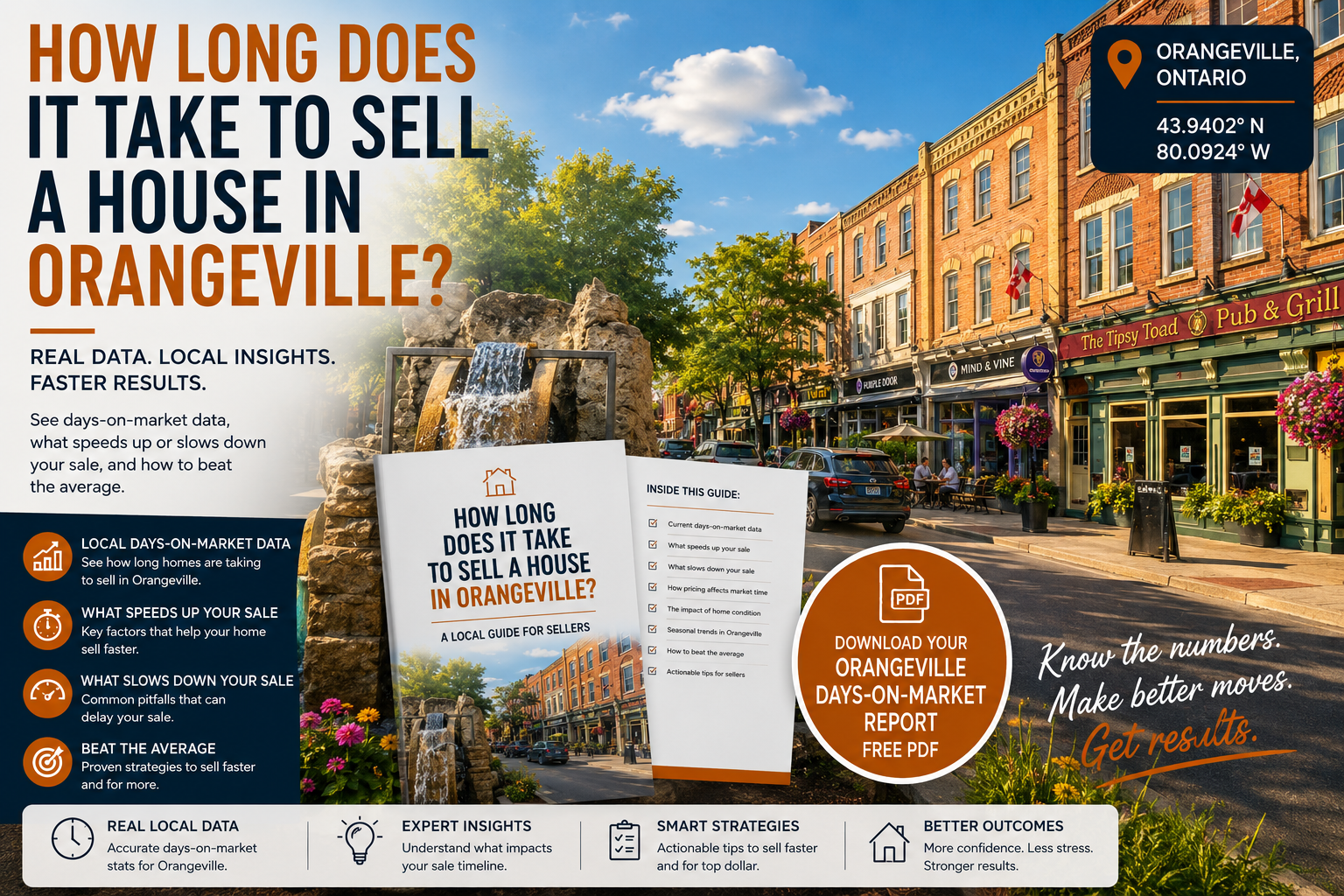
Click the image to download the PDF guide for Orangeville sellers. This page uses Orangeville centre coordinates 43.919739, -80.095202 for local relevance.
This featured video explains why positioning, preparation, and buyer confidence matter when a seller wants both speed and a strong result.
In May 2026, Orangeville homes averaged 33 days on market using TRREB-attributed data from Flaherty.ca. Public portal checks were close, with Zolo showing 30 median days and Wahi showing 34 average days for a similar period, so a realistic public-data answer is roughly one month before conditions and closing steps.
In May 2026, detached homes in Orangeville averaged 37 days on market. Detached homes also represented 33 of the 50 local sales and sold at a 97% sale-to-list ratio, so the category was active but still required price discipline.
Semi-detached homes averaged 23 days on market in the May 2026 TRREB-attributed table. The sample was smaller at 5 sales, but the shorter timeline suggests well-priced semi-detached homes were moving faster than the Orangeville average.
Condo townhouses averaged 10 days on market in May 2026, with 10 sales, a $530,000 average price, and a 99% sale-to-list ratio. That was the fastest property-type result in the published Orangeville table.
Condo apartments averaged 53 days on market in May 2026, but the sample was only 2 sales. That means the number is useful context, not a promise for every apartment-style property.
Orangeville was faster than Shelburne, Erin, and Mono in the latest comparison set. The nearby DOM figures were Caledon 32 days, Shelburne 44 days, Erin 48 days, and Mono 110 days, compared with Orangeville at 33 days in TRREB-attributed data and 34 days in Wahi.
Yes, public portal data showed sold volume improving. Wahi reported 48 Orangeville sold listings in May 2026 compared with 39 in the comparable 2025 period, which is roughly a 23% year-over-year increase; Flaherty/TRREB reported 50 May 2026 sales.
Flaherty/TRREB reported 151 active listings against 50 sales, which works out to about 3.0 active listings per monthly sale. Wahi corroborated the level with 155 active listings and 3 months of inventory.
The May 2026 TRREB-attributed Orangeville ratio was 97% overall. Detached and semi-detached homes were also at 97%, condo townhouses were at 99%, and condo apartments were at 98%, which means sellers were often negotiating below list price but not always by much.
Homes tend to beat the 33-day average when the launch price matches active competition, the home is prepared before listing, buyers can understand the layout online, and showings are easy to book. This matters whether the home is in Downtown Orangeville, South End, West End, or Montgomery Village.
Kevin uses Video Narrated VR Animated Online Showings to help buyers understand the layout, features, upgrades, and location before they visit. The goal is to remove uncertainty so serious buyers can decide faster whether the home belongs on their shortlist.
Staging can shorten the timeline when it helps buyers understand scale, flow, and use of rooms. In practical terms, staging works best when it supports the price and helps a buyer compare the property more favourably against active homes in Park Lane, Lisa Marie Nook, Highland Ridge, or Orangeville Highlands.
A price adjustment should be considered when the home has enough exposure but not enough showings, when showings do not produce second visits, or when similar active listings receive offers while yours does not. In a 97% sale-to-list market, pricing evidence should be reviewed early rather than after momentum is gone.
Winter can reduce casual traffic, but serious buyers still search. The better question is whether your listing has enough lighting, exterior access, photography, and value clarity to compete when buyers have fewer reasons to tour casually.
Start with a property-specific review before choosing a launch price or listing date. Kevin can compare your home against active alternatives, May 2026 DOM patterns, current inventory, and neighbourhood buyer expectations, then recommend a strategy through the free home evaluation process.
Kevin Flaherty sold our home for asking at a time when the market would be considered by most to be slow. His team also found us our new home before the home was on the market, and helped us to buy it at a price that was significantly below asking cost. If you are buying or selling a home, Kevin and his team are the ones that you want working for you!
The property was listed and sold with second viewing within two days at more than the asking price. The closing dates of this place and the new purchase matched perfectly. Kevin and his team were the epitome of skill and efficiency.
The current public-data answer is about one month: 33 days in the TRREB-attributed May 2026 Orangeville table, 30 median days in Zolo’s rolling-period display, and 34 average days in Wahi’s May report. Your property-specific answer depends on whether your home looks like the faster categories, such as condo townhouses at 10 days and semi-detached homes at 23 days, or the slower categories, such as detached homes at 37 days and condo apartments at 53 days.
If speed matters, focus on the choices that create buyer certainty: price against current competition, prepare the home before launch, use professional media, make showings easy, answer predictable questions early, and review feedback quickly. If you want a number for your home rather than a general answer, the next step is a property-specific evaluation.
General market averages can help with context, but your likely timeline depends on your property, your neighbourhood, your competition, and your launch strategy. Kevin Flaherty can review your home, explain what buyers are likely to notice, and recommend the preparation, pricing, and marketing plan most likely to reduce unnecessary days on market.
Serving Orangeville homeowners near 43.919739, -80.095202, including Browns Farm, Credit Springs, Downtown Orangeville, Edgewood Valley, Highland Ridge, Hospital Hill, Kin Corner, Lisa Marie Nook, Midtown Orangeville, Montgomery Village, Orangeville Highlands, Outer Downtown, Park Lane, Parkview Acres, Settlers Creek, South End, Sunvale On The Hill, Veterans Park, and West End.
Use these Orangeville seller resources to compare timing, pricing, preparation, staging, home value, buyer hesitation, costs, and agent selection before you choose a listing strategy.
Selling timelines can vary by buyer expectations and local property style. Review Orangeville community pages for neighbourhood context across the town centre coordinate 43.919739, -80.095202.
This Orangeville selling timeline guide was prepared for Flaherty.ca by Kevin Flaherty and updated June 7 2026. The May 2026 market statistics are sourced from TRREB-attributed local reporting in Flaherty.ca’s Orangeville Real Estate Market Report and Dufferin Market Pulse, with public portal corroboration from Zolo and Wahi where reporting periods and definitions differ.
The guide uses centre Orangeville geo coordinates 43.919739, -80.095202 for local relevance and blends current data with practical seller strategy. For broader housing context, sellers can also review CMHC and OREA. Kevin's local business presence is reflected in his Dufferin Board of Trade business profile. If you want a current estimate for your property, use the free home evaluation form or schedule a conversation through Kevin's calendar.
Source notes: primary figures are TRREB May 2026 via Flaherty.ca. Zolo’s Orangeville report used a May 07–Jun 04, 2026 rolling period and showed 30 median days on market, 47 homes sold, a 97% sale-to-list ratio, and detached DOM up 32% year over year. Wahi’s May 2026 report showed 34 average days on market, 48 sold listings, 155 active listings, and 3 months of inventory for Orangeville, plus nearby-area DOM comparisons.

170 Lakeview Court; Unit 3A
Orangeville, ON
L9W 5J7

Not Intended To Solicit Properties Already Listed For Sale.
A HoneyCombHub.ca Web Site Solution
Copyright 2026 . All rights reserved.