




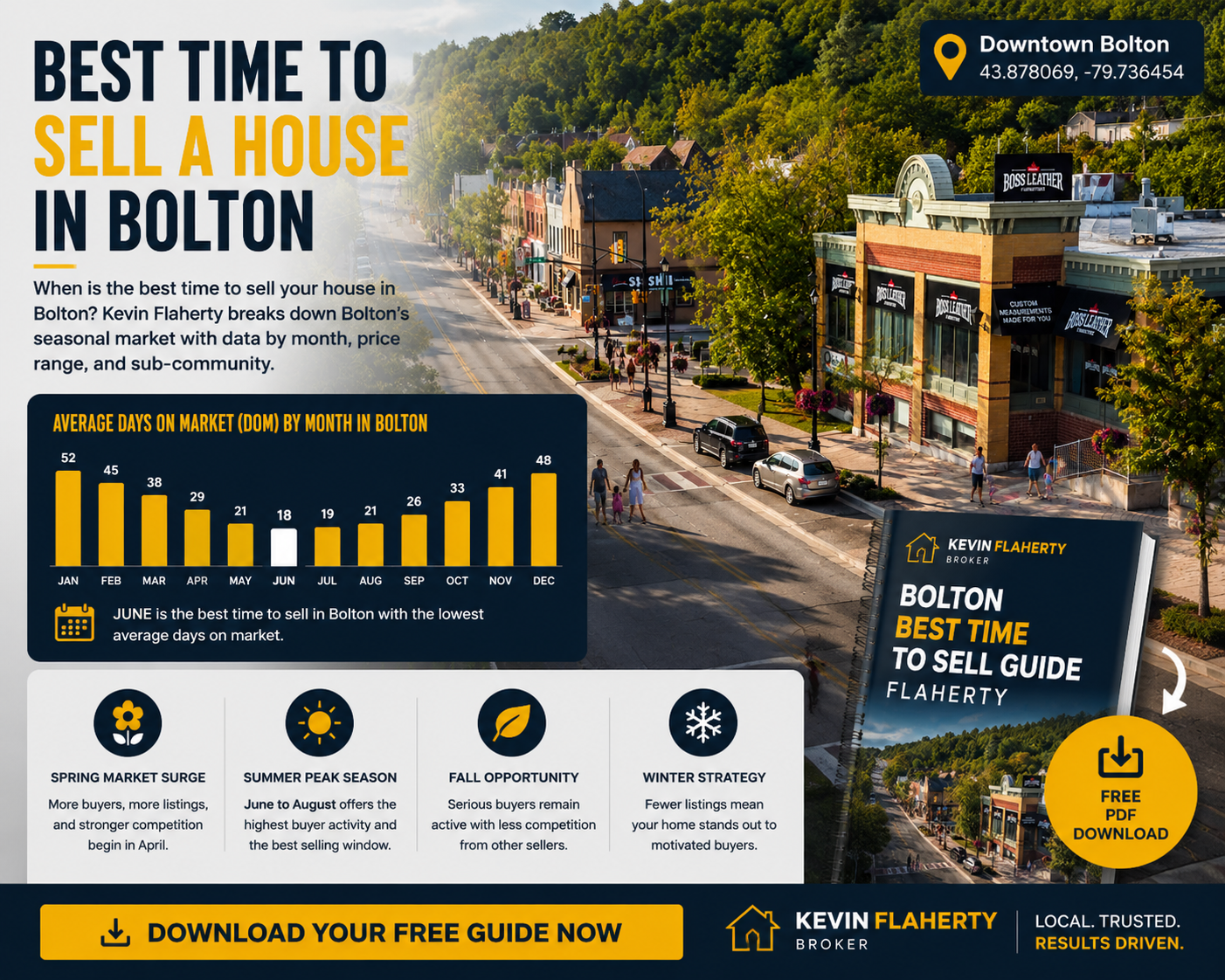
Timing a home sale in Bolton, Ontario is not simply a matter of listing in spring and hoping for the best. Bolton's market has a distinct buyer profile — heavily weighted toward commuter families relocating from Brampton and Vaughan along the Highway 50 corridor — and that profile creates seasonal demand patterns that differ meaningfully from the broader GTA. This guide breaks down Bolton's seasonal data, explains how timing affects your net proceeds by property type, and includes a free Bolton Listing Month Optimizer tool so you can make a data-backed decision for your specific situation.
Bolton's Seasonal Market Cycles
Bolton's real estate market follows a predictable seasonal rhythm, but the amplitude of that rhythm — how much better spring is compared to winter — is shaped by the town's unique position as a commuter community at the northern edge of Peel Region.
Bolton sits at the intersection of Highway 50 and Highway 9, approximately 45 minutes from downtown Toronto and 20 minutes from Brampton. This geography makes it a natural landing spot for GTA families seeking more space, better schools, and a quieter lifestyle without sacrificing commute viability. The consequence for sellers is that Bolton's demand is not locally generated — it flows in from the south, and it flows in seasonally.
When spring arrives and GTA buyers begin their search, Bolton is typically one of the first communities north of Brampton they consider. This creates a concentrated demand surge in March through May that is more pronounced in Bolton than in more self-contained communities. Conversely, when GTA buyers pause their search in summer and winter, Bolton feels that pause acutely.
Primary Peak Season
Balanced / Slower
Secondary Peak Season
Slowest Season
Bolton recorded 87 active listings, 23 sold, a median sold price of $960,000, and 32 average days on market in April 2026 — a balanced market with 4 months of inventory. Bolton East specifically averaged $1,008,913 with 26 DOM and a 97% sale-to-list ratio in the March–May 2026 window.
How Seasonal Timing Affects Your Net Proceeds
The table below illustrates how listing month affects estimated net proceeds on a $960,000 Bolton home, based on seasonal price premiums and discounts relative to the annual average. These figures reflect typical Bolton market patterns and will vary by property type, condition, and neighbourhood.
| Season / Month | Typical DOM | S/L Ratio | Price vs Annual Avg | Est. Net on $960K Home | Buyer Profile |
|---|---|---|---|---|---|
| 🌸 Late March | 22–28 days | 97–99% | +3–5% | $989K–$1,008K | GTA commuter families, move-up buyers |
| 🌸 April | 26–32 days | 97% | +3–6% | $989K–$1,018K | Peak demand — Brampton/Vaughan buyers, school-year movers |
| 🌸 May | 26–35 days | 96–97% | +2–4% | $979K–$998K | Strong demand, inventory building |
| ☀️ June | 30–40 days | 95–96% | 0–+1% | $960K–$970K | Motivated buyers, school-year urgency fading |
| ☀️ July–August | 38–50 days | 94–96% | -1–-2% | $941K–$950K | Vacation season, reduced GTA buyer activity |
| 🍂 September | 28–38 days | 95–97% | 0–+2% | $960K–$979K | Serious buyers, back-to-school movers |
| 🍂 October | 32–42 days | 95–96% | -1–+1% | $950K–$970K | Motivated buyers, inventory competition rising |
| ❄️ November | 40–55 days | 93–95% | -2–-4% | $922K–$941K | Serious buyers only, pre-holiday urgency |
| ❄️ December | 45–65 days | 93–94% | -3–-5% | $912K–$931K | Highly motivated, relocation/life event buyers |
| ❄️ January–February | 50–70 days | 92–94% | -4–-6% | $902K–$922K | Thinnest buyer pool, maximum price sensitivity |
On a $960,000 Bolton home, the difference between a late March/April list and a January list can be $67,000–$116,000 in net proceeds. That gap alone justifies a 6–8 week preparation investment to hit the spring window.
Spring: Bolton's Primary Selling Season (March–May)
Spring is not just the best season to sell in Bolton — it is the season that defines whether you leave money on the table or maximize your equity. Understanding why spring works, and exactly when within spring to list, is the difference between a good result and a great one.
Why Spring Demand Is So Concentrated in Bolton
Bolton's spring surge is driven by a very specific buyer archetype: the GTA commuter family. These buyers — typically in their mid-30s to mid-40s, with school-age children, working in Brampton, Vaughan, or Toronto — begin their home search in earnest in February and March. They want to close by June so their children can start the new school year in September without disruption.
This creates a demand window that is both intense and time-limited. By late May, many of these buyers have either purchased or paused their search until fall. The sellers who list in late March or April are competing for the largest pool of qualified, motivated buyers Bolton sees all year. The sellers who wait until June are competing for a much smaller pool.
The Bolton East Advantage in Spring
Bolton East is particularly well-positioned to capture spring demand. Its newer housing stock, proximity to Highway 50, and mix of detached and townhome inventory align precisely with what GTA commuter families are seeking. The March–May 2026 data for Bolton East confirms this: an average sold price of $1,008,913, 26 days on market, and a 97% sale-to-list ratio. For context, that is a market where homes are selling in under four weeks at essentially full asking price.
Bolton West and Bolton North also benefit from spring demand, but the premium is somewhat less pronounced. These neighbourhoods attract more local move-up and move-down buyers who are less concentrated in the spring window.
The Optimal Spring List Date
Within the spring window, the last week of March and the first two weeks of April represent the sweet spot. Here is why: inventory is still relatively thin (sellers who waited for "warmer weather" haven't listed yet), but buyer demand is already at full intensity. This supply-demand imbalance is what generates competing offers and above-asking results.
By mid-May, inventory has typically built to the point where buyers have more choices and less urgency. The spring premium begins to erode. Sellers who list in the first week of May can still achieve strong results, but the window is narrowing.
List on a Thursday or Friday to capture the full first weekend showing cycle. The first 72 hours on market are the most critical — this is when competing offers are generated. A Thursday list in late March puts you in front of the maximum number of spring buyers before inventory builds.
Kevin Flaherty's Video Narrated VR Animated Online Showings are particularly effective in spring because they allow GTA buyers who are actively searching to tour your Bolton home virtually before committing to a drive. This technology extends your reach to buyers who might otherwise skip Bolton in favour of communities they know better, and it is a key reason why his listings achieve a 99.2% sale-to-list price ratio — compared to the market average of 97%.
Fall: Bolton's Secondary Selling Window (September–October)
If you missed the spring window, fall is your next best opportunity — and for some Bolton sellers, it can actually outperform spring. The key is understanding who is buying in fall and how to position your home for that buyer profile.
Who Buys in Bolton in the Fall
Fall buyers in Bolton tend to be more decisive and less price-sensitive than spring buyers. They have typically been searching since spring, lost out on one or more properties, and are now highly motivated to close before the holiday season. They are not browsing — they are buying.
This buyer profile is particularly valuable for sellers of larger detached homes in the $900K–$1.2M range. These buyers have done their research, know the market, and are ready to move quickly on a well-presented property. Kevin Flaherty notes that fall offers in Bolton often come with fewer conditions than spring offers, because fall buyers have already done their due diligence on the market and are not hedging their bets.
The Fall Inventory Problem
The challenge with fall in Bolton is inventory. Sellers who missed spring often re-list in September, creating a surge of competing listings right when buyer demand is recovering. This supply build-up can offset the demand recovery, resulting in longer DOM and modest price discounts compared to spring.
The solution is to list early in September — ideally the first or second week — before the inventory build-up peaks. Sellers who list in late September or October are competing against a much larger pool of listings and a buyer pool that is beginning to thin as the holiday season approaches.
Bolton homes listed after mid-October face a shrinking buyer pool and increasing competition from re-listed spring properties. If you cannot list by the first week of October, consider waiting for the spring window rather than listing in late October or November, when DOM stretches and price concessions become necessary.
Bolton Listing Month Optimizer
Enter your home type and price range below to get a personalized listing month recommendation, expected days on market, and estimated price premium or discount compared to the Bolton annual average.
Bolton Listing Month Optimizer
Free tool — based on Bolton seasonal market data. For a personalized analysis, book a free evaluation.
For a precise analysis of your specific Bolton address, book a free opinion of value with Kevin Flaherty at flaherty.ca/homeeval or call 226-270-6433.
Preparation Timeline: When to Start for Each Season
The biggest mistake Bolton sellers make is not missing the spring window — it is starting too late to hit it. Here is a practical preparation timeline for each selling season.
Targeting Spring (Late March – May)
Begin preparation in early to mid-February. This 6–8 week runway allows time for: decluttering and deep cleaning (1–2 weeks); minor repairs and touch-ups (1–2 weeks); staging consultation and furniture arrangement (1 week); professional photography and video production, including Kevin Flaherty's VR animated online showing (1–2 weeks); and MLS listing preparation and marketing launch (1 week). Sellers who start in March are already behind for a late March list date.
Book your free home evaluation in January to understand your current market position and get a pricing strategy before you begin preparation. This prevents over-investing in improvements that will not generate a return in your specific neighbourhood.
Targeting Fall (September – October)
Begin preparation in mid-July. The summer preparation window is actually advantageous — contractors are more available in July and August than in February, and you can take advantage of warm weather for exterior work. Target a September 1–15 list date to beat the fall inventory build-up.
If You Must Sell in Winter
Winter preparation should begin in October. Focus on interior presentation — professional staging, exceptional photography that compensates for bare trees and grey skies, and maximum digital marketing reach. Kevin Flaherty's Video Narrated VR Animated Online Showings are especially valuable in winter because they allow buyers to experience your home's full potential regardless of outdoor conditions. Price sharply — winter buyers in Bolton are motivated but price-conscious.
5 Timing Mistakes Bolton Sellers Make
After 30+ years selling homes in the Bolton and Caledon area, Kevin Flaherty has seen the same timing errors repeated by sellers who cost themselves tens of thousands of dollars. Here are the five most common — and how to avoid them.
Listing in July or August and Wondering Why It Is Not Selling
Summer is Bolton's weakest selling season. GTA commuter buyers — Bolton's primary demand driver — are on vacation or have paused their search after the spring market. Sellers who list in July or August are competing for a fraction of the buyer pool, and the buyers who are active in summer are typically more price-sensitive and condition-focused. If your home sits for 45+ days in summer, the stigma of a long DOM follows you into fall. The fix: either hit the spring window or wait for September.
Assuming Bolton Follows Brampton's Market Timing Exactly
Bolton's market lags Brampton by approximately 2–3 weeks. When Brampton's spring market heats up in early March, Bolton's surge typically begins in late March. Sellers who watch Brampton news and try to time their Bolton list accordingly often list too early (before Bolton demand peaks) or too late (after the Brampton surge has already pushed buyers north). The fix: track Bolton-specific data, not GTA-wide headlines. The Bolton Listing Month Optimizer on this page uses Bolton data, not GTA averages.
Listing on a Monday or Tuesday and Missing the Weekend Surge
In Bolton, the first weekend on market is the most critical 72-hour window in your entire sale. Homes that generate 5+ showings in the first weekend are far more likely to receive competing offers. Homes listed on Monday or Tuesday go live when buyer attention is at its weekly low — most buyers do their serious searching on Thursday evening through Sunday. A Monday list means your home has been sitting for 4–5 days before the first high-traffic weekend, which can create a perception of low demand. Always list Thursday or Friday.
Over-Preparing and Missing the Spring Window Entirely
Kevin Flaherty sees this every year: a seller decides in January to sell in spring, spends February and March on a major renovation, and ends up listing in late May — after the peak has passed. The renovation added $30,000 in cost and pushed them into a slower market. The fix: get a pre-list evaluation in January to understand which improvements actually move the needle in your Bolton neighbourhood. In many cases, decluttering, staging, and professional photography deliver a better ROI than a kitchen renovation. Do not let perfect be the enemy of good timing.
Treating Bolton East and Bolton West as Interchangeable Markets
Bolton East and Bolton West have meaningfully different buyer profiles and seasonal patterns. Bolton East, with its newer housing stock and Highway 50 proximity, sees stronger spring premiums from GTA commuter buyers. Bolton West attracts more local move-up and move-down buyers who are less concentrated in the spring window. A timing strategy that is optimal for a Bolton East detached home may not be optimal for a Bolton West townhome. Always get neighbourhood-specific advice — Kevin Flaherty offers a free opinion of value that includes a neighbourhood-level analysis at flaherty.ca/homeeval.
10 Questions You Should Ask Before Hiring a REALTOR
Before you sign a listing agreement, watch this. Kevin Flaherty covers the 10 questions every Bolton seller should ask any agent — including questions most agents hope you never ask.
What Is Your Bolton Home Worth Right Now?
Get a free, no-obligation opinion of value with current comparable sales data and a personalized timing recommendation for your specific Bolton neighbourhood.
Get Free Home Evaluation Book a Call with KevinBolton & Caledon Communities
Browse active MLS listings in Bolton and Caledon by community. Each page shows all current homes for sale and provides neighbourhood-specific market data to help you understand your local competition before you list.
Newest housing stock, Highway 50 proximity. Strongest spring premiums in Bolton. Browse all active detached, semi, and townhome listings in Bolton East — updated daily from MLS.
View Active Bolton East Listings →Established neighbourhoods with a mix of detached and semi-detached homes. Browse all active Bolton West listings — including townhomes, semis, and detached homes — updated daily from MLS.
View Active Bolton West Listings →Larger lots, mature trees, and a quieter rural character. Browse all active Bolton North listings — detached homes and estate properties — updated daily from MLS.
View Active Bolton North Listings →Covers all of Caledon including Caledon East, Palgrave, Alton, Inglewood, and Caledon Village. Browse all active Caledon listings — rural estates, detached homes, and acreage properties — updated daily from MLS.
View Active Caledon Listings →Related Resources for Bolton Sellers
Whether you are still deciding when to sell or ready to take the next step, these resources will help you prepare, price, and market your Bolton home effectively.
Bolton & Caledon Real Estate — Key Pages
Explore the full range of resources available for Bolton and Caledon home sellers and buyers:
Frequently Asked Questions: Best Time to Sell in Bolton Ontario
Answers to the most common questions Bolton homeowners ask about seasonal market timing, pricing strategy, and how to maximize net proceeds.
Ready to Time Your Bolton Home Sale Perfectly?
Kevin Flaherty has 30+ years of experience selling homes in Bolton and Caledon. Get a free, no-obligation opinion of value and a personalized timing strategy for your specific neighbourhood.
Get Free Home Evaluation Book a Call Book a ZoomKevin Flaherty • eXp Realty • 226-270-6433 • flaherty.ca

170 Lakeview Court; Unit 3A
Orangeville, ON
L9W 5J7

Not Intended To Solicit Properties Already Listed For Sale.
A HoneyCombHub.ca Web Site Solution
Copyright 2026 . All rights reserved.