




Downsizing in Mulmur: How to Transition from Rural Living to Your Next Step
Downsizing in Mulmur starts with evaluating your rural property, choosing a home that fits your needs and coordinating the sale, purchase and move. Options include smaller town lots, adult lifestyle communities and more manageable rural properties. Kevin Flaherty brings 30+ years of rural expertise and over $500M sold to accurately value your acreage, find the right buyer, and plan your transition smoothly.
Downsizing in Mulmur: Questions Empty Nesters Ask Most
How do I know it is time to downsize from my rural property?
The signs are often practical rather than emotional. When the maintenance burden of large acreage outpaces your energy, or when the cost of maintaining outbuildings and long driveways no longer makes financial sense, it is time to downsize. Many Mulmur empty nesters find that a smaller home can reduce the burden of upkeep, while still requiring maintenance and ownership costs.
Where do Mulmur homeowners typically move when downsizing?
Options include smaller residential lots in Orangeville or Shelburne, adult lifestyle communities such as Briar Hill, or single-storey homes in nearby towns. Compare each option with your budget, maintenance preferences and access to family, healthcare and activities. Travel times depend on the actual addresses and route; these are options to explore, not a claim about where most Mulmur sellers move.
Should I buy my smaller home before selling my Mulmur acreage?
Selling first can reduce the risk of carrying two properties, while buying first can secure your preferred next home. Acreage and estate homes appeal to a specific buyer pool, so allow flexibility. A firm sale helps clarify your budget, but proceeds arrive at closing. Review financing, closing dates, appropriate purchase conditions and a contingency plan with your lender and lawyer. RECO’s buyer checklist.
How do I prepare a large estate home for sale after decades of living there?
The process starts with aggressive decluttering and organizing documentation. Buyers of rural properties will scrutinize well records, septic pump-out receipts, and outbuilding condition. By addressing deferred maintenance and presenting a clean, well-documented property, you help buyers assess the property and support their due diligence; records do not guarantee a price or sale.
What makes selling a rural property different from selling in town?
Selling a rural property requires marketing the lifestyle and the land, not just the square footage. You must reach buyers outside the immediate area, often from the GTA, who are looking for privacy, Escarpment views, or recreational space. This requires specialized marketing like drone photography and comprehensive online showings to help interested buyers explore the property before they make the drive; a showing does not establish financial qualification.
Your Mulmur Downsizing Guide Map
Jump to any section below:
I have spent 30+ years selling real estate across Dufferin County, and I have helped countless homeowners navigate the transition from a large rural property to a more manageable lifestyle. Downsizing in Mulmur is a fundamentally different process than simply moving from one suburban house to another. You are not just changing your address; you are changing your daily routine, your relationship with the land, and the scope of your responsibilities.
Many homeowners in Mulmur reach a point where the acreage, the long driveway, and the outbuildings transform from a source of joy into a heavy maintenance burden. Empty nesters and retirees often realize that their large estate home or hobby farm is no longer serving their needs. The decision to downsize is usually driven by a desire for a simpler life, lower carrying costs, and the freedom to travel or focus on hobbies without worrying about property upkeep.
When you list your property with me, we focus on maximizing your equity so you can comfortably fund your next chapter. We ensure your rural property is presented flawlessly to the right audience, using a system called Video Narrated VR Animated Online Showings. This technology gives out-of-town buyers a complete understanding of your property online, reducing unnecessary showings and building the buyer confidence needed to secure top dollar.
Why Mulmur Homeowners Decide to Downsize
The most common triggers I see are consistent. Empty nesters find themselves heating and cleaning rooms nobody uses. Retirees calculate the hours and dollars spent on grass cutting, snow clearing, and outbuilding repairs and decide those resources are better spent on travel or grandchildren. Health changes can make stairs, uneven terrain, and physical property maintenance genuinely unsafe. And for some, it is simply a lifestyle shift: after decades of stewarding a large property, they are ready for a chapter where the home serves them instead of the other way around. Whatever the trigger, the earlier you begin planning, the more control you keep over timing, price, and destination.
Kevin's Mulmur Connection: When I was twenty two years old and single, the first piece of property I ever purchased was in Mulmur on the 1st Line East at 44.160269, -80.121750 overlooking the ravine. It was 4 acres with the perfect natural roll in the middle for a house with a walkout basement. I absolutely loved the lot and the rolling hills of Mulmur. It was my intention to build on the property, however my wife came along shortly after and had other plans.
The Emotional Landscape of Leaving Rural Life
Leaving a rural property is rarely just a financial transaction. For many Mulmur residents, their property is deeply intertwined with their identity and family history. Acknowledging and managing these emotional hurdles is a crucial part of a successful downsizing journey.
Attachment to the Land and Memories
When you have spent decades tending to gardens, walking bush trails, or watching children grow up on a property, the emotional attachment is profound. The thought of leaving the space where so many memories were made can be paralyzing. It is entirely normal to feel a sense of grief when preparing to sell. I encourage my clients to focus on the memories themselves, which travel with you, rather than the physical structures. Taking extensive photos or videos of the property before packing begins can help preserve the legacy of your time there.
The Fear of Losing Privacy
One of the primary reasons people move to Mulmur is the unparalleled privacy. The idea of moving to a town or a subdivision where neighbours are visible can be daunting. The fear of noise, lack of space, and a faster pace of life often delays the decision to downsize. The solution is careful selection of your next home. We look for properties that back onto ravines, feature mature landscaping, or are located in quiet adult communities that offer a buffer while still reducing maintenance.
Community Ties and Identity
Rural communities are tight-knit. Leaving your road or your township can feel like leaving your support network. Many downsizers worry they will lose touch with friends or the local culture. This is why a significant portion of my clients choose to stay within Dufferin County or nearby Simcoe County. By moving to a smaller property in Orangeville or Shelburne, you remain close enough to maintain those vital community ties while enjoying the convenience of town living.
Overcoming the Fear of Change
Even when the logic of downsizing is overwhelming, the fear of change itself can keep homeowners frozen in place for years. I have met sellers who knew for five years that the property was too much for them but could not bring themselves to make the call. The most effective antidote to this paralysis is information. When you know exactly what your property is worth, what your monthly carrying costs would look like in a smaller home, and what your equity position would be after the move, the decision becomes far less frightening. A free, no-obligation home evaluation is the lowest-risk first step you can take, because it converts vague anxiety into concrete numbers you can plan around.
Practical Challenges of Selling a Mulmur Property
Beyond the emotional aspects, selling a rural property involves specific logistical challenges that must be managed to protect your equity. Buyers of acreage properties have different concerns than urban buyers, and addressing these proactively is the key to a smooth sale.
Preparing Unique and Custom Homes
Many homes in Mulmur are custom-built to suit the original owner's specific tastes or the unique topography of the lot. While this character is a selling feature, it can also limit the buyer pool. Preparing a custom home for sale often involves neutralizing highly personalized decor and clearly defining the function of every room. We must help buyers envision their own lives in the space, which sometimes requires professional staging or strategic decluttering.
Managing Longer Timelines for Estate Properties
Large estate properties and significant acreage typically take longer to sell than standard residential homes. The buyer pool is smaller, and the financial commitment is larger. This means patience is required. We must price the property accurately from day one and rely on robust marketing to reach buyers across the province. A longer time on market is not necessarily a sign of a problem; it is often just the reality of finding the perfect match for a unique rural property.
Navigating Seasonal Showing Considerations
The changing seasons dramatically affect how a rural property presents. In winter, ensuring the driveway is plowed and walkways are safe is paramount. In spring, managing mud and demonstrating good drainage is crucial. We tailor our marketing to highlight the property's best seasonal features, often using photography captured during peak seasons to show buyers the full potential of the land, regardless of when they view the home. For downsizers who are flexible on timing, we plan the listing launch around the season when your specific property shows best, whether that is the lush green of early summer or the dramatic colours of a Mulmur autumn.
Decluttering Decades of Accumulation
Rural properties accumulate belongings in a way town homes never do. Barns, drive sheds, basements, and attics fill with equipment, tools, and keepsakes over decades. For downsizers, the sorting process is often the single largest task of the entire move, and it cannot be rushed. I recommend starting at least two to three months before listing, working one building or one room at a time, and sorting everything into four categories: keep, sell, donate, and dispose. Local auction services can handle equipment and tools, while consignment and donation options exist for furniture. Getting this done before photography and showings begin transforms how the property presents and directly protects your sale price.
Financial and Timing Strategies for Downsizers
A successful downsizing move requires careful financial planning and a strategic approach to timing the market. Protecting your equity while minimizing stress is the primary goal of our selling strategy.
Equity Extraction and Capital Gains
For most downsizers, their rural property represents a significant portion of their net worth. Extracting this equity efficiently is critical for funding retirement or the purchase of the next home. It is important to consult with a tax professional regarding capital gains, especially if your property includes significant acreage, a secondary dwelling, or a portion that has been used for agricultural or business purposes, as these may not be fully covered by the principal residence exemption. Read CRA’s principal-residence guidance.
The Cost of Selling vs. Buying Simultaneously
Attempting to buy a new home and sell your current rural property simultaneously can create immense pressure. If you buy first, you risk carrying two mortgages if your rural property takes longer to sell than anticipated. If you sell first, you may feel rushed to find a new home. We analyze your financial flexibility to determine the best path, ensuring you are not forced into a disadvantageous position during negotiations.
Timing the Transition: Sell First vs. Buy First
In Kevin’s experience, selling a rural property first can reduce uncertainty about the next purchase budget. A firm agreement helps you plan, but it is not the same as receiving sale proceeds at closing. A longer closing period may help coordinate the move if the buyer agrees; it does not guarantee that the next purchase will close in time or eliminate financing or appropriate purchase conditions. Review RECO’s guidance on conditions and closing.
Bridge financing may help cover a gap between purchase and sale closings, subject to your lender’s requirements, approval, costs and repayment terms. A sale-of-property condition is another option to discuss with your agent and lawyer. Compare sell-first and buy-first risks, including temporary accommodation and delayed closings, rather than assuming one sequence removes every risk.
Includes a downsizing decision checklist, rural property preparation checklist, an 8 to 12 week moving timeline, and a where-to-move comparison. This is a planning example, not a promised selling or closing schedule.
What Attracts Buyers to Mulmur Properties
To secure top dollar, we must understand what drives buyers to look in Mulmur and highlight those exact features in our marketing. The buyers for your home are likely coming from denser urban areas, seeking the lifestyle you currently enjoy.
Privacy, Views, and Escarpment Access
The primary draw of Mulmur is the natural environment. Buyers are looking for space to breathe, mature trees, and distance from neighbours. Views and recreational opportunities can appeal to buyers, but they do not automatically create a price premium. Confirm any claimed trail access or rights for the actual property. Our marketing focuses heavily on these attributes, using drone videography to showcase the privacy and the topographical beauty of your land.
The Value of Acreage and Recreation
Whether it is five acres of mixed bush or fifty acres of workable land, space is a commodity. Buyers are looking for room for hobbies, gardening, or simply the buffer that acreage provides. We clearly define the utility of your land, highlighting any trails, water features, or outbuildings that enhance the recreational value of the property.
The Power of VR Online Showings
Because the natural market for Mulmur homes consists of out-of-area buyers, we must make it easy for them to experience the property remotely. My team uses Video Narrated VR Animated Online Showings to provide a comprehensive digital tour. This technology visualizes and narrates all of the home's key features, upgrades, and benefits, as well as detailing the surrounding area and location benefits. This helps interested buyers explore the depicted features before visiting; it does not establish financial qualification or guarantee their intentions.
The One Move Strategy: Rightsizing Without Regret
The single most expensive mistake downsizers make is not selling for too little. It is downsizing into the wrong home and having to move twice. An extra move can add commissions, applicable taxes, legal fees and moving expenses, depending on the transactions, plus the enormous emotional toll of packing a lifetime of belongings again. My approach is built around getting the transition right the first time, which I call the One Move Strategy.
Test Drive Your Destination Before You Commit
Before you list your Mulmur property, spend real time in the community you are considering. Rent a cottage or a short-term unit for a month in winter, not just in summer. Drive your normal errands from the new location. Attend a community event at the local hall or recreation centre. Many downsizers discover that a town they loved visiting on weekends feels very different as a daily home base. Conversely, some clients who were dreading a move to town discover that walking to a coffee shop every morning becomes the best part of their day. Firsthand experience prevents the two most common regrets: choosing a location that is too isolated after leaving the community they knew, or choosing one that is too busy for a couple accustomed to the quiet of a Mulmur concession road.
Rightsizing the Home Itself, Not Just the Land
Downsizing does not always mean dramatically less interior space. Many of my clients move from a 3,500 square foot two-story estate home on 25 acres to a 1,800 square foot bungalow on a town lot, and the change that matters most is not the square footage. It is the elimination of stairs, the end of acreage maintenance, and the shift to a layout designed for the next 20 years of living. When evaluating your next home, prioritize main-floor living, wide doorways, an attached garage, and low-maintenance exteriors. These features can support your independence as your needs change. Evaluate the actual home’s accessibility and upkeep; a bungalow layout alone does not guarantee demand or future resale value.
Sequence the Sale to Fund the Purchase
The One Move Strategy depends on knowing your numbers before you commit to anything. We begin with a detailed evaluation of your Mulmur property so you know your realistic equity position. From there, we build a timeline that sequences your sale, your purchase, and your physical move so they interlock rather than collide. One approach is to seek a flexible closing, secure a firm sale and then shop within a realistic budget. Sale proceeds arrive at closing. Keep appropriate financing, inspection and legal protections on the purchase, and budget for temporary accommodation or a closing delay rather than assuming those costs will be recovered.
Where Mulmur Downsizers Can Move
Choosing your next destination is a balance of lifestyle preferences, proximity to family, and financial goals. Here are options to compare when transitioning out of a large rural property in Mulmur.
Adult Lifestyle Communities
Adult lifestyle communities may appeal to downsizers seeking main-floor living, less upkeep or opportunities to meet neighbours. Features, fees, rules and maintenance responsibilities vary by property and community. Explore options such as Briar Hill through AdultCommunities.ca’s Simcoe County resource, then confirm the actual home’s amenities and travel times rather than assuming the same benefits everywhere.
Kevin's Dedicated Downsizing Resource: AdultCommunities.ca
Kevin’s AdultCommunities.ca resource helps you explore adult lifestyle community options across Ontario as you plan your next move. Compare locations and community features with your own priorities, then confirm current listings, fees, rules, amenities and maintenance responsibilities for each property.
If Briar Hill, Green Briar or another community interests you, visit in person and check travel times to family, healthcare and everyday services. Community living can reduce some upkeep, but it is not maintenance-free, and the available services and social activities vary.
Explore Adult Communities →Moving to Town: Orangeville, Shelburne, and Alliston
For those who want to remain close to their established networks but eliminate acreage maintenance, moving to a smaller residential lot in a nearby town is the logical step. Orangeville offers comprehensive amenities and healthcare, while Shelburne provides a quieter, rapidly growing community. These towns offer the convenience of municipal services and walking distance to shops.
Smaller Rural Lots and Condominiums
Some sellers are not ready to give up country living entirely and opt for a smaller rural lot of perhaps one or two acres that requires less upkeep but still offers privacy. Others swing the opposite direction, considering condominiums where some exterior maintenance is handled by the corporation. Review fees, governing documents and owner obligations before relying on a lock-and-leave arrangement. Check the Condominium Authority of Ontario’s maintenance guidance.
Downsizing Options Comparison
| Destination | Typical Property Type | Lifestyle Change | Distance from Mulmur | Cost Considerations |
|---|---|---|---|---|
| Orangeville / Shelburne | Bungalow or smaller 2-story on town lot | Walkability, municipal services, less privacy | 15-30 minutes | Compare purchase price, selling and moving costs before estimating equity release |
| Adult Communities (e.g., Briar Hill) | Attached or detached bungalow, condo corp | Upkeep and social opportunities vary by community | 30-40 minutes | Confirm purchase price, recurring fees and included services |
| Smaller Rural Lot | Bungalow on 1-2 acres | Retains country feel, reduced yard work | 0-20 minutes | Compare the actual property, upkeep and location |
| Urban Condominium | Apartment-style condo | Lock-and-leave convenience, urban amenities | 60+ minutes (GTA) | Include condo fees, possible assessments and transaction costs |
The travel ranges above are approximate planning examples, not verified journey times. Check the actual addresses and route. Smaller properties do not automatically release equity; compare total purchase, sale, moving and ongoing costs.
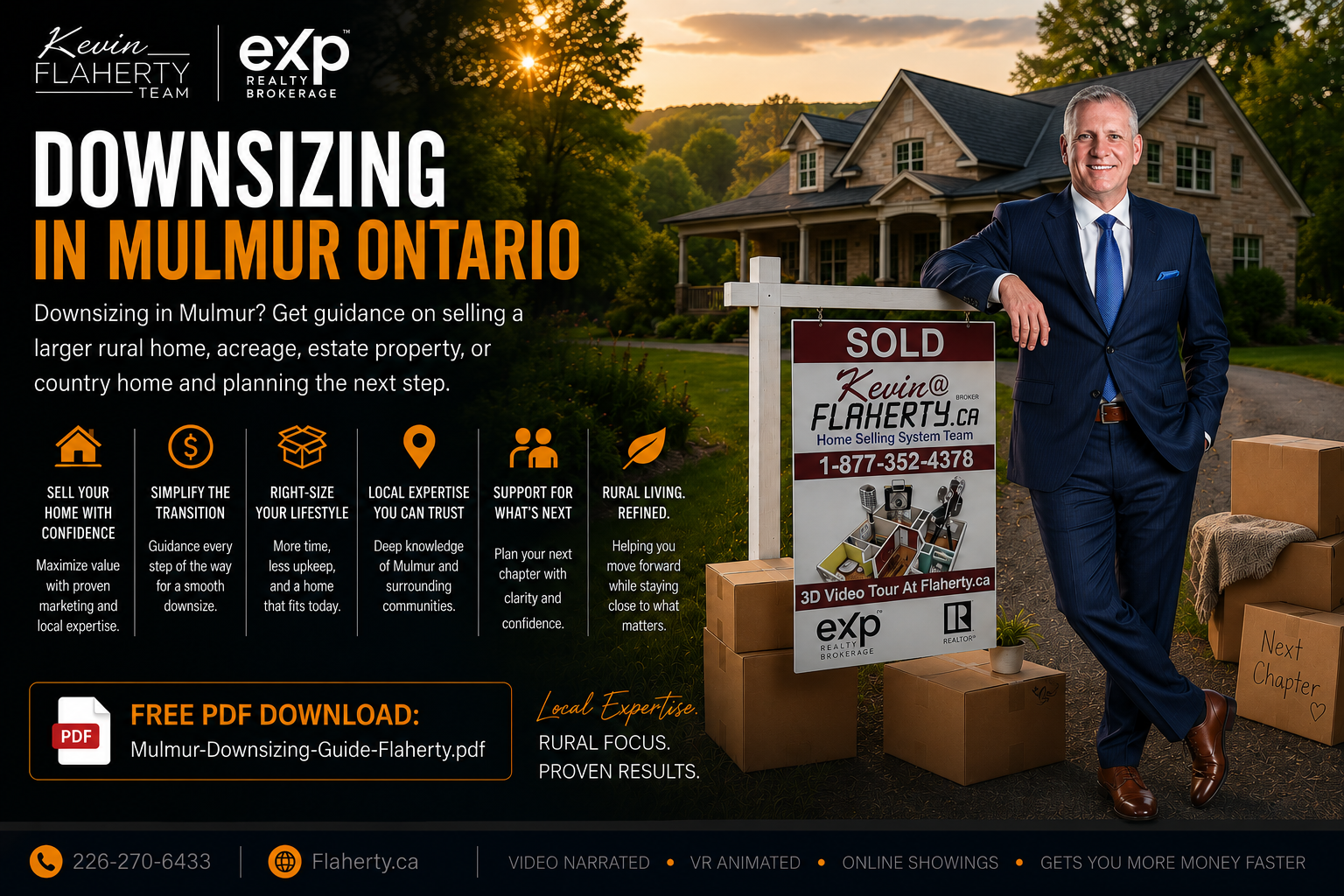
Click the image to download your free Downsizing Guide. Download the Free Downsizing Guide (PDF) →
Watch: A Backstage Tour of the Seller Marketing Plan
The right marketing plan is essential to capturing the full value of your property. This video is a backstage tour of the seller marketing plan. It shows how the Video Narrated VR Animated Online Showings highlight all of a home's key features and benefits online, where buyers shortlist homes they are willing to go see.
How to Get Top Dollar For Your House
A backstage tour of the seller marketing plan, showing how Video Narrated VR Animated Online Showings highlight all of a home's key features and benefits online, where buyers shortlist homes they are willing to go see.
10 Questions You Should Ask Before Hiring A Realtor
The essential questions every seller should ask before signing a listing agreement.
Why Didn't My House Sell?
Common reasons rural properties fail to sell and what to do about it.
How to Avoid Legal Mistakes When Selling Your House
Protect yourself from costly legal errors during the selling process.
How Do I Know My House Will Pass the Building Inspection?
What inspectors look for and how to prepare your home before listing.
What Our Clients Say
The Flaherty Team’s Google Business Profile shows 5.0/5 from 61 reviews. Kevin Flaherty’s RankMyAgent profile shows 4.96/5 from 52 verified reviews. Ratings and counts checked October 7, 2026. These profiles cover work across their service areas; they are not Mulmur-only totals. Read more Flaherty Team reviews.
“Kevin and his team were absolutely amazing. From start to finish, they made selling our home seamless. The marketing was incredible, the communication was constant, and we got more than we expected. I would recommend Kevin to anyone looking to sell.”
“We were nervous about selling after 25 years in our home, but Kevin made it so easy. His online showing system brought buyers from across Ontario, and we sold in under a week. The whole process was stress-free.”

Kevin Flaherty, Broker
Flaherty.ca Home Selling System Team | eXp Realty
Kevin Flaherty has been selling real estate in Mulmur and Dufferin County for 30+ years and is ranked in the Top 1% of Ontario Realtors. Kevin and his dedicated marketing specialists provide free, professional home evaluations and sell rural homes, acreage, hobby farms, and estate properties. His team utilizes targeted buyer outreach calls and advanced digital strategies to ensure maximum exposure. With over $500M sold, Kevin's proven system helps empty nesters downsize smoothly and profitably.
Phone: 226-270-6433
Website: flaherty.ca
Kevin’s personal connection to Mulmur began with his first property purchase: a four-acre parcel on the 1st Line East overlooking a ravine, where he intended to build. Read Kevin’s Mulmur story.
Downsizing in Mulmur: Frequently Asked Questions
How do I start the process of downsizing my Mulmur home?
The best first step is to get a professional home evaluation. Kevin Flaherty will walk your property, assess the land and outbuildings, and provide an accurate market value along with a clear strategy for preparing your home for the market.
What is the most important factor when selling a large rural property?
Pricing it correctly based on an accurate evaluation of both the land and the dwelling, followed closely by presenting the property effectively to out-of-town buyers using comprehensive online marketing.
How does the Video Narrated VR Animated Online Showing help sell my estate home?
Should I buy my next home before selling my rural property?
Do I need to fix my long gravel driveway before selling?
Ensuring your driveway is passable and well-graded is important for first impressions, but you rarely need to pave it just to sell. Focus on making the access clean and safe.
Should I have my septic tank pumped before listing?
Do buyers care about the age of my well?
How does acreage affect the time it takes to sell?
Larger acreage properties often have a smaller buyer pool, which can sometimes extend the time on market. Kevin coaches Mulmur sellers to price accurately from the start to help attract suitable buyers. Selling time still depends on the property, asking price, competing listings and buyer response; accurate pricing does not guarantee a timely sale.
What if my property is under the jurisdiction of the Niagara Escarpment Commission?
Should I sever a lot before selling to maximize my return?
Severances in Mulmur are highly regulated and often difficult to obtain due to provincial policies. Kevin recommends consulting with the township before assuming a severance is possible or marketing the property as having severance potential.
How do I market a hobby farm to potential buyers?
Marketing a hobby farm requires highlighting the functional value of the outbuildings, the quality of the fencing, and the usability of the pasture. It is about selling the capability of the land as much as the house.
Do I need a WETT inspection report if I have a wood stove?
What should I do about old, unused outbuildings on my property?
Kevin recommends having unsafe or deteriorated outbuildings assessed by qualified professionals before deciding whether to repair or remove them. Before demolition, driveway grading or trail clearing, check the applicable requirements with Dufferin County and the Township of Mulmur and, where relevant, the Niagara Escarpment Commission or conservation authority. Obtain any required approvals before starting work. If an outbuilding is structurally sound, clear it out safely so buyers can envision their own use for the space.
How do property lines work in rural sales?
Is winter a bad time to sell my estate home in Mulmur?
Not necessarily. While spring and fall are popular, winter buyers are often highly motivated. The key in winter is ensuring your driveway is plowed and the home is warm and inviting during showings.
How does internet access affect rural home sales?
What if my home needs significant updating before I downsize?
In Kevin's experience, it is usually better to price the home to reflect its condition rather than undertaking massive renovations before selling. Buyers often prefer to do their own updates to suit their tastes.
How are property taxes calculated for rural homes?
They are based on the MPAC assessment, which considers the home, the acreage, and any outbuildings. If part of your land is actively farmed or managed forest, you may qualify for tax reductions, which is a great selling feature.
Do I need to leave my appliances when I move to a smaller home?
What is a fixture versus a chattel?
How do we handle the sale of farm equipment or large tractors?
Kevin coaches sellers to handle farm equipment separately from the real estate transaction, often through a separate bill of sale, to keep the home purchase clean and straightforward for the buyer's lender.
What if a buyer's financing falls through on my large property?
How much are closing costs for the seller?
Sellers typically pay real estate commissions, legal fees, and any penalties for breaking their mortgage early. Unlike buyers, sellers do not pay land transfer tax in Ontario.
When do I have to move out of my rural home?
You must vacate the property by the closing date agreed upon in the Agreement of Purchase and Sale. Kevin recommends planning to be completely moved out a few days prior to avoid any last-minute stress.
Mulmur Seller Guides: Your Complete Resource Library
Explore the topic that fits your situation. Start with the Mulmur Realtors hub.
Core Selling Guides
Property Type Guides
Seller Strategy Guides
Explore Mulmur Communities and Live Listings in Each Area
Nearby Flaherty Service Areas
Also considering a nearby area? Explore these existing Flaherty resources.
A complete checklist covering emotional readiness, financial review, property preparation, moving timeline, and destination research for empty nesters.