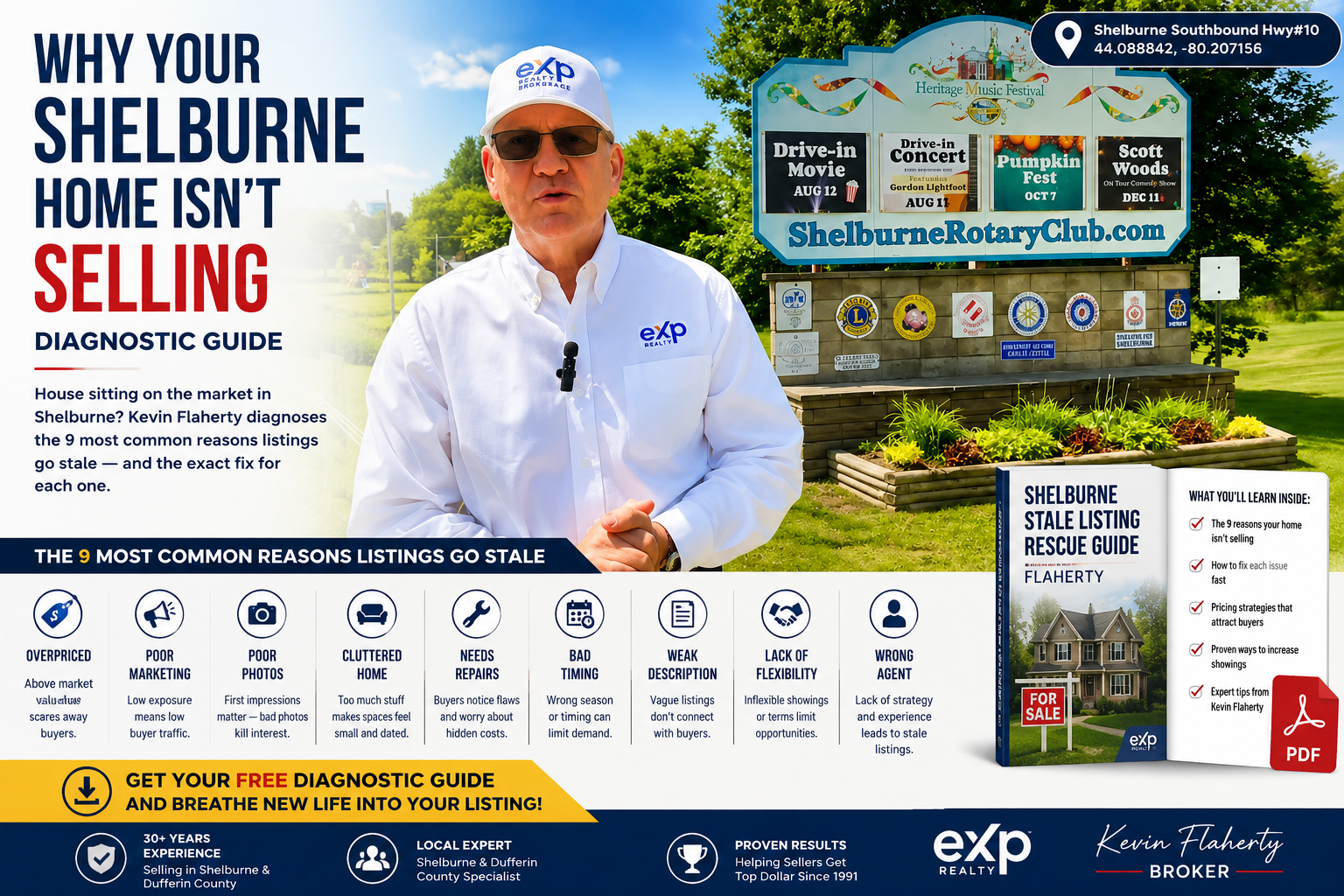
1. Price friction
The price may be above the evidence or sitting in the wrong buyer search bracket.





If your Shelburne home is sitting, the problem is usually not one thing. I look at price, buyer confidence, online presentation, showing quality, competition, and whether the listing gives serious buyers enough proof to act. My Video Narrated VR Animated Online Showing is a major part of that fix because it helps buyers understand the home before they ever step inside.
This page is not a generic selling article and it is not a repeat of my Shelburne preparation, staging, or multiple-offer guides. The unique angle here is the stuck-listing diagnostic: why a home that looked ready to sell is not creating the response you expected. If you need the broader local hub, start with Shelburne Realtors and real estate. If the issue may be neighbourhood positioning, compare your home against Emerald Crossing, Greenbrook Village, Hyland Village, Summerhill, Fiddler's Glen, and Historic Downtown Shelburne.
The Shelburne market gives buyers meaningful choice. TRREB April 2026 data shows 8 sales, 32 new listings, 75 active listings, 36 average days on market, and a 96% sale-to-list-price ratio. That does not mean every home is overpriced. It means buyers are comparing carefully, and a seller must make the value easy to understand.
The biggest missed opportunity I see is not only price. It is uncertainty. Buyers hesitate when they cannot understand the floor plan, when they cannot see how the rooms flow, when the basement or yard use is unclear, or when the listing looks similar to every other photo-only listing. My Video Narrated VR Animated Online Showing solves that problem by turning the listing into an online guided tour with context, narration, flow, features, and buyer-focused explanation.
The PDF lead magnet gives you a room-by-room, pricing, presentation, feedback, showing-quality, and VR readiness checklist to diagnose why buyers are not acting.
Market averages are not a substitute for a property-specific valuation, but they do show the environment your listing is competing in. In April 2026, Shelburne sellers were not dealing with a no-choice buyer frenzy. Buyers could compare active listings, push back on price, and take time when a listing did not feel clearly better than the alternatives.
| TRREB April 2026 measure | Shelburne result | What it means if your home is not selling |
|---|---|---|
| Average sold price | $691,750 | Your list price must be explained against current evidence, not just hoped-for equity. |
| Average days on market | 36 | If you are well beyond the expected window, the listing needs a diagnostic review. |
| Sale-to-list-price ratio | 96% | Buyers are negotiating and are less likely to reward unsupported pricing. |
| Active listings | 75 | Buyers have alternatives, so your online presentation must make the home easy to choose. |
| New listings | 32 | Fresh competition can reset buyer expectations quickly. |
Source: TRREB April 2026 Dufferin report as summarized in the supplied market-data reference.
A stale listing usually has a mix of pricing friction, visual friction, access friction, confidence friction, and competition friction. The solution is to identify which friction matters most before changing everything at once. If the home is truly overpriced, the market will say so. If buyers are confused, a better evidence package can change the conversation.
That evidence package is where the Video Narrated VR Animated Online Showing becomes a practical tool rather than a novelty. Photos can make rooms look attractive, but they rarely explain how the front hall connects to the kitchen, how the living area flows to the yard, whether a basement works for teenagers, or whether the home is worth a relocating buyer’s travel time. The VR showing answers those questions before the in-person appointment.
The price may be above the evidence or sitting in the wrong buyer search bracket.
Buyers cannot understand flow from photos, so they delay or skip the showing.
The home looks interchangeable with photo-only competitors in the same price range.
People are booking before they understand the home, creating wasted disruption.
Remote family members or relocation buyers cannot review enough detail to act quickly.
The listing is collecting clues, but the strategy is not being updated fast enough.
When a Shelburne listing is not selling, the seller often hears a vague objection: “buyers just are not feeling it.” That is not enough information. I want to know whether buyers understand the floor plan, whether they can picture furniture, whether they know what has been updated, whether the yard or basement solves a real problem, and whether the listing can be discussed by decision-makers who are not present at the showing.
The Video Narrated VR Animated Online Showing is built to solve exactly that. It helps remote and relocating buyers understand the layout without driving to Shelburne first. It reduces wasted showings by giving unqualified or mismatched buyers enough information to opt out. It makes the listing stand out from competitors who only use still photos. It gives serious buyers confidence to make faster decisions because they can review room flow, measurements, and features with narration. It also allows family decision-makers to revisit the home remotely before an offer is written.
For sellers in Shelburne real estate hub, Emerald Crossing, Greenbrook Village, Hyland Village, Summerhill, Fiddler's Glen, and Historic Downtown Shelburne, this matters because different buyers care about different things. A buyer considering a newer subdivision may focus on layout, parking, basement potential, and family function. A buyer considering Historic Downtown Shelburne may care about character, walkability, updates, and long-term maintenance. The VR showing gives each buyer a clearer reason to keep the home on the shortlist.
The framework below is also reflected in the HowTo schema. It is a practical sequence for diagnosing and correcting the listing rather than reacting emotionally to weak activity.
A listing can have online views and still have weak demand. It can have showings and still have low confidence. The point is not simply to create more activity; it is to create better-qualified activity. A VR online showing can help because the people who book after watching it generally know more about the home, have fewer basic layout questions, and are more prepared to decide whether the property fits.
If traffic is high and showings are low, buyers may be curious but unconvinced. If showings are high and offers are low, the in-person experience may not match the online promise. If showings are low and traffic is low, the price, first photo, headline, or exposure may be failing. Each diagnosis leads to a different fix.
A price improvement can be the right move, but it should not be the first move if buyer uncertainty is the real problem. Use the checklist to decide what needs fixing first.
These videos explain the broader Flaherty.ca Home Selling System, the VR online showing advantage, and the questions a seller should ask before trusting a new strategy with a stale listing.
★★★★★“Kevin's experience and marketing team sold my home over asking price in one day. The house was sold before it even went on MLS. We did not have to go through open houses or multiple viewings. The professional videos his team produces are amazing.”
★★★★★“In my time-sensitive house closing, Kevin and his team created a stellar, high-tech, personalized virtual video. This enabled virtual views with busy schedules for potential buyers. Kevin is professional, knowledgeable, experienced, and reputable.”
Use these related pages to solve the specific issue your listing is facing. Preparation, staging, repair choices, fast-sale timing, multiple-offer strategy, and as-is selling all connect to the broader question of why a home is not selling.
Shelburne home evaluation
Seller services
Book a strategy call
Neighbourhood context matters when a listing is not selling. A home may be competing against a newer subdivision, an older downtown option, a different lot profile, or a buyer’s preferred school and commute pattern. Review Emerald Crossing, Greenbrook Village, Hyland Village, Summerhill, Fiddler's Glen, and Historic Downtown Shelburne to understand which buyer expectations your listing must satisfy.
Use this page to understand how buyer expectations, layout preferences, and pricing pressure differ in this Shelburne pocket.
Use this page to understand how buyer expectations, layout preferences, and pricing pressure differ in this Shelburne pocket.
Use this page to understand how buyer expectations, layout preferences, and pricing pressure differ in this Shelburne pocket.
Use this page to understand how buyer expectations, layout preferences, and pricing pressure differ in this Shelburne pocket.
Use this page to understand how buyer expectations, layout preferences, and pricing pressure differ in this Shelburne pocket.
Use this page to understand how buyer expectations, layout preferences, and pricing pressure differ in this Shelburne pocket.
A Shelburne home usually fails to sell because the market is not seeing enough value, enough clarity, or enough confidence at the current price. TRREB April 2026 data shows Shelburne had 75 active listings, 32 new listings, 36 average days on market, and a 96% sale-to-list-price ratio, so buyers had choice and were negotiating. I diagnose the issue by comparing price, presentation, exposure, showing feedback, and buyer confidence instead of assuming one single problem.
No. Price is important, but a good home can sit if buyers do not understand the layout, cannot picture room flow, cannot compare value, or do not feel confident enough to book a showing. I often see listings that need clearer evidence before they need a dramatic price reduction.
Kevin compares the property to active competition, recent sales, expired or cancelled listings, and the exact price filters buyers are using. He also checks whether the home is being compared with newer subdivisions, older downtown homes, townhomes, or detached alternatives because the right comparison group changes the pricing answer.
The 96% SP/LP ratio in the TRREB April 2026 Shelburne data means the average sold home closed at about 96% of its list price. It does not mean every seller must accept 96%, but it does mean the price must be defensible. If buyers see stronger alternatives, they will either negotiate hard or ignore the listing.
You should review strategy quickly, not emotionally. The first 72 hours can reveal whether online traffic matches expectations, and the first one to two weeks usually show whether buyers are converting into showings. I use planned checkpoints so the seller does not wait until momentum is gone.
Sometimes, yes. If the issue is confusion rather than value, better presentation can create more confidence without immediately lowering the price. The most powerful example is Kevin’s Video Narrated VR Animated Online Showing because it helps buyers understand room flow, measurements, features, and layout in a way still photos cannot.
It turns the listing from a photo gallery into an online guided showing. Buyers can see how rooms connect, how furniture fits, what features matter, and whether the home suits their family before they visit. I use the VR showing to make a listing stand out against competitors that only show photos and a short MLS description.
Yes. Remote and relocating buyers often need more information before committing to travel for a showing. A Video Narrated VR Animated Online Showing lets them understand the layout, share the home with family decision-makers, and decide faster whether the property belongs on their shortlist.
Yes. When buyers can explore the home online, unqualified or mismatched buyers can self-select out before booking. That saves the seller disruption and helps focus in-person showings on people who already understand the layout and are more likely to be serious.
That usually means the listing is creating interest but not enough confidence. I look at the first photo, price band, copy, layout explanation, competing listings, and online showing package. If photos are attractive but buyers still hesitate, the missing piece may be a clearer guided VR explanation of how the home actually lives.
Showings without offers often point to a gap between online expectation and in-person reality. The price may be too high, the home may need preparation, or buyers may be discovering a concern that was not handled upfront. I review agent feedback and buyer behaviour to decide whether the fix is presentation, price, documentation, or negotiation strategy.
Cancelling and relisting can help only if the underlying problem is fixed first. If the price, presentation, access, or buyer confidence issue remains, the new listing can become stale again. I would rather correct the friction, improve the evidence package, and then decide whether a relaunch makes sense.
Staging can help when buyers cannot understand scale, purpose, or flow. It is especially useful when paired with a VR online showing because the staging then supports both still photos and the guided room-to-room experience. If your property competes with Emerald Crossing, Greenbrook Village, Hyland Village, Summerhill, Fiddler's Glen, and Historic Downtown Shelburne, the right staging choice depends on the buyer profile for that pocket.
Fix the issues that make buyers doubt value: obvious maintenance, poor lighting, cluttered sightlines, odours, incomplete trim, weak curb appeal, and unclear room use. Kevin does not recommend spending blindly; he prioritizes repairs that change buyer confidence or remove negotiation leverage.
Older homes need a clear story about character, updates, function, and maintenance. I recommend showing how the floor plan works and which improvements have already been handled. Sellers in Historic Downtown Shelburne should make age feel like value, not uncertainty.
Newer subdivision homes often compete closely on finishes, layout, upgrades, and price. In Emerald Crossing, Greenbrook Village, Hyland Village, and Summerhill, I use the VR online showing to show practical differences that photos can miss, such as room flow, basement potential, office space, and family gathering areas.
Yes. This is one of the strongest reasons to use the Video Narrated VR Animated Online Showing. A buyer may love the home, but a parent, partner, adult child, or relocation adviser may need to review it before the offer. Kevin’s online showing gives those decision-makers more confidence without requiring everyone to attend the same appointment.
Good photos are only the first layer. Photos can hide awkward flow, make rooms hard to compare, or fail to explain how spaces connect. Kevin’s VR showing adds narration, sequence, room context, measurements, and feature explanation so buyers understand the home instead of guessing.
Weak copy repeats generic features without answering buyer objections. Strong copy explains why the home is worth seeing, how the layout works, what upgrades matter, what the neighbourhood offers, and what kind of buyer will value it most. The copy should support the same story shown in the photos and VR showing.
No. The $691,750 average sold price is useful market context, but it is not a property-specific valuation. Kevin adjusts for property type, condition, neighbourhood, lot, upgrades, competition, and buyer demand before recommending a strategy.
Yes. A higher-priced home can sell if buyers understand the premium and believe it. The listing must show proof: better condition, larger layout, stronger location, finished space, lot quality, or upgrade value. This is where a detailed visual and VR evidence package matters because buyers need reasons to pay more.
Do not react automatically, but do not ignore it. Kevin compares the competing home’s condition, location, days on market, price history, and buyer appeal. If the reduction changes the buyer’s choice set, your strategy may need a price adjustment, better positioning, or a stronger explanation of value.
Not automatically. A stale listing can attract opportunistic offers, but it can also attract a fair offer from a serious buyer who finally understands the value. I review price, deposit, conditions, closing date, buyer strength, and risk before advising whether to accept, counter, or keep negotiating.
The first step is a listing diagnostic. Kevin will review the price, competition, photos, copy, showing history, feedback, online engagement, and whether the home needs a stronger VR online showing. Start with the free Shelburne home evaluation or Kevin’s calendar.
This page uses TRREB April 2026 data from the supplied Dufferin market-data reference. The visible updated date and schema dateModified are set to May 26, 2026. Kevin should refresh the page quarterly or when a newer TRREB Shelburne report is added.

170 Lakeview Court; Unit 3A
Orangeville, ON
L9W 5J7

Not Intended To Solicit Properties Already Listed For Sale.
A HoneyCombHub.ca Web Site Solution
Copyright 2026 . All rights reserved.