




Selling Rural Property and Acreage in Mono
Sell the whole property: document the land, rural systems, outbuildings and access; price against relevant comparable properties; and explain the setting with clear photos, plans and narrated media. Verify legal boundaries and permitted uses, and separate known facts from questions buyers still need to investigate.
People Also Ask
Quick answers for Mono sellers with estate homes, hobby farms, luxury acreage, conservation-adjacent land, and large-lot estate subdivision properties.
How do you sell acreage in Mono?
Sell the whole property, not only the house. Buyers need land, systems, boundaries, access, outbuildings, documents, and lifestyle value explained clearly before they visit.
What matters most to rural buyers?
Consider usable land, privacy, access, services, outbuildings and maintenance alongside the home. Their importance depends on the property and the buyer’s actual needs.
Should I prepare documents first?
Yes. Septic, well, WETT, propane, survey, permit, easement, conservation, utility, and outbuilding records should be organized before serious buyers start asking.
Why use drone and VR?
Drone footage and narrated plans explain layout, land and setting. Boundary overlays are illustrative, measurements need verification, and buyers still need appropriate due diligence.
What makes Mono unique?
Mono is north and east of Orangeville, has no urban core, and includes rural estate lots, hobby farms, conservation-area homes, luxury acreage, and estate communities.
To sell a rural property or acreage in Mono, you need to sell the land story as deliberately as the house story. A buyer must understand what they are getting: the setting, privacy, views, access, outbuildings, systems, documents, boundaries, and the way the property lives day to day.
Mono buyers may be comparing more than kitchens and bathrooms. They may be comparing a Hockley Valley view, a Purple Hill driveway, a Cardinal Woods estate lot, a Watermark lifestyle property, a hobby farm setup, or a conservation-adjacent setting near Island Lake or Mono Cliffs.
I build the marketing around buyer confidence. That means rural documentation, professional media, narrated explanation, drone footage, VR floor plans, flat floor plans, custom web pages, and a launch plan that helps buyers understand the whole property before they book a showing.
The land tells the story. The house is one part of the value.
In Mono, many properties are detached rural estate homes, hobby farms, luxury acreage, conservation-adjacent homes, and large-lot estate subdivision properties. That is why this guide is different from tactical guides about timing, pricing, staging, renovation, preparation, speed, costs, as-is selling, or what not to fix. Those topics matter, but this page addresses the core rural challenge: how do you sell a property where the land, setting, outbuildings, systems, boundaries, access, and lifestyle value are as important as, or more important than, the house itself?
The buyer psychology is different. A subdivision buyer may want to know room dimensions, school boundaries, commute time, and finish level. A Mono acreage buyer may want to know whether the driveway is practical in winter, how the property drains, where the septic bed is, how the well performs, whether the shop has heat and hydro, how private the land feels, whether there is trail access, and how the setting relates to Orangeville amenities, Mono Cliffs Provincial Park, Island Lake Conservation Area, and Hockley Valley Resort.
Kevin’s Mono rule: do not make buyers guess. The more complex the property, the more the marketing must explain the property, area, systems, and lifestyle in a structured, confidence-building way.
September 2026 Mono sales: context for rural pricing
TRREB reported five Mono sales in September 2026. The township figures are useful context, but the report does not isolate rural properties, hobby farms or acreage. Compare the small monthly sample with year-to-date results and relevant property-specific sales before choosing a price.
| Period | Sales | Average price | Median price | New listings | Active listings | Average LDOM | SP/LP |
|---|---|---|---|---|---|---|---|
| September 2026 | 5 | $1,064,000 | $950,000 | 26 | 71 | 77 days | 94% |
| January–September 2026 | 49 | $1,314,225 | $1,250,000 | 224 | Not cumulative | 46 days | 96% |
Source: TRREB September 2026 Dufferin report, Mono tables, page 7. The five September sales were reported as detached; that describes those sales, not all housing in Mono. LDOM means listing days on market; SP/LP is the reported selling-price-to-listing-price ratio.
Condition, usable land, services, permissions and current competing listings should guide the property-specific discussion. For broader regional context, see TRREB’s September 2026 Market Watch; regional totals are separate from Mono results.
A Mono acreage plan must fit the property type.
| Property Type | What Buyers Need to Understand | Marketing Priority |
|---|---|---|
| Rural estate home | Privacy, architecture, views, road context, garage space, landscaping, systems, and service history. | High-quality media plus a polished explanation of the land and house together. |
| Hobby farm | Barns, stalls, fencing, paddocks, water access, storage, equipment routes, and practical farm function. | Outbuilding documentation, safety, access, and lifestyle use cases. |
| Luxury acreage | Design, setting, privacy, recreation, views, guest areas, smart systems, and premium improvements. | Narrated lifestyle presentation with professional visuals and supporting documents. |
| Conservation-adjacent property | Trails, protected setting, regulated features, permits, drainage, and future-use expectations. | Balance lifestyle value with organized due diligence information. |
| Large-lot estate subdivision home | Community feel, lot usability, executive finish level, privacy, landscaping, and amenities. | Estate-level polish plus neighbourhood-specific positioning. |
Every Mono pocket has a different acreage story.
Compare the actual property, permitted use, services and setting within each Mono pocket. Community labels do not establish a universal buyer preference or price premium. The verified community links below help you investigate local context.
The VR system is purpose-built for properties where land is part of the product.
For a Mono rural property, the online showing has to do more than make rooms look attractive. The system must highlight all the home's key features and benefits while detailing the property, area, and surrounding amenities. That is the full dual function: show the house clearly and explain the land, setting, and local context at the same time.
Kevin’s video-narrated VR animated online showing can include professional photographs, drone footage, narration, VR floor plans, flat floor plans that detail square footage and measurement points, surveys and documents buyers may request, all MLS details, and a custom property web page. For acreage, the drone story can even show animated boundary lines with a north arrow that continually points north regardless of the direction of the drone. That helps buyers understand orientation, views, driveways, fields, tree lines, trails, buildings, and surrounding context.
Kevin’s rural presentation: not only do we highlight the home’s key features and benefits visually and through narration, and not only do we show rooms vacant or furnished when appropriate, we also detail the outside of the property through narration, photographs, and drone footage. The home’s custom web page is then syndicated to over 57 locations online for maximum exposure.
Maps, drone footage and animated boundary lines are illustrative and do not establish legal property boundaries or access rights. Verify measurements and obtain appropriate survey and title review.
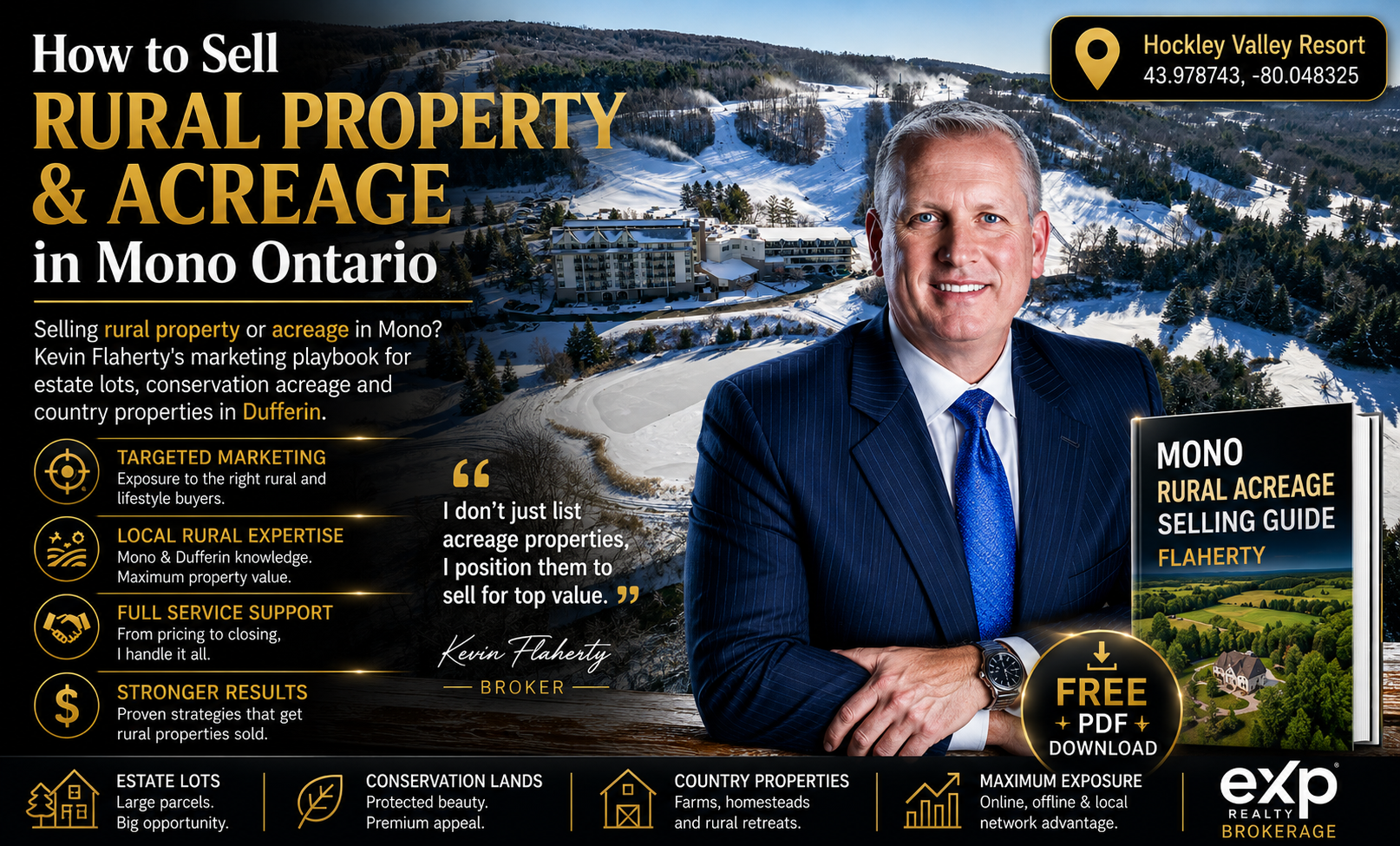
Download the Mono Rural Acreage Selling Guide Flaherty PDF for a dense checklist covering land, systems, outbuildings, buyer pools, media, and pricing.
How to sell a rural property or acreage in Mono.
This six-phase process organizes the land, systems, documents, preparation, media and launch decisions for a rural sale.
Phase 1: Define the acreage story before pricing
- Separate the value drivers into house, land, setting, outbuildings, systems, access, and community context.
- Walk the property from the road, driveway, house, outbuildings, trails, fields, views, and boundary edges so the selling story follows the way a buyer experiences the land.
- Identify the buyer profiles most likely to value the acreage, such as privacy buyers, hobby farmers, workshop users, equestrian buyers, gardeners, retirees, luxury estate buyers, or recreation-focused families.
- Record what is unique about the property that does not appear in ordinary interior photos, including approach, elevation, tree cover, sunrise or sunset orientation, and relationship to neighbouring properties.
- Document nearby amenities, road access and local services accurately. Verify recreation access or membership; proximity alone does not grant rights.
- State the one-sentence property promise buyers should understand before they book a showing.
Phase 2: Assemble rural systems and legal documentation
- Gather septic permits, pump-out records, inspection notes, tank location, bed location, and any known capacity or service details.
- Gather well records, bacterial test results, treatment and pump history, flow and pressure information. Bacterial tests do not establish chemical safety or water quantity.
- Gather written wood-appliance inspection reports and service records. Confirm insurer requirements with a WETT-certified professional.
- Collect propane tank ownership or rental details, fuel contracts, equipment service records, and utility cost summaries.
- Locate available surveys, title and easement records, driveway agreements and site plans. Maps, fences and imagery do not establish legal boundaries or access rights.
- Review conservation authority, Niagara Escarpment, drainage, environmental, permit, and outbuilding documentation that could affect buyer conditions.
Phase 3: Prepare land, access, outbuildings, and exterior usability
- Clean the driveway approach, entrance, gates, laneways, parking areas, turnaround spaces, and snow-storage or drainage areas.
- Open safe access to barns, shops, garages, sheds, paddocks, greenhouses, utility rooms, loft storage, and mechanical areas.
- Explain outbuilding services, dimensions, condition and permitted uses. Record agreed fixtures, equipment, rentals and exclusions clearly in the purchase agreement.
- Tidy safe access to land features, gardens, outbuildings and views. Confirm permissions before clearing, grading, changing drainage or removing structures.
- Remove or relocate equipment, trailers, vehicles, material piles, and personal property that block the buyer’s understanding of scale and access.
- Prepare safety notes for uneven terrain, livestock areas, machinery zones, icy approaches, private lanes, and sensitive conservation-adjacent spaces.
Phase 4: Build the house presentation around buyer confidence
- Declutter the house so room size, light, views, floor plan, and daily function are easier to understand online and in person.
- Decide which rooms benefit from existing furnishings and which should be shown more simply or vacant through the VR environment.
- Prioritize repairs that support confidence in rural living, including water, heat, access, drainage, odours, safety, lighting, and mechanical clarity.
- Stage utility spaces practically because rural buyers may inspect mechanical rooms, water treatment, panels, storage, basements, garages, and mudrooms closely.
- Create room-by-room notes for unusual spaces such as lofts, walkout basements, second kitchens, in-law suites, offices, gym rooms, and hobby rooms.
- Prepare photo and narration notes showing why views, window orientation, privacy, ceiling height, fireplaces, and access points matter.
Phase 5: Produce the rural VR, drone, document, and syndication package
- Capture professional photography that shows interiors, exterior elevations, outbuildings, land features, approaches, views, and seasonal lifestyle value.
- Use drone footage to show the full setting, land shape, privacy, road context, tree cover, trails, fields, slope, and neighbouring relationship.
- Use illustrative boundary overlays and north orientation to explain the setting. Obtain appropriate survey and title review; overlays do not establish legal boundaries.
- Use narrated media to highlight all the home's key features and benefits while detailing the property, area, and surrounding amenities.
- Build the home’s custom web page with VR floor plans, flat floor plans, square footage, measurement points, professional photographs, documents, MLS details, and buyer resources.
- Syndicate the custom property web page to more than 57 online locations for maximum exposure.
Phase 6: Launch and assess buyers, offers and rural conditions
- Use the online showing to help interested buyers assess suitability before visiting. Verify financial qualification and offer terms separately.
- Prepare showing instructions for gates, long driveways, pets, livestock, outbuildings, lighting, snow, private lanes, sensitive spaces, and security.
- Track buyer feedback separately for house, price, land, systems, documents, access, outbuildings, lifestyle, and perceived risk.
- Update captions, remarks, documents, or showing notes if repeated buyer questions reveal confusion.
- Review offer conditions with a rural-property lens, including financing, insurance, water, septic, WETT, outbuilding inspections, survey, and chattels.
- Negotiate by reinforcing documented value: land, systems, boundaries, setting, lifestyle, improvements, and market evidence.
Organize available rural-system records before launch
On a Mono acreage, systems documentation often prevents small questions from becoming major objections. Buyers may still complete their own due diligence, but your launch should show that the property is organized, understandable, and professionally represented.
| Document Area | Prepare Before Listing | Why It Matters |
|---|---|---|
| Septic | Permit, tank and bed location, pump-outs, inspections, age, service notes. | Buyers fear unknown rural waste systems. |
| Well | Water tests, equipment, treatment system, pressure, flow, service records. | Water confidence affects financing, insurance, and offer conditions. |
| WETT / wood heat | Written inspection reports, chimney work, fireplace or stove details and insurer requirements. | Wood-burning features can be lifestyle assets or insurance concerns. |
| Propane / utilities | Tank ownership or rental, fuel history, equipment service, utility summaries. | Operating costs and heating confidence matter to rural buyers. |
| Survey / boundaries | Survey, parcel map, fence context, easements, driveway or right-of-way notes. | Land value depends on what the buyer understands they are buying. |
| Conservation / permits | Known regulated-area notes, permits, drainage, improvements, outbuilding permits. | Future use, financing, insurance, and buyer plans can depend on rules. |
For a private well, Public Health Ontario’s bacterial tests cover E. coli and total coliforms, not chemical safety or water quantity. Ask your public health unit about chemical testing and obtain appropriate advice on yield, treatment and maintenance.
For wood-burning appliances, obtain the written inspection report from a WETT-certified professional and confirm the inspection level and timing your insurer requires. WETT certifies people; the document is an inspection report rather than an appliance certificate.
Maps, drone footage and animated boundary lines are illustrative and do not establish legal property boundaries or access rights. Verify measurements and obtain appropriate survey and title review.
Before clearing, grading, removing structures or changing drainage, confirm permissions with the Town of Mono and relevant authorities. Use the Niagara Escarpment Commission’s property and development guidance to check whether its development-control requirements may apply, and Conservation Ontario’s authority finder to identify whom to contact. Confirm jurisdiction and requirements with the relevant authority for your actual property. Nearby trails, parks and private recreation facilities do not automatically grant access or membership; verify the terms for the actual property.
Record fixtures, appliances, farm equipment, rented items and exclusions clearly in the Agreement of Purchase and Sale. Confirm ownership and rental obligations with your lawyer.
Pricing acreage is not just price per square foot.
A rural Mono valuation must separate house value from land value, then reconnect them into one believable buyer story. Price per square foot can miss privacy, views, outbuildings, estate subdivision identity, conservation proximity, road access, driveway practicality, tree cover, terrain, trails, gardens, equipment storage, and whether the buyer pool is broad or specialized.
For deeper tactical support, use the related guides on how to price your house in Mono, the best time to sell in Mono, costs of selling a home in Mono, and how long it takes to sell in Mono. This acreage guide is the master lens; those pages answer the tactical questions around it.
Video resources for Mono rural sellers.
These five videos explain the selling system, online presentation, Realtor selection, disclosure and relaunch strategy.
How To Get Top Dollar For Your House
Kevin Flaherty explains the complete home selling system and how presentation helps buyers understand a property before enquiring.
Video Narrated VR Animated Online Showings
A sample of the video-narrated VR animated online showing system used to explain homes and properties before buyers arrive.
10 Questions to Ask Before Hiring a Realtor
Kevin Flaherty explains important questions sellers should ask before choosing a Realtor and marketing plan.
How To Avoid Legal Mistakes When Selling A House
Kevin Flaherty discusses seller disclosure, documentation, and mistakes to avoid during a home sale.
Why Didn't My House Sell?
Kevin Flaherty explains why homes may fail to sell and how stronger presentation, pricing, and buyer education can help.
What sellers say about Kevin’s marketing
Brian Masulka
Kevin's experience and marketing team sold my home over asking price in one day. The house was sold before it even went on MLS. We did not have to go through open houses or multiple viewings. The professional videos his team produces are amazing.
Google review · Dufferin County · Read client reviews
Joanne Holding
I couldn't believe how fast my home sold at a time when other homes were sitting on the market. Kevin got mine sold quickly and at a price that was top dollar and even more than I expected. His video narrated VR animated online showing gave my home amazing exposure and reduced unnecessary showings. Kevin was a pleasure to deal with. He was always patient and kept me informed every step of the way. I highly recommend his innovative approach.
Google review · Dufferin County · Read client reviews
Individual experiences vary. These Dufferin County testimonials describe their own transactions.
Flaherty Team on Google: 5.0/5 from 61 reviews — Google Business Profile. Last checked October 13, 2026.
Kevin Flaherty on RankMyAgent: 4.96/5 from 52 verified reviews — RankMyAgent profile. Last checked October 13, 2026.
Frequently asked questions about selling rural property and acreage in Mono.
What is the best way to sell a rural property or acreage in Mono?
The best way to sell a rural property or acreage in Mono is to market the whole property, not only the house. Kevin Flaherty’s system starts with the land story, documents rural systems, explains boundaries and access, shows outbuildings and lifestyle value, and uses narrated VR, drone footage, floor plans, photographs, documents, MLS details, and a custom property web page so buyers understand why the property is different before they arrive.
Why is selling acreage different from selling a subdivision house?
The most important difference is that acreage buyers evaluate land, privacy, access, systems, outbuildings, terrain, views, maintenance, and lifestyle as much as rooms and finishes. A subdivision buyer may compare floor plans and upgrades; a Mono acreage buyer may also compare driveway length, well and septic confidence, workshop function, trail access, conservation context, and whether the setting matches the life they want.
What documents should I prepare before listing a Mono acreage?
Gather available septic and well records, bacterial water tests, wood-appliance inspection reports, propane agreements, surveys, permits, utility history, outbuilding records and access documents. Identify missing records and questions for professional review.
Do buyers care more about the house or the land in Mono?
Both house and land matter. Privacy, terrain, usable land, services and outbuildings can affect value differently for each property. A community label or large lot does not establish an automatic premium.
How does drone footage help sell a rural Mono property?
The best reason to use drone footage is that it helps buyers understand the approach, terrain, scale, tree cover, slope, fields, trails, outbuildings, privacy, and relationship to roads or neighbours. Interior photos cannot show why a Hockley Valley view, a Purple Hill setting, or an estate lot near Island Lake Estates feels valuable.
Why are animated boundary lines useful for acreage marketing?
Maps, drone footage and animated boundary lines are illustrative and do not establish legal property boundaries or access rights. Verify measurements and obtain appropriate survey and title review. Animated overlays and north orientation help explain shape and setting, while legal boundaries require appropriate professional review.
Should I get a septic inspection before selling?
Gather septic permits and maintenance history. Choose inspection or pumping according to system condition, specialist advice and agreed terms; records do not establish current performance.
Should I test my well water before listing?
For a private well, Public Health Ontario’s bacterial tests cover E. coli and total coliforms, not chemical safety or water quantity. Ask your public health unit about chemical testing and obtain appropriate advice on yield, treatment and maintenance.
How should I present barns, shops, garages, and outbuildings?
The most effective presentation treats outbuildings as value features, not background structures. Kevin recommends documenting doors, hydro, heat, ceiling height, concrete floors, stalls, water, storage, equipment access, and realistic uses so buyers can see whether the building supports hobbies, horses, business storage, cars, gardening, or recreation.
Is staging important for a Mono rural estate?
Not necessarily. Selective staging may help, but it is not the main answer for a land-heavy property. Clean, declutter, and present the house well, then make sure the online showing explains the acreage, systems, buildings, floor plans, access, boundaries, views, and lifestyle because those are the issues a rural buyer cannot understand from furniture alone.
How should I price a rural acreage in Mono?
Use relevant comparable sales and current competing listings, then assess usable land, condition, services, access, outbuildings and permissions. September 2026 township figures provide context, not a valuation of rural acreage.
What does the September 2026 Mono report tell rural sellers?
TRREB reported five Mono sales in September 2026: a $1,064,000 average, $950,000 median, 26 new listings, 71 active listings, 77 average LDOM and 94% SP/LP. This small sample is township-wide and does not isolate acreage. Use relevant comparables for an individual property.
How long does it take to prepare an acreage for sale?
The existing three-to-eight-week sequence is an illustrative planning window. Actual preparation depends on documents, inspections, permissions, repairs, weather and media scheduling; it is not a promised listing or selling timeline.
What should I fix before selling acreage?
The most important fixes are the ones that remove buyer fear: water issues, active leaks, safety concerns, odours, access problems, obvious drainage issues, unsafe outbuildings, broken gates, poor lighting, mechanical confusion, and documentation gaps. Cosmetic improvements are secondary if rural systems or land function feel uncertain.
Can a custom property web page help sell rural real estate?
Yes, a custom property web page can make a complex rural property easier to understand. Kevin’s page can combine the narrated video, VR floor plans, flat floor plans with square footage and measurement points, photographs, documents, MLS details, and rural feature explanations in one place, then syndicate the home online for broader exposure.
What buyer pool is most likely to consider Mono acreage?
Potential buyers include privacy seekers, hobby farmers, equestrian users, workshop users, gardeners, remote workers, downsizers and estate-home buyers. This page does not establish which group is most prevalent; assess actual needs and permitted uses.
How do community pockets change the selling strategy?
Compare the particular home, land, services, permitted uses and relevant competing properties within each community. Pockets can contain different property types and buyer needs.
What should I disclose about conservation-adjacent land?
Gather known conservation, environmental, drainage and permit information. Confirm permissions with the Town of Mono and relevant authorities before work or representations about future use. Nearby recreation does not automatically provide access.
Should I sell as-is if my acreage needs work?
Not necessarily. Selling as-is can be appropriate when repairs are impractical, but it should not be an excuse for unclear documentation. Even an as-is rural property benefits from organized well, septic, survey, access, outbuilding, and systems information because buyers still need to price risk.
Can online marketing reduce unnecessary showings?
Detailed online media helps interested buyers assess suitability before enquiring. It does not financially qualify buyers or guarantee fewer showings.
What makes Kevin’s VR system different for acreage?
Kevin Flaherty designed the VR system for properties where buyers need more than room photos. It can show vacant or furnished rooms, narrate key features, include drone footage with animated boundary lines and a north arrow, explain outside areas, show surrounding amenities, and build everything into a custom property web page syndicated to more than 57 online locations.
Should I mention nearby amenities if the property is rural?
Describe actual distances, routes, services and recreation terms. Commute suitability depends on the buyer’s destination and schedule; proximity to trails, parks or private facilities does not grant access.
What mistakes should Mono acreage sellers avoid?
The most common mistakes are pricing only by house square footage, hiding or delaying systems documentation, ignoring outbuildings, using weak aerial media, failing to explain boundaries, under-preparing driveways and exterior access, and treating a rural lifestyle property like a small urban house with a larger lawn.
Who should I call to sell a rural property or acreage in Mono?
Kevin Flaherty is the person to call at 226-270-6433, or you can book a Zoom strategy call. Kevin has sold real estate in south-central Ontario since 1988, has lived in Purple Hill, Mono since 1998, and understands how to present land, setting, systems, outbuildings, boundaries, and lifestyle value to rural buyers.

About Kevin Flaherty
Kevin Flaherty, Realtor with eXp Realty, has sold real estate in south-central Ontario since 1988 and has lived in Purple Hill, Mono since 1998. He understands that rural Mono properties need more than ordinary room photos: they need a land, system, document, and lifestyle presentation that helps buyers understand the whole property.
Call 226-270-6433, visit Flaherty.ca, request a Mono Home Evaluation, or review the broader Mono Realtors page.
Research, Resources and Important Information
Use these sources for market context, well-water testing, wood-appliance inspections, municipal permissions and local business information. Property-specific legal boundaries, access and permitted uses require appropriate professional review.
- TRREB September 2026 Dufferin report — Mono, page 7
- TRREB September 2026 Market Watch — regional context
- RECO — facts a seller has a legal obligation to disclose
- Public Health Ontario — well-water testing
- WETT — inspection reports
- Town of Mono — permissions and municipal services
- Dufferin County
- Dufferin Board of Trade
- Flaherty Team — Dufferin Board of Trade business profile
- Town of Mono maps and GIS — municipal and planning context; not a legal survey
- Niagara Escarpment Commission — property lookup and development guidance
- Conservation Ontario — find the authority to contact; confirm property-specific jurisdiction
Mono’s municipal boundary, roads and nearby towns
The blue outline shows Mono’s municipal boundary. Roads and nearby town names help you locate it; neighbouring municipalities are not highlighted.
Loading the Mono street map…
Boundary data: Government of Ontario municipal boundaries. Contains information licensed under the Open Government Licence – Ontario. Street map: © OpenStreetMap contributors. This municipal outline is not a neighbourhood, county or legal property boundary, does not establish access rights, and does not identify a Flaherty office location.