




Selling a Hobby Farm in New Tecumseth
Sell your small acreage, barns, paddocks, and farmhouse with guidance on land valuation, septic and well documentation, rural zoning, buyer fit, and marketing that reaches the right country-lifestyle buyers.
Hobby Farm Selling Guide • Kevin Flaherty, Realtor since 1988 • Serving Alliston, Beeton & Tottenham
Guide Map
People Also Ask About Selling a Hobby Farm in Ontario
These concise answers address the questions hobby farm owners in New Tecumseth ask most often before listing their small acreage, barns, and farmhouse.
What is considered a hobby farm in Ontario?
A hobby farm is a small rural property, typically between five and fifty acres, where the owner keeps animals, gardens, or grows produce for lifestyle and self-sufficiency rather than as their main income. In real estate terms it is usually treated as a residential home with an accessory agricultural use, which makes its valuation and marketing different from both a town home and a commercial farm.
Do you pay capital gains tax when selling a hobby farm?
The Principal Residence Exemption generally shelters the house and up to roughly half a hectare (about 1.24 acres) of surrounding land. The remaining acreage can be subject to capital gains tax unless it is necessary for the use and enjoyment of the home. Because most hobby farms do not qualify for the Lifetime Capital Gains Exemption reserved for working farms, you should always confirm your situation with a tax professional before listing.
What documents do I need to sell a hobby farm?
Buyers and their lenders expect a recent septic inspection or pump-out record, a current well water potability test from Public Health Ontario, an up-to-date survey or reference plan, written zoning and permitted-use confirmation, and disclosure of whether any propane tank is owned or leased. Assembling these before listing prevents the most common deal delays.
Does a barn, arena, or fencing add value to a property?
Yes, but only when the structures are sound and functional. Safe, well-maintained fencing returns the most relative to its cost, followed by practical barns with good stalls, ventilation, and roofing. A riding arena adds appeal for equestrian buyers, while a neglected or collapsing outbuilding can read as a demolition cost and actually reduce value.
How long does it take to sell a hobby farm?
Hobby farms generally spend more days on market than urban homes because the buyer pool is smaller and more specialized. Complete documentation, accurate pricing, and marketing aimed at the right segments, such as equestrian buyers and GTA families seeking a country lifestyle, can meaningfully shorten that timeline.
Selling a hobby farm in New Tecumseth is a different exercise from selling a house in town. A hobby farm is part home, part small-scale farm, and part lifestyle, so the buyer is purchasing the land, the outbuildings, and a way of living as much as the four walls of the farmhouse. That means your marketing has to speak to people who want paddocks, a barn, a riding arena, room for a few horses or chickens, and the quiet of the countryside, while reassuring them on the practical realities of wells, septic systems, and rural zoning.
As a Realtor serving New Tecumseth since 1988, I have helped owners sell country properties around Alliston, Beeton, and Tottenham where the value sits across the whole property rather than in the house alone. Whether you keep a couple of horses, run a small market garden, or simply enjoy the space, the same principle applies: a hobby farm sells fastest and for the most money when the land and outbuildings are presented with the same care as the home, and when the documentation buyers need is ready before the sign goes up.
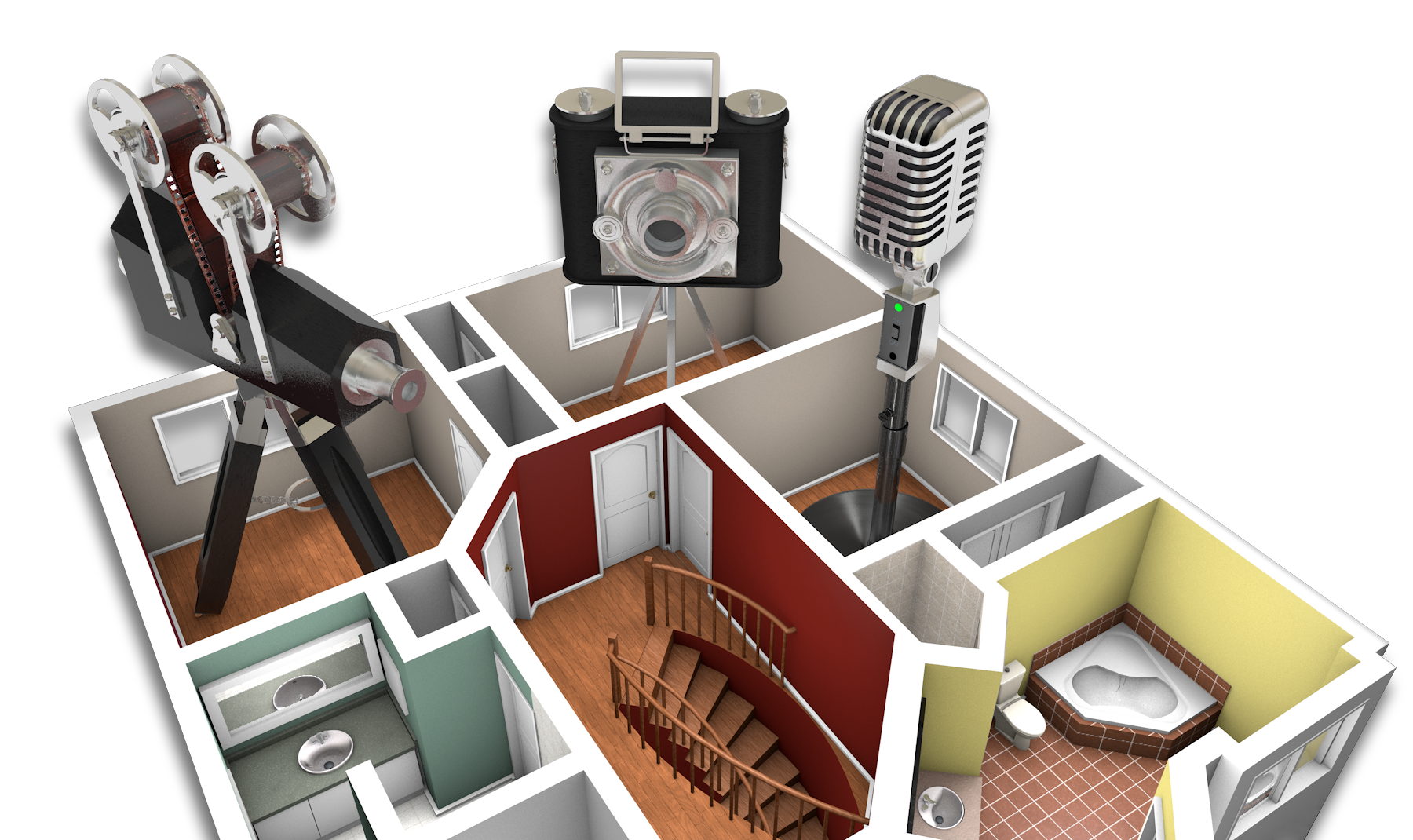
This guide walks through how to define and position your property, how to value barns, fencing, and acreage realistically, what paperwork to gather, and how to reach the right buyer pool. Because so many buyers come from the GTA, I lean heavily on Video Narrated VR Animated Online Showings so out-of-town buyers can explore your land, barns, and farmhouse online before they ever make the drive north. For a deeper look at the rural systems side of a sale, this pairs closely with my guide to selling rural property in New Tecumseth and my page on septic and well homes in New Tecumseth.
What Defines a Hobby Farm, and Why It Changes the Sale
Knowing exactly which kind of country property you own determines how it is valued, taxed, and marketed.
Hobby Farm vs. Commercial Farm vs. Rural Residential
A hobby farm is a small acreage property, often cited in the five to fifty acre range, where farming is done for enjoyment and self-sufficiency rather than profit. It is usually treated as a residential home with an accessory agricultural use. A commercial farm, by contrast, is a working business with a reasonable expectation of profit, frequently zoned Agricultural and sometimes eligible for the Farm Property Tax Class and provincial farm programs. A rural residential property is essentially a large country lot kept as open space or recreation, with little or no farming use at all. Most New Tecumseth listings that buyers call "hobby farms" sit between these categories, which is exactly why pricing and disclosure have to be handled carefully.
Who Buys Hobby Farms in New Tecumseth
The buyer pool is more specialized than it is for a subdivision home, and identifying it early shapes the entire marketing plan. The most common buyers are GTA families seeking a country lifestyle and more room for children, equestrian buyers who need safe fencing, stalls, turnout, and ideally an arena, and hobby farmers who want to keep chickens, bees, goats, or a market garden. Retirees downsizing from larger operations and Honda plant employees who want acreage with a short commute to Alliston round out the list. Each group values different features, so the listing has to lead with the lifestyle that fits your specific property.
Why the Distinction Matters at Sale
The category affects three things at once: how the property is valued, how it is taxed at closing, and which marketing message lands. A property positioned as a turnkey equestrian hobby farm reaches a very different buyer than one marketed simply as a country home with a barn. Getting this right from the first day on market is one of the most important decisions in the whole sale, and it is where an experienced rural Realtor earns their fee.
Valuing the Land, Barns, and Outbuildings
On a hobby farm the value is distributed across the entire property, not concentrated in the house, so each component has to be assessed on its own merits.
The Acreage-Utility Approach
Workable, usable land is valued very differently from protected forest, wetland, or unusable bush. When I evaluate a hobby farm I look at how much of the acreage is genuinely productive for pasture, paddocks, or gardens, how the land drains, and whether any of it is encumbered by the Nottawasaga Valley Conservation Authority or a floodplain. You cannot price acreage on house square footage alone, and you cannot assume every acre carries the same value. A clear-eyed breakdown of usable versus constrained land is the foundation of an accurate asking price.
What Barns, Fencing, and Arenas Are Worth
Outbuildings carry quantifiable weight, but only when they are sound and functional. Among the improvements buyers pay for, fencing tends to deliver the strongest return relative to its cost because safe, well-maintained fencing signals a property is immediately horse-ready. Practical barns with good stalls, ventilation, lighting, and roofing follow, and pasture and drainage improvements also reward sellers well. A riding arena adds appeal for equestrian buyers, though the return is more variable, so building a brand-new arena purely to sell rarely pays back dollar for dollar. The table below summarizes how these features typically influence value.
| Feature | Value Impact | What Buyers Look For |
|---|---|---|
| Perimeter & Paddock Fencing | Strongest return on prep dollars | Safe, tight, no sagging boards or broken wire; secure gates |
| Barn & Stalls | Solid value when functional | Structural integrity, stall safety, ventilation, lighting, sound roof, organized tack and feed rooms |
| Pasture & Drainage | Good return; signals care | Reseeded worn areas, no chronic mud, rotation evidence, clean manure management |
| Riding Arena | Variable; appeals to equestrian buyers | Level, well-drained footing, adequate size, sound fencing and access |
| Neglected / Collapsing Outbuilding | Can reduce value | Read as a demolition and cleanup cost rather than an asset |
Don't Over-Improve Before Listing
Today's hobby farm buyer wants immediate functional value, not flash. The smartest pre-list spending is targeted: walk every fence line and fix what sags, clean and organize the barn, drag and level the arena, address muddy spots in the pasture, and power wash and tidy the yard. These moves build buyer confidence and remove negotiating leverage far more efficiently than a large capital project undertaken purely to impress.
Documents, Zoning, and Rural Systems to Confirm Before Listing
A hobby farm sale is most often won or lost during the buyer's due diligence period, so the goal is to remove uncertainty before an offer is even written.
Septic and Well Documentation
The private water and waste systems are the first things a rural buyer scrutinizes. Gather recent septic pump-out records or a use permit, and arrange a current well water potability test, which Public Health Ontario provides at no charge for bacterial analysis. A 24-hour flow test that proves the well's recovery rate reassures cautious buyers that the property can sustain a modern household. My guide to septic and well homes in New Tecumseth goes through this in detail.
Survey, Boundaries, and Easements
Ontario does not legally require a survey to sell, but on a hobby farm an up-to-date reference plan is invaluable. It clarifies boundary lines, fence locations, and any easements such as a shared driveway or utility right-of-way, all of which can otherwise become sources of buyer hesitation or post-closing disputes. Where no survey exists, municipal GIS mapping and clearly marked stakes help, but a fresh reference plan is the safest path.
Zoning, MDS, and Conservation Authority
Zoning dictates what a buyer can actually do, so confirm in writing whether the property is Agricultural or Rural Residential and exactly which uses are permitted, such as keeping livestock, building a secondary dwelling, or running a home-based business. Where livestock buildings are involved, Minimum Distance Separation rules may affect a buyer's ability to add or expand barns near neighbouring uses. If any part of the land falls under the Nottawasaga Valley Conservation Authority, those development and land-use restrictions must be disclosed clearly. None of these need to be deal-breakers, but unexplained they create exactly the kind of doubt that stalls a sale.
Heating, Utilities, and Connectivity
Disclose the heating system type and age, and whether any propane tank is owned or leased, since a leased tank remains the supplier's property and its contract must be assumed by the buyer. In today's market, documented high-speed internet is a genuine value driver for buyers planning to work remotely from the country.
Watch: A Backstage Tour of the Seller Marketing Plan
This video is a backstage tour of the seller marketing plan. It shows how Video Narrated VR Animated Online Showings highlight all of a home's key features and benefits online — where buyers shortlist homes they are willing to go see.
How to Get Top Dollar for Your House
A backstage tour of the seller marketing plan, showing how Video Narrated VR Animated Online Showings highlight all of a home's key features and benefits online — where buyers shortlist homes they are willing to go see.
10 Questions You Should Ask Before Hiring A REALTOR
Essential questions to ensure your agent has the experience and marketing plan to sell your hobby farm quickly and for top dollar.
Why Didn't My House Sell?
Common reasons properties fail to sell, from overpricing to poor presentation, and how to avoid these mistakes.
How to Avoid Legal Mistakes When Selling Your House
Protect yourself during the selling process by understanding disclosures, conditions, and contract details.
How Do I Know My House Will Pass the Building Inspection?
Proactive steps to address potential inspection issues before they derail your sale.
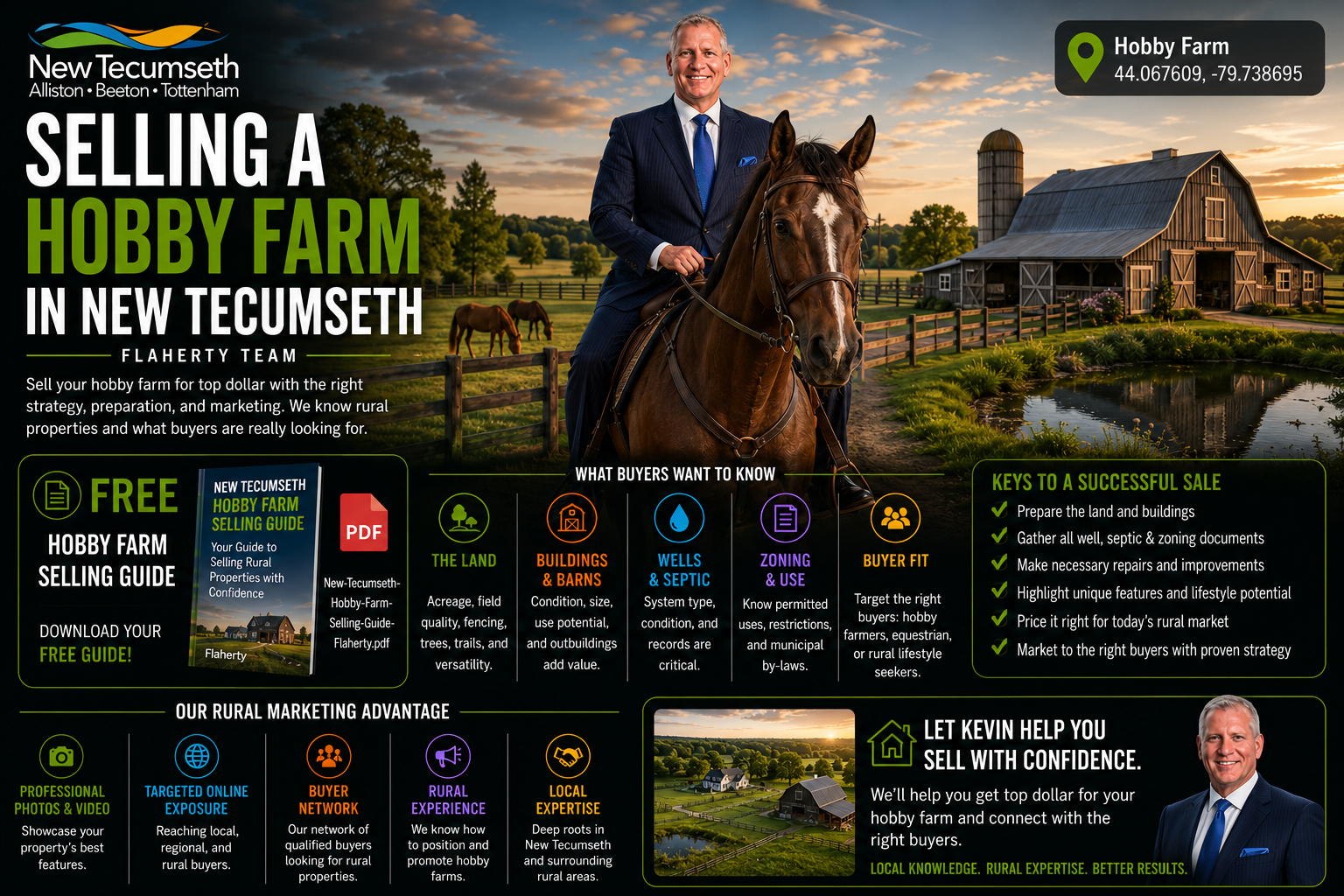
Click the image to download your free New Tecumseth Hobby Farm Selling Guide.
Download the Hobby Farm Selling Guide
Get the complete checklist for preparing your New Tecumseth hobby farm for sale. This comprehensive guide covers land and outbuilding preparation, septic and well documentation, fencing, paddock and arena inspection, zoning and permitted-use verification, and marketing to rural buyers — with empty checkboxes you can work through step by step.
Download PDF GuideSeasonal Timing for a Hobby Farm Sale
Unlike a town home, a hobby farm shows its true potential when the land is at its best, so timing influences both presentation and price.
Spring and Early Summer Show the Land Best
Green pastures, leafed-out tree lines, tidy gardens, and visible fencing all photograph beautifully in late spring and summer, and buyers can clearly see paddock layouts, drainage, and the relationship between the house and outbuildings. For most lifestyle and equestrian buyers, this is when a hobby farm is easiest to fall in love with, which supports a stronger price.
Listing in the Off-Season
There is nothing wrong with selling in fall or winter, but snow hides landscaping and property boundaries and bare trees flatten the scenery. The fix is preparation: I often capture drone footage and full marketing materials in the warmer months so a property listed in January still shows buyers exactly what it looks like in June. With the right preparation, a well-documented hobby farm can sell in any season.
Client Success Stories
Read how the Flaherty Team has helped sellers achieve successful results with rural and acreage properties.
"Kevin's VR online showing brought in a buyer from Mississauga who never would have found our property otherwise. The whole process from listing to close took under three weeks."
— Alexander Rowe
"Kevin and Adam helped us sell our rural property when two other agents had failed. Their marketing reached buyers we didn't know existed. The VR showing made all the difference for out-of-town buyers."
— Edwin Muntz
"Kevin and the team were outstanding. They took care of everything and kept us informed every step of the way. We sold quickly and for more than expected."
— Sandy Small Proudfoot

Related New Tecumseth Seller Guides
Explore our core New Tecumseth resource pages and the selling strategies most relevant to rural and acreage owners.
New Tecumseth Community Pages
Local expertise across every New Tecumseth community where hobby farms are found.
Frequently Asked Questions
Answers to common questions about selling a hobby farm, small acreage, barns, and farmhouse in New Tecumseth.
The most important step is positioning the property correctly and assembling documentation early. A hobby farm sells on its land, outbuildings, and lifestyle as much as its house, so deciding whether to market it as an equestrian property, a self-sufficiency homestead, or a country home with a barn shapes everything that follows. Kevin Flaherty advises every hobby farm seller to settle that angle and gather septic, well, survey, and zoning records before listing.
A hobby farm is a small rural property, typically between five and fifty acres, where farming is done for enjoyment and self-sufficiency rather than as the owner's main income. In real estate it is generally treated as a residential home with an accessory agricultural use, which distinguishes it from both a town home and a working commercial farm.
A commercial farm is operated as a business with a reasonable expectation of profit, is usually zoned Agricultural, and may qualify for the Farm Property Tax Class and provincial programs. A hobby farm is run for lifestyle, is often taxed at the residential rate, and is not required to generate farm income. This affects how each is valued, taxed, and marketed at sale.
There is no official size, but most hobby farms fall in the five to fifty acre range, with many smaller lifestyle holdings closer to two to ten acres. What matters more to buyers than total acreage is how much of the land is genuinely usable for pasture, paddocks, or gardens versus how much is bush, wetland, or otherwise constrained.
The Principal Residence Exemption generally covers the house and up to about half a hectare (roughly 1.24 acres) of land. The remaining acreage can attract capital gains tax unless it is necessary for the use and enjoyment of the home. Most hobby farms do not qualify for the Lifetime Capital Gains Exemption that applies to working farms, so always confirm your specific situation with a tax professional.
Buyers and lenders expect a recent septic inspection or pump-out record, a current well water potability test from Public Health Ontario, an up-to-date survey or reference plan, written zoning and permitted-use confirmation, and disclosure of whether any propane tank is owned or leased. Kevin Flaherty recommends assembling all of these before listing so the buyer's conditional period runs smoothly.
A sound, functional barn adds real value because buyers want immediate, safe use for animals or storage. They look for structural integrity, stall safety, ventilation, lighting, a good roof, and organized tack and feed areas. A barn in poor condition can have the opposite effect, reading as a demolition and cleanup cost rather than an asset.
Fencing typically delivers one of the strongest returns relative to its cost when selling a hobby or horse property, because safe, well-maintained fencing immediately signals the property is ready for animals. Sagging boards, leaning posts, or old wire fencing do the reverse and hand buyers negotiating leverage. In Kevin Flaherty's experience, walking and repairing every fence line is among the highest-value things a seller can do before listing.
Usually not. An existing, well-graded and well-drained arena is a strong marketing advantage for equestrian buyers, but building a brand-new arena solely to sell rarely returns its cost dollar for dollar. The better strategy is to make any existing arena look and function its best by improving drainage, leveling the footing, and tidying fencing and access.
Hobby farms are generally zoned either Agricultural or Rural Residential. Agricultural zoning tends to permit more livestock and larger barns but can restrict additional dwellings, while Rural Residential zoning limits the number and type of animals. Confirming the exact designation in writing tells buyers precisely what they can and cannot do with the property.
Minimum Distance Separation is a provincial formula that sets required setbacks between livestock barns or manure storage and other land uses. It can affect a buyer who wants to build or expand livestock structures near a neighbouring use. It rarely prevents a sale, but buyers planning to expand will want to understand the constraints, so disclosing what you know avoids surprises.
If part of your land falls under the Nottawasaga Valley Conservation Authority, there may be restrictions on development, building near waterways, and tree removal. These must be disclosed to buyers. While they can deter someone planning major construction, they also appeal to buyers who value protected, natural surroundings.
The buyer pool includes GTA families seeking a country lifestyle, equestrian buyers needing fencing, stalls, turnout, and ideally an arena, hobby farmers who want chickens, bees, goats, or a market garden, retirees downsizing from larger operations, and Honda plant employees who want acreage with a short commute to Alliston.
Hobby farm pricing requires a wider geographic lens and a component-by-component view rather than a simple price-per-square-foot. Kevin Flaherty evaluates the usable acreage, the condition and function of barns and fencing, zoning permissions, and recent sales of similar lifestyle properties across the broader region to arrive at a defensible asking price.
It is not always legally mandated for every transaction, but it is highly recommended and sometimes required by local rules. Even where it is optional, most buyers will make their offer conditional on a satisfactory septic inspection, so having recent records or a use permit ready prevents delays during their conditional period.
Test for bacterial potability immediately before listing, which Public Health Ontario offers free of charge. Kevin Flaherty also recommends having a recent 24-hour flow test on file to demonstrate the well's recovery rate, since a steady, safe water supply is a top concern for anyone planning to keep animals or a garden.
A survey is not legally required to sell in Ontario, but for a hobby farm an up-to-date reference plan is strongly advised. It clarifies boundary lines, fence locations, and easements, all of which reduce buyer hesitation and prevent post-closing disputes over shared driveways or fence positions.
You must disclose whether the propane tank is owned or leased. A leased tank remains the property of the supplier, so the buyer either assumes the rental contract or arranges for the supplier to remove it. Clarifying this early avoids a last-minute snag at closing.
Since the shift to remote work, reliable high-speed internet has become a major priority for buyers leaving the GTA for the country. Documenting your current speeds and provider options removes a common objection and can meaningfully strengthen your listing.
No. Today's hobby farm buyer wants immediate functional value rather than flashy upgrades. Kevin Flaherty coaches sellers to spend targeted effort on fencing repairs, barn cleanup, arena and pasture maintenance, and general tidiness, which build buyer confidence far more efficiently than a large capital project undertaken just for the sale.
Late spring and summer usually show a hobby farm best, when pastures are green, gardens are in, and fencing and paddock layouts are clearly visible. You can still sell well in fall or winter, but it takes preparation, such as capturing drone footage in the warmer months, so buyers can see the property's full potential year-round.
Hobby farm marketing has to showcase the entire property, not just the house. Kevin Flaherty uses drone photography and Video Narrated VR Animated Online Showings so out-of-town buyers can explore the land, barns, and outbuildings online, ensuring the buyers who book in-person showings are already serious about the rural lifestyle on offer.
The biggest deterrents are missing well and septic records, unclear property boundaries with no survey, poor internet connectivity, visible deferred maintenance on barns and fencing, and uncertainty about what the zoning actually permits. Kevin Flaherty works through each of these with sellers before listing, because every one introduces doubt, and doubt is what stalls or kills a rural sale.
Yes. Proximity to the Honda plant in Alliston is a genuine selling feature, attracting plant employees and executives who want a country lifestyle with a short, easy commute. It is one more buyer segment a well-marketed hobby farm can reach.