A Mono acreage listing fails when buyers cannot convert rural uncertainty into confidence. This page uses a distinct Rural Buyer Confidence Dossier approach: gather proof, explain country realities, plan stigma responses, and market the property so buyers understand the estate before they arrive.
That is deliberately different from a suburban turnoff checklist. Mono is north and east of Orangeville and has no urban core. Many properties are detached estate homes, hobby farms, luxury acreage homes, or estate-subdivision homes on large lots. Buyers may be comparing rural property and acreage in Mono, hobby farm selling strategy, and luxury estate positioning at the same time.
In April 2026, TRREB reported 8 Mono sales, 25 new listings, 51 active listings, an average price of $1,380,000, a median price of $1,477,500, 41 average days on market, and a 96% sale-to-list price ratio. In a 6.4-to-1 inventory-to-sales environment, buyers have choices. If your listing gives them unanswered rural risk, they do not need to solve it; they can simply move on.
| TRREB April 2026 Mono metric | Result | Why it matters to buyer fear |
|---|---|---|
| Sales | 8 | Limited buyer activity means objections matter more. |
| Average price | $1,380,000 | Acreage buyers expect evidence before paying estate-level prices. |
| Median price | $1,477,500 | Many Mono transactions sit in the luxury-estate decision zone. |
| New listings | 25 | Fresh competition gives buyers alternatives. |
| Active listings | 51 | Inventory pressure lets buyers be selective. |
| Average days on market | 41 | Unanswered questions can turn into stale-listing suspicion. |
| Sale-to-list price ratio | 96% | Pricing must match perceived risk. |
| Inventory-to-sales ratio | 6.4:1 | Buyers can walk away when the rural story is incomplete. |
The Mono difference: buyer hesitation is often not about whether the house is attractive. It is about whether the buyer feels capable of owning the property. A rural listing must sell confidence in the land, the systems, the access, the setting, and the story.
The Rural Buyer Confidence Dossier: a better Mono framework
The right buyer for a Mono estate may love privacy, land, trails, mature trees, views, and room to breathe. But that same buyer can still freeze if the listing leaves too much to imagination. A buyer who has only owned in town may not know how to evaluate a septic bed, a drilled well, propane heat, wildlife management, snow removal, agricultural neighbours, internet options, or a property history issue. The fear is not always rational, but it is still real.
My recommendation is to build a Rural Buyer Confidence Dossier before the listing is launched. It is not a glossy brochure full of vague lifestyle language. It is a practical evidence package that says, “Here is what is known. Here is what has been serviced. Here is what rural ownership looks like here. Here is how questions will be answered.” That is how a seller reduces fear before it turns into a lower offer, a long condition, or a cancelled showing.
Proof
Septic, well, heating, internet, access, and maintenance records help buyers stop guessing.
Plain language
Rural clauses, nearby farming, wildlife, and winter maintenance need explanation before paperwork creates anxiety.
Strategy
Pricing, video marketing, disclosure planning, and showings must match the realities of a high-value Mono acreage decision.
Fear 1: septic and well unknowns
Private services are often the first major fear for buyers moving from Orangeville, Brampton, Mississauga, Toronto, or a newer subdivision. They may love the idea of acreage until they realize there is no municipal water bill and no city sewer connection. Then the questions begin: Is the water safe? How old is the well pump? Has the septic been pumped? Where is the bed? What happens if the system fails after closing?
A seller should not wait for the buyer’s inspector to create the first real information about the property. Before listing, gather the pump-out receipt, septic inspection if appropriate, any available permit, tank and bed location notes, water potability test, filtration and UV service records, and available well flow information. This supports the deeper guidance in selling a home with septic and well in Mono.
Buyers do not expect every rural system to be new. They expect the seller to know what they are selling. A clean, organized file turns “what if the septic fails?” into “here is the last pump-out, here is the inspection, here is the location, and here is the maintenance history.” That change can preserve trust and keep a buyer from treating the entire property as a risk discount.
Fear 2: the farming proximity clause and country property reality
Many Mono buyers want countryside views, quiet roads, and space. Then they see the country property clause and suddenly the countryside feels more complicated. The clause can sound alarming to a buyer who has never lived near agricultural activity because it describes discomfort, inconvenience, odour, equipment, manure, spraying, and protected farming operations in legal language.
“The Buyer acknowledges that the property lies within, partially within, adjacent to or within two kilometres of an area zoned, used or identified for agricultural and food production activities and that such activities occur in the area. These activities may include intensive operations that cause discomfort and inconveniences that involve, but not limited to dust, noise, flies, light, odour, smoke, traffic, vibration, operating of machinery during any 24 hour period, storage and utilization of manure and the application by spraying or otherwise of chemical fertilizers, soil amendments, herbicides and pesticides. One or more of these inconveniences have protection in Ontario under the Farming and Food Production Protection Act.”
If the first meaningful discussion of that clause happens during offer review, the seller has lost control of the narrative. Instead, explain what actually exists around the property. Is the neighbouring land actively farmed? Is it hay, cash crop, livestock, or hobby use? Is activity seasonal? Is the field distant from the house? Are there windbreaks? Is the home in an estate setting where the clause is technically relevant but daily impact is limited?
This does not mean minimizing rural reality. It means presenting it accurately. Some buyers will decide country living is not for them, and that is a good filter. The wrong buyer walking away early is better than the wrong buyer tying up the property and collapsing later.
Fear 3: winter access, long driveways, hydro, and heat
A long driveway can feel like luxury in September and liability in February. Mono sellers should assume buyers will think about snow removal, road status, delivery access, school bus logistics, emergency vehicles, slopes, turnarounds, hydro reliability, backup power, heating fuel, and whether large interior volumes create high winter carrying costs.
The solution is to make winter ownership concrete. Provide the name or type of plowing arrangement, approximate annual cost if known, where snow is pushed, whether the driveway has a turnaround, whether the road is municipal or private, and whether the home has generator backup or wiring. If the house is heated by propane, oil, electric, heat pump, wood, or a hybrid system, provide service records and ordinary operating context.
Buyers who are serious about Mono expect some rural responsibility. What scares them is not responsibility itself; it is the feeling that the seller has not thought about it or is hoping they will not ask.
Fear 4: wildlife, pests, ticks, and unmanaged land
Wildlife is part of the appeal and the responsibility of rural living. Deer, coyotes, raccoons, mice, insects, ticks, mosquitoes, and, in some settings, larger wildlife can shape a buyer’s perception of the property. For a buyer coming from an urban setting, normal country sounds and signs can feel like warning signs.
The presentation goal is not to pretend wildlife does not exist. The goal is to show that the home and land are managed. Seal visible entry points. Remove old feed, debris, and clutter near outbuildings. Cut back overgrowth around foundations. Maintain trails and lawns. Keep garbage storage tidy. If professional pest-control work has been done, keep records available. A rural property that looks managed tells buyers that wildlife is part of the setting, not evidence of neglect.
Overgrown acreage can create the same problem. Buyers may see long grass, abandoned materials, unsafe fencing, and tired outbuildings as a sign that every hidden system is also neglected. Strategic cleanup can be more valuable than cosmetic interior spending because it changes the buyer’s first emotional conclusion about stewardship.
Fear 5: distance from amenities, schools, emergency response, and connectivity
Mono offers privacy and space, but it is not an urban neighbourhood with walkable services. The closest urban amenities are generally in Orangeville, and buyers may ask about groceries, medical appointments, children’s activities, school bus routes, commuting, emergency response, package delivery, and winter driving. A seller should not apologize for the location; the location is part of the value. But the listing should help buyers understand daily life.
Connectivity deserves special attention. Many modern buyers work from home, stream, run businesses, or need reliable video calls. If the property has strong internet through fibre, cable, fixed wireless, Starlink, or another provider, document it. If cell service is stronger in certain parts of the house, know that before showings. For some buyers, internet confidence removes more fear than a staged dining room.
Buyer objections vary across Mono Real Estate, Camilla, Cardinal Woods, Fieldstone, Hockley Village, Hockley Valley, Island Lake Estates, Mono Centre, Purple Hill, Starrview Acres, Watermark, because each setting changes how buyers think about access, services, land, farming proximity, and daily convenience.
Fear 6: deferred maintenance across a large estate property
Large properties multiply maintenance signals. A suburban buyer may only be worried about the roof, furnace, windows, and basement. A Mono estate buyer may also be thinking about outbuildings, barns, detached garages, fences, gates, laneways, ponds, trails, decks, pools, septic, well, propane, generators, drainage, tree work, and long-term land stewardship.
That is why “as-is” silence can be expensive. If the property has outbuildings, label their use and condition honestly. If a structure is not safe, fix the safety concern or price accordingly. If a pond is ornamental and not swimmable, say so. If trails are seasonal, explain that. If the roof is older on a large home, provide quotes or context so buyers are not left to imagine the highest possible replacement cost.
When sellers ask where to spend before listing, I often separate confidence work from vanity work. Review how to prepare your house for sale in Mono, whether to renovate before selling in Mono, and what adds the most value before selling in Mono before assuming cosmetic updates are the best use of money.
Fear 7: property stigma and uncomfortable history
The required video in this section is a REALTOR training session I led on selling stigmatized real estate in Ontario. It is not legal advice, and I am a real estate broker rather than an attorney. The training is useful for sellers because it shows why stigma cannot be handled casually or emotionally at the offer table.
Selling Stigmatized Real Estate in Ontario: Kevin Flaherty leads a realtor training session on selling stigmatized real estate in Ontario — covering disclosure obligations, strategic planning, and marketing approaches for properties with non-physical history concerns.
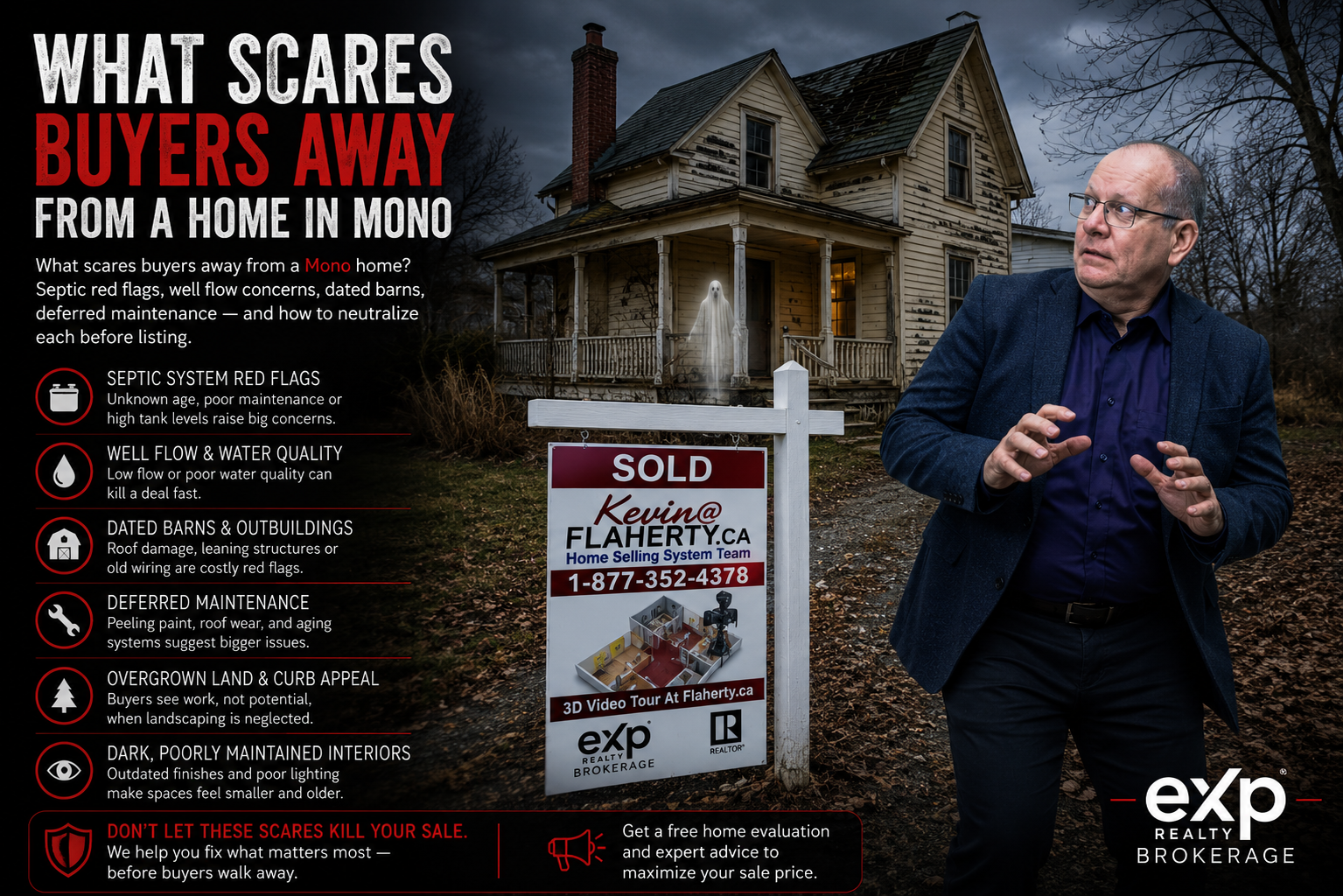
In the training, I define a stigma as a non-physical, intangible attribute of a property that could possibly cause an emotional or psychological response from a potential buyer. The reaction does not have to be logical. One buyer may be terrified by an alleged haunting, while another buyer may not care. Examples discussed include murder, suicide, natural death in the home, and rumours of a haunted property.
The most important teaching point is that stigma must not be confused with a physical defect. A former marijuana grow operation, structural problems, leak history, contamination, or meth-lab concern may involve physical defects or safety issues. Those require different treatment than an intangible stigma. A seller who blurs that distinction can create serious disclosure and misrepresentation risk.
For Ontario, the training explains that there is no simple statute or clear case-law rule that forces every stigma disclosure in every circumstance. That does not mean an agent or seller can mislead people. Registrants still have duties connected to fairness, honesty, integrity, best efforts, and preventing error or misrepresentation. The practical result is that sellers need a strategic disclosure plan before marketing begins.
For a listing agent representing a seller, the training covers seller direction. A seller can instruct the agent not to disclose a stigma, and an agent must follow lawful client instructions. But if a buyer agent directly asks, the listing agent cannot lie. If the seller has instructed the agent not to disclose, the response may need to be, “I cannot answer that question.” That is not a line to improvise; it should be documented and planned.
The training also warns about the multiple-representation trap. If the listing agent brings a buyer and the seller has instructed the agent not to disclose a stigma, the agent’s duties to that buyer may create a conflict. If the seller refuses to permit disclosure, the buyer may have to be released to seek other representation. That is why the training references written instructions from seller regarding stigma, with one option to disclose and another option not to disclose, including acknowledgment of what happens if multiple representation arises.
From the buyer-agent side, the video discusses using a stigma clause when the buyer has a concern. That type of clause can ask the seller to represent and warrant, to the best of the seller’s knowledge, that the property has not been involved in circumstances that may elicit a negative psychological response, such as deaths, suicides, or murders. The training also recognizes a real-world difficulty: in a multiple-offer situation, a stigma clause can make an offer look complicated and may be rejected or crossed out. If a buyer directs the agent to keep the offer clean by removing that clause, the agent should document that instruction in writing.
The video uses the Paul Bernardo property example to show why documentation matters, and it recommends practical due diligence when a clause cannot be used: search the property address online and ask neighbours, because neighbours often know and talk about major property history. For Mono sellers, the lesson is simple. If a stigma exists or may exist, decide the strategy before launch, separate stigma from physical defects, avoid false comfort, and link buyers who want more detail to the full stigmatized real estate guide.
Fear 8: price, stale listings, and the “what’s wrong with it?” question
When a Mono acreage listing sits, buyers often assume there is a hidden reason. It may be overpricing, weak presentation, missing documentation, poor showing access, unresolved rural concerns, or competition from better-prepared listings. In a market with 51 active listings and only 8 sales in April 2026, a seller cannot rely on scarcity alone.
Overpricing is especially damaging when the property already has unanswered questions. A buyer who sees an ambitious asking price plus missing septic documentation, vague well information, tired outbuildings, a long driveway with no winter context, and no explanation of farming proximity will not think, “This must be rare.” They will think, “How much less can I get it for, or should I avoid it?”
If your listing has already launched and buyer traffic is weak, review why your Mono home isn’t selling, how to price your house in Mono, how long it takes to sell a house in Mono, and how to sell your house fast in Mono. The answer is rarely just one more ad. It is usually a combination of price, proof, presentation, and buyer confidence.
How I would remove Mono buyer fear before listing
This is the full practical sequence I would use to identify and remove the buyer fears that prevent offers on a Mono estate property. It is intentionally rural, documentation-led, and focused on confidence rather than generic decluttering advice.
Phase 1: Build the rural proof file before the listing appointment
Collect septic permits, pump-out receipts, inspections, and any tank or bed location information.
Collect well records, water tests, filtration service history, pump invoices, and available flow details.
Summarize heating fuel, generator readiness, hydro history, internet provider, cell reception, and winter utility experience.
Create a one-page rural systems note that explains what has been serviced, what is known, and what still needs verification.
Phase 2: Translate farming proximity into plain language
Identify visible agricultural uses within roughly two kilometres and note whether they are active, seasonal, or distant.
Prepare an honest explanation of normal rural activity such as dust, machinery, odour, manure, spraying, traffic, and early or late equipment use.
Avoid dismissing the farming clause as boilerplate because unfamiliar buyers may read it as a major warning.
Frame the setting accurately so buyers who want country living understand both the benefit and responsibility.
Phase 3: Remove winter access and driveway anxiety
Measure or estimate the driveway length and identify slope, turnaround, parking, and snow storage areas.
Document the plowing arrangement, annual costs if available, equipment used, and reliability of access after major storms.
Explain municipal road status versus private responsibility, and identify any shared-lane or maintenance arrangement.
Photograph the property in winter if possible so out-of-season buyers can visualize access honestly.
Phase 4: Present the land as cared-for acreage
Mow strategic areas, clear obvious debris, open trails, trim around outbuildings, and define usable outdoor zones.
Deal with visible rodent entry points, wasp nests, abandoned materials, unsafe fencing, and neglected structures before launch.
Prepare a simple land-use map showing lawn, woods, trails, pond, outbuildings, paddocks, gardens, and conservation areas.
Explain wildlife realities calmly so buyers distinguish ordinary rural living from unmanaged property problems.
Phase 5: Plan stigma disclosure and direct-question responses
Identify what the seller actually knows, what is rumour, and what may involve a physical defect rather than stigma.
Separate intangible stigma issues from physical defects such as grow-op history, structural concerns, leaks, or contamination.
Decide in writing whether and how stigma will be disclosed, and prepare an honest response for direct buyer-agent questions.
Avoid multiple-representation confusion by planning how buyer inquiries will be handled before a conflict arises.
Phase 6: Price for proof, not hope
Compare the property against current Mono estate inventory, not only against the seller’s desired net price.
Use TRREB April 2026 data, including 51 active listings, 8 sales, 41 average days on market, and 96% sale-to-list ratio.
Adjust for documented strengths such as recent septic work, strong water results, winter access, and high-quality online presentation.
Do not ask buyers to pay a premium while also asking them to accept unanswered rural risk.
Phase 7: Market the property so buyers understand it before arrival
Use narrated online showing content to explain the house, acreage, systems, access, and setting in a controlled sequence.
Show land features, outbuildings, driveway, utility areas, and mechanical systems instead of relying only on pretty interior photos.
Link buyers to relevant guides on septic and well, rural acreage, luxury estate selling, and preparation for sale.
Filter out mismatched buyers early so in-person showings come from people who understand the rural trade-off.
Phase 8: Keep negotiation focused on verified facts
Give serious buyers the documentation package promptly so their conditional period starts with evidence.
Answer system, access, stigma, and farming questions consistently and without exaggeration.
Use inspection findings to solve actual concerns rather than allowing vague fear to control the negotiation.
If new information appears, update the buyer-confidence file and pricing strategy quickly.
Want the checklist version? Download the printable guide and use it as a pre-listing worksheet before photos, showings, or price launch.
Videos that help sellers understand buyer confidence
These videos support the strategy behind the page: price correctly, answer buyer concerns, use stronger presentation, choose representation carefully, and avoid legal or disclosure mistakes.
How to Get Top Dollar For Your House: Kevin Flaherty explains the complete system for getting top dollar when selling your house.
Video Narrated VR Animated Online Showings: A sample of the online showing system that presents homes to buyers before they visit.
10 Questions to Ask Before Hiring a Realtor: Questions sellers should ask before choosing representation.
How To Avoid Legal Mistakes When Selling A House: Seller-focused guidance on avoiding common legal and disclosure mistakes.
Why Didn’t My House Sell: Kevin Flaherty explains why listings sit and what sellers can do.
Proof that better marketing changes buyer behaviour
“I couldn't believe how fast my home sold at a time when other homes were sitting on the market. Kevin got mine sold quickly and at a price that was top dollar and even more than I expected. His video narrated VR animated online showing gave my home amazing exposure and reduced unnecessary showings. Kevin was a pleasure to deal with. He was always patient and kept me informed every step of the way. I highly recommend his innovative approach.”
— Joanne Holding
“Sold in 4 days, 17 showings, 7 offers, $50,000 over asking when other homes in my area were sitting 6 months to a year. Kevin and his team are second to none when it comes to marketing homes. With the online showing technology they use, I believe my home was exposed faster and to more people.”
— Fay McCrea
Frequently asked questions about Mono buyer objections
What scares buyers away from a Mono estate property?
Mono estate buyers are usually frightened by uncertainty more than by one cosmetic issue. They worry about septic capacity, well quality, farming activity nearby, winter driveway access, wildlife, internet reliability, distance from Orangeville services, and whether an unusual history is being hidden. Kevin Flaherty recommends turning those unknowns into a written buyer-confidence package before the first showing.
Why are Mono buyer objections different from objections in a subdivision?
A subdivision buyer usually compares layouts, finishes, school zones, and commute time. A Mono acreage buyer also evaluates private services, land stewardship, driveway maintenance, outbuildings, ponds, tree cover, wildlife pressure, heating systems, and neighbouring agricultural operations. The decision feels bigger because the buyer is not just purchasing a house; they are buying a rural operating environment.
Do septic and well concerns really stop offers?
Yes. Many buyers coming from urban or newer subdivision homes have never owned a private septic or well system, so silence creates fear. A recent pump-out receipt, septic inspection, water potability test, flow-rate information, and plain-language explanation of system location can prevent a buyer from assuming the worst.
How should I handle the country property clause near farmland?
The farming proximity clause can shock buyers because it lists dust, noise, flies, odour, manure, traffic, machinery, vibration, light, smoke, and chemical applications. Kevin Flaherty’s approach is to explain the clause before it becomes a surprise and to describe the actual farming pattern near the property: whether activity is seasonal, distant, visible, intensive, or largely limited to neighbouring fields.
Will nearby farms automatically reduce my sale price?
Not automatically. Some Mono buyers want countryside views, working farms, and rural privacy. The risk appears when the buyer first learns about protected agricultural activity in the offer documents rather than during the property story. A clear explanation helps buyers decide whether the setting fits their lifestyle instead of reacting emotionally at the paperwork stage.
What documentation should I gather for a well?
Gather a recent water potability result, any flow or recovery information available, well record if you have it, filtration or UV maintenance records, pump replacement invoices, and notes about seasonal performance. Buyers do not need perfection; they need enough evidence to know they are not inheriting a mystery.
What documentation should I gather for a septic system?
Gather the septic use permit or available records, pump-out receipt, inspection report, service invoices, tank and bed location notes, and any information about household capacity. If records are incomplete, be direct about what is known and what can be verified before listing.
Do long driveways scare buyers in winter?
They can. A 200-to-500-metre private driveway is attractive in summer and intimidating in February. Buyers want to understand who plows it, where snow is pushed, what equipment is needed, whether the grade is steep, and whether emergency or delivery vehicles can access the home reliably.
Should I disclose hydro outages or internet limitations?
Material service realities should be handled honestly and proactively. Rural buyers often ask about hydro reliability, generator readiness, cell coverage, and internet speed. If the property has fibre, strong fixed wireless, Starlink, generator backup, or a proven service provider, provide evidence because connectivity can be as important as a renovated kitchen for some buyers.
Do wildlife concerns matter to estate buyers?
Yes, especially to buyers moving from town. Coyotes, deer, raccoons, mice, ticks, mosquitoes, and sometimes bears are part of rural life in many Ontario settings. Kevin Flaherty advises sellers to separate normal country living from neglect: show pest-control records, seal obvious entry points, keep garbage and feed managed, and present the land as cared for.
Can overgrown acreage make a buyer walk away?
Overgrown land can be interpreted as hidden work. Buyers may wonder whether trails, fences, drainage, outbuildings, lawns, ponds, and treelines have been neglected. Strategic mowing, brush clearing, labelled outbuildings, and a simple land-use map help buyers see usable acreage instead of future labour.
What if my house has a stigma such as a death or alleged haunting?
Kevin Flaherty’s training defines stigma as a non-physical, intangible fact or allegation that may create a psychological or emotional response in a buyer. His key warning is that stigma must not be confused with a physical defect. Murder, suicide, natural death, or alleged haunting may be stigma; a former grow operation, structural problem, leak history, or contamination concern may involve physical defect issues that must be treated differently.
Does Ontario require every stigma to be disclosed?
In the training video, Kevin explains that Ontario has not had a simple statute or clear case-law rule forcing every stigma disclosure in every situation. He stresses that registrants still have duties of fairness, honesty, integrity, best efforts, and avoidance of misrepresentation, so sellers should plan the response instead of improvising during negotiations.
What happens if a buyer agent directly asks about a stigma?
The direct-question moment is where poor planning becomes dangerous. Kevin Flaherty teaches that an agent cannot lie. If a seller has instructed the listing agent not to disclose a stigma, the proper response may be that the agent cannot answer the question, and that position should be documented before the listing ever goes public.
Why can multiple representation complicate a stigma issue?
If the listing agent is also working with a buyer, the situation can become complicated because the agent owes duties to that buyer. Kevin Flaherty highlights this as a major trap: if the seller will not permit disclosure to that buyer, the buyer may need to be released to obtain other representation. That is why written instructions matter.
Should I include a stigma plan before listing?
Yes. A stigma plan decides what is known, what is not known, what will be disclosed, how direct questions will be answered, what documentation will be kept, and how marketing will avoid misrepresentation. The worst time to design that plan is after a buyer, neighbour, or agent raises the issue.
How does pricing affect buyer fear in Mono?
In April 2026 TRREB data for Mono, there were 51 active listings and 8 sales, a 6.4-to-1 inventory-to-sales ratio. In that environment, buyers have choices. If the price feels high and the property has unresolved rural unknowns, they often wait, negotiate aggressively, or move to the next acreage listing.
What does a stale listing signal to acreage buyers?
A stale Mono listing often creates the question, “What is wrong with it?” The answer might be price, presentation, access, missing documentation, or simply weak marketing. The stronger strategy is to fix the source of hesitation rather than only changing photos or waiting for a different buyer.
Should I renovate before addressing rural buyer fears?
Not automatically. A new countertop will not answer septic, well, access, internet, stigma, or farming-proximity concerns. Review what not to fix before selling in Mono and prioritize the proof that removes buyer doubt.
How can video marketing reduce unnecessary showings?
Video-narrated and animated online showings give buyers a fuller understanding before they visit. For a rural property, that can mean explaining the driveway, land, outbuildings, setting, room flow, and lifestyle fit. Better-informed buyers are less likely to book a showing just to discover the property does not match their expectations.
Are Mono communities affected by these fears differently?
Yes. A buyer considering Hockley Valley may focus on terrain, winter roads, and resort proximity, while a buyer in Island Lake Estates may ask different questions about estate-lot living and access to Orangeville amenities.
Does Mono’s distance from amenities matter?
It matters for buyers who have not lived rurally. They will think about grocery trips, school buses, medical access, emergency response, sports schedules, and winter driving. The solution is not to pretend Mono is urban; it is to present the rural trade-off clearly so the right buyer understands the benefit.
What if my property has outbuildings in poor condition?
Outbuildings can add value or create fear. If they look unsafe, buyers may price in demolition, insurance issues, or immediate repairs. Stabilize, clean, label, photograph, and disclose the intended use of each structure so the buyer sees a manageable asset rather than a liability.
What is the first step if I want to sell my Mono acreage?
Start with an objection audit before public marketing. Kevin Flaherty can review the property through the lens of rural buyer fears, identify which concerns need documentation, and help decide which issues should be solved, disclosed, explained, or simply priced correctly before launch.

Related Mono seller guides
Use these pages to plan the rest of your sale strategy, including pricing, preparation, timing, rural acreage positioning, septic and well questions, and value decisions.
Mono community pages
Buyer questions change by neighbourhood and setting. Explore the Mono hub and individual community pages below.
Local authority resources
For broader context, sellers can also review TRREB, Town of Mono, Dufferin County, and Dufferin Board of Trade.