1. Maintenance
Small defects create big doubt when buyers see them throughout the home.





If you are selling in Shelburne, the best pre-sale improvement is not always the biggest renovation. I look for the changes that protect your equity, remove buyer doubt, improve the first impression, and make the home easier to understand online before buyers ever step inside.
This page is not a generic renovation article and it is not a repeat of a staging checklist. The unique angle is return-focused pre-sale prioritization: deciding what actually adds value before selling in Shelburne, what only looks productive, and what should be handled through pricing, disclosure, staging, documentation, or stronger marketing instead.
If you need the local seller hub, start with Shelburne Realtors and real estate. If you are still early in the process, also review how to prepare your house for sale in Shelburne, what not to fix when selling in Shelburne, and whether you should stage your house in Shelburne before spending heavily.
Neighbourhood context changes the answer. Start with the Shelburne real estate community hub for an overview, then compare individual pockets. A home in Emerald Crossing, Greenbrook Village, Hyland Village, Summerhill, Fiddler's Glen, and Historic Downtown Shelburne may need a different improvement strategy because buyers compare age, floor plan, lot, finishes, commute, school access, and storage differently in each pocket.
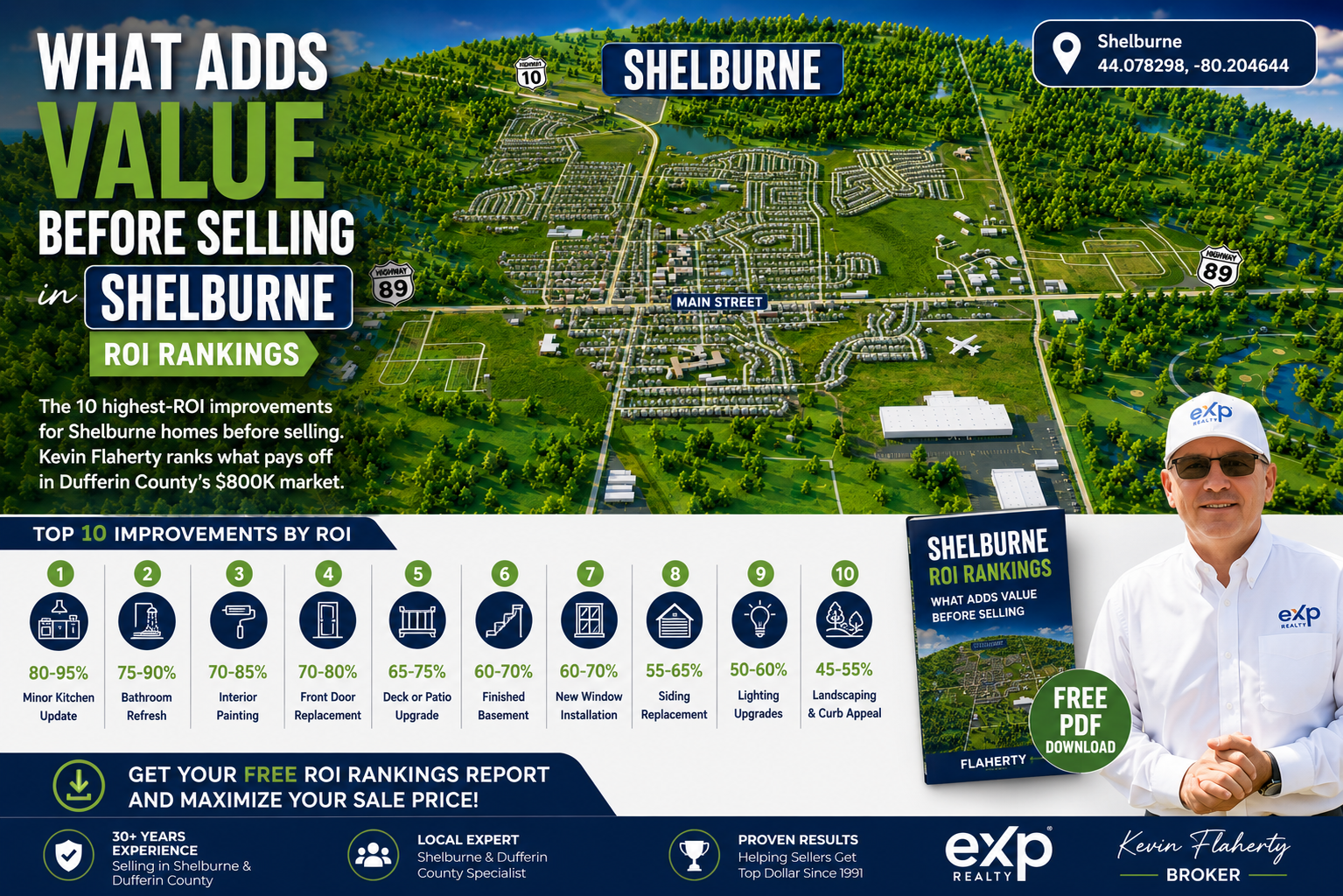
The PDF lead magnet gives you a 140+ item checklist with worksheets, room-by-room priorities, decision tables, and callout boxes so you can decide what to fix, refresh, stage, document, or leave alone.
How to Get Top Dollar For Your House
Market averages do not tell you exactly what your home is worth, but they do tell you the environment your improvements must compete in. TRREB April 2026 data shows Shelburne had an average sold price of $691,750, a median sold price of $695,000, 36 average days on market, a 96% sale-to-list-price ratio, 75 active listings, and 32 new listings. Detached homes averaged $756,750 with a $712,500 median, which matters when a seller is deciding how much to spend before listing.
| TRREB April 2026 measure | Shelburne result | What it means for value-boosting work |
|---|---|---|
| Average sold price | $691,750 | Spending should be proportionate to the price band and buyer expectations, not based on a renovation wish list. |
| Median sold price | $695,000 | Buyers near the centre of the market compare alternatives closely, so condition and confidence matter. |
| Average days on market | 36 | Preparation should help the home launch cleanly rather than need corrections after momentum fades. |
| Sale-to-list-price ratio | 96% | Buyers negotiated, so weak maintenance and unclear value can quickly become price pressure. |
| Active listings | 75 | When buyers have options, your improvements must make the home easier to choose. |
| Detached average / median | $756,750 / $712,500 | Detached sellers should compare improvement budgets against detached competition, not only the overall average. |
Source: TRREB April 2026 Dufferin report as summarized in the supplied market-data reference.
The best value boosters usually share one quality: they help buyers believe the home has been cared for. In Shelburne, that often means maintenance, cleaning, lighting, paint, curb appeal, simple hardware, documentation, room clarity, and strong visual presentation before expensive remodeling. A buyer may admire a trendy renovation, but they will discount a property quickly if basic care looks weak.
I separate value boosters into five groups. The first group protects the deal by fixing issues that can create fear. The second improves the first impression. The third clarifies room use through staging. The fourth documents value with receipts, warranties, upgrades, and utility information. The fifth packages everything through photography, copy, and a Video Narrated VR Animated Online Showing so buyers can understand the home remotely.
Small defects create big doubt when buyers see them throughout the home.
Deep cleaning helps buyers trust that the home has been cared for.
Brightness and neutral finishes help photos, showings, and buyer imagination.
The exterior sets expectations before the buyer enters or clicks through the gallery.
Rooms add more value when buyers immediately understand purpose and flow.
Receipts, upgrade lists, and VR narration make value easier to believe.
10 Questions You Should Ask Before Hiring A REALTOR®
A rushed renovation can feel productive, but it may not create the best net return. The risk is especially high when a seller chooses finishes based on personal preference, completes only one room while the rest of the house still looks tired, or spends heavily in a price band where buyers will not pay enough more to justify the work. In many cases, the better move is a targeted refresh: paint where needed, repair obvious defects, clean deeply, improve lighting, stage key rooms, and make the strongest features easier to understand.
That is why the first step is strategy, not shopping. A detached home competing above the Shelburne average may need stronger documentation and presentation to defend the price. A townhouse or smaller home may need storage, function, and affordability emphasized. A Historic Downtown property may need the seller to prove updates, maintenance, and character. A newer subdivision home may need to show how its layout, basement, office space, and backyard compare to similar alternatives.
Decision rule: do not ask whether a project makes the home nicer. Ask whether it changes what the buyer believes, what the buyer fears, or what the buyer is willing to pay.
The framework below is also reflected in the HowTo schema. It is a practical sequence for deciding what to improve before listing, how to avoid over-improving, and how to package the work so buyers see value instead of a list of chores.
Video Narrated VR Animated Online Showings
Pre-sale improvements only help when buyers notice and understand them. Photos can show a clean room, but they do not always explain how the rooms connect, how the basement can be used, why a particular upgrade matters, or how the property compares to other Shelburne options. My Video Narrated VR Animated Online Showing helps turn preparation work into buyer confidence because it gives the home a guided online explanation.
This matters for relocating buyers, family decision-makers, and people comparing several homes in the same price band. If a buyer can understand the layout, review the rooms, hear the value story, and share the home with others before booking a showing, the in-person visit becomes more serious. That can reduce wasted showings and help the seller’s improvement dollars work harder.
Learn more about the Flaherty.ca Home Selling SystemThe Shelburne Value Boosters Guide is designed to help you sort repairs, cosmetic refreshes, staging, documentation, and marketing decisions before the listing launch.
Flaherty.ca Home Selling System
★★★★★“Kevin's experience and marketing team sold my home over asking price in one day. The house was sold before it even went on MLS. We did not have to go through open houses or multiple viewings. The professional videos his team produces are amazing.”
★★★★★“In my time-sensitive house closing, Kevin and his team created a stellar, high-tech, personalized virtual video. This enabled virtual views with busy schedules for potential buyers. Kevin is professional, knowledgeable, experienced, and reputable.”
Use these related pages to refine the specific part of the plan that matters most: preparation, repair choices, staging, speed, as-is selling, multiple-offer strategy, or a stuck-listing diagnosis.
Shelburne home evaluation
Seller services
Book a strategy call
Improvement priorities change by neighbourhood. A newer subdivision buyer may compare finishes, layout, parking, and basement potential. A Historic Downtown buyer may weigh character, updates, walkability, and maintenance proof. Review Emerald Crossing, Greenbrook Village, Hyland Village, Summerhill, Fiddler's Glen, and Historic Downtown Shelburne to understand which buyer expectations your property must satisfy.
Use this page to understand how buyer expectations, upgrade standards, pricing pressure, and neighbourhood appeal differ in this Shelburne pocket.
Use this page to understand how buyer expectations, upgrade standards, pricing pressure, and neighbourhood appeal differ in this Shelburne pocket.
Use this page to understand how buyer expectations, upgrade standards, pricing pressure, and neighbourhood appeal differ in this Shelburne pocket.
Use this page to understand how buyer expectations, upgrade standards, pricing pressure, and neighbourhood appeal differ in this Shelburne pocket.
Use this page to understand how buyer expectations, upgrade standards, pricing pressure, and neighbourhood appeal differ in this Shelburne pocket.
Use this page to understand how buyer expectations, upgrade standards, pricing pressure, and neighbourhood appeal differ in this Shelburne pocket.
The highest-value improvements are the ones that remove buyer doubt and make the home easier to choose: obvious maintenance repairs, deep cleaning, lighting, paint where colour or damage distracts, curb appeal, strategic staging, and a clear online presentation. Kevin recommends starting with buyer confidence before spending on major renovations because Shelburne buyers in the TRREB April 2026 market had 75 active listings to compare.
Usually, a full kitchen renovation is not the first move unless the existing kitchen is seriously damaging buyer confidence. Clean counters, working hardware, improved lighting, fresh caulking, neutral walls, organized storage, and honest presentation often do more for net return than a rushed full renovation. The question is whether the kitchen blocks the sale or simply reflects normal age.
Kevin starts by comparing the property with active competition, recent Shelburne sales, likely buyer profile, condition, and the price range the seller wants to defend. He then separates repairs that protect the deal from upgrades that only look attractive. The best projects either remove a negotiation objection or make the home feel easier to understand and trust.
Fix visible issues that make buyers wonder what else is wrong. That usually includes leaking taps, loose handles, damaged trim, cracked caulking, poor lighting, obvious odours, safety items, cluttered storage, and curb-appeal problems. Small maintenance items can feel larger to buyers when they appear throughout the home.
Painting is worth it when colour, scuffs, patch marks, or inconsistent finishes distract buyers from the space. Neutral paint can make photos cleaner, help rooms feel brighter, and support staging. It is less useful when the home already looks fresh or when painting consumes budget that should go to maintenance or cleaning.
Kevin does not automatically recommend new flooring. He first checks whether the flooring is creating a real buyer objection, whether replacement will photograph better, and whether the cost fits the expected price band. Cleaning, minor repair, selective replacement, or strategic rugs may be enough if the floor is not undermining confidence.
Deep cleaning is often the best low-cost improvement because it changes how buyers interpret maintenance. Clean windows, baseboards, appliances, bathrooms, grout, vents, light fixtures, closets, and entry areas can make the home feel cared for. Good cleaning also makes professional photos and VR presentation more effective.
Staging is useful when buyers need help understanding scale, room purpose, traffic flow, or lifestyle. It is especially important in open-concept spaces, awkward rooms, basements, spare bedrooms, and homes competing against newer subdivision listings. Staging does not need to mean renting a full house of furniture; it means making each space easy to read.
Kevin’s Video Narrated VR Animated Online Showing increases perceived value by helping buyers understand room flow, layout, features, measurements, and practical use before they visit. It also helps family decision-makers and relocating buyers review the home remotely, which can reduce hesitation and make the property feel more credible than a photo-only listing.
Yes. Curb appeal sets the buyer’s expectation before they enter the home and strongly affects the first photo online. A tidy entry, clean driveway, trimmed lawn, seasonal planters, working exterior lights, visible house numbers, and clean siding or porch surfaces can improve perceived care without requiring a major exterior renovation.
A full basement finish is rarely a default recommendation because it can be expensive and may not return enough before sale. A better first step is to make the basement clean, dry, bright, organized, and understandable. If it is already finished, make sure buyers can see storage, recreation, office, gym, or guest potential clearly.
Kevin usually looks at layout proof, storage, basement potential, driveway and garage function, kitchen presentation, office space, and family gathering areas in newer subdivisions such as Emerald Crossing, Greenbrook Village, Hyland Village, and Summerhill. Buyers often compare similar homes closely, so small differences must be easy to see.
Older homes need a balance of character and confidence. Sellers near Historic Downtown Shelburne should highlight charm, walkability, updates, mechanical care, storage, parking, and practical layout. The goal is to make age feel like value rather than uncertainty.
A pre-list inspection can help when the home has age, visible concerns, rural-edge features, or major systems that buyers may question. It is not required for every listing, but it can reduce surprises and help the seller decide whether to repair, disclose, or price around an issue before negotiations begin.
Kevin advises sellers not to spend blindly on projects buyers may not value. Avoid highly personal renovations, luxury finishes beyond the neighbourhood standard, full remodels without clear return, and cosmetic work that hides bigger issues. For a deeper list, review what not to fix when selling in Shelburne.
TRREB April 2026 data shows Shelburne had an average price of $691,750, median price of $695,000, 36 average days on market, 96% sale-to-list ratio, 75 active listings, and 32 new listings. Those numbers suggest buyers had choice, so improvements should help the home stand out clearly rather than simply making the seller feel busier.
Replace appliances only when their condition, appearance, or function creates a buyer objection that affects value. If appliances are older but clean and working, documentation and realistic pricing may be better than buying new units. Matching, clean, functional appliances are usually more important than premium brands.
Bathrooms are worth improving when they look dirty, dated in a distracting way, poorly lit, or poorly maintained. Caulking, grout cleaning, mirrors, lighting, hardware, ventilation, toilet seats, and simple storage can produce a strong impression. A full bathroom renovation should be tested against the likely return and timeline.
Kevin prioritizes safety, function, water concerns, buyer-visible maintenance, cleanliness, lighting, and the first impression before decorative extras. A limited budget should protect the sale first and beautify second. The right sequence is usually repair what scares buyers, clean what they touch, brighten what they see, and stage what they misunderstand.
No improvement guarantees a specific sale price. Improvements increase the probability that buyers will understand the value, feel confident, and compete or negotiate from a stronger starting point. Pricing, timing, competition, property type, condition, and marketing still matter.
If the home already looks good, the opportunity may be in proof rather than projects. Make sure the listing explains layout, upgrades, room function, storage, outdoor use, and neighbourhood context. A strong visual package can make existing value easier for buyers to believe.
Start 30 to 60 days before listing if possible. That gives time to evaluate repairs, gather documents, schedule cleaning, plan staging, complete minor improvements, and build the marketing package. Rushing often leads to overspending on visible projects while missing quieter deal risks.
Begin with a property-specific review rather than a generic renovation list. Compare your home with current competition, decide what buyer profile you need to impress, and identify the top three objections a buyer might raise. You can start with a free Shelburne home evaluation.
The first step with Kevin is a strategy conversation about the home, likely buyer, current Shelburne competition, and the seller’s timeline. He can help decide whether the next dollar should go to repair, cleaning, staging, documentation, pricing strategy, or stronger media. Use Kevin’s calendar if you want that decision made before spending.

170 Lakeview Court; Unit 3A
Orangeville, ON
L9W 5J7

Not Intended To Solicit Properties Already Listed For Sale.
A HoneyCombHub.ca Web Site Solution
Copyright 2026 . All rights reserved.