Horses and equestrian use
I document stalls, paddocks, gates, fencing, trailer turning, hay storage, water access, footing, and safe showing procedures.







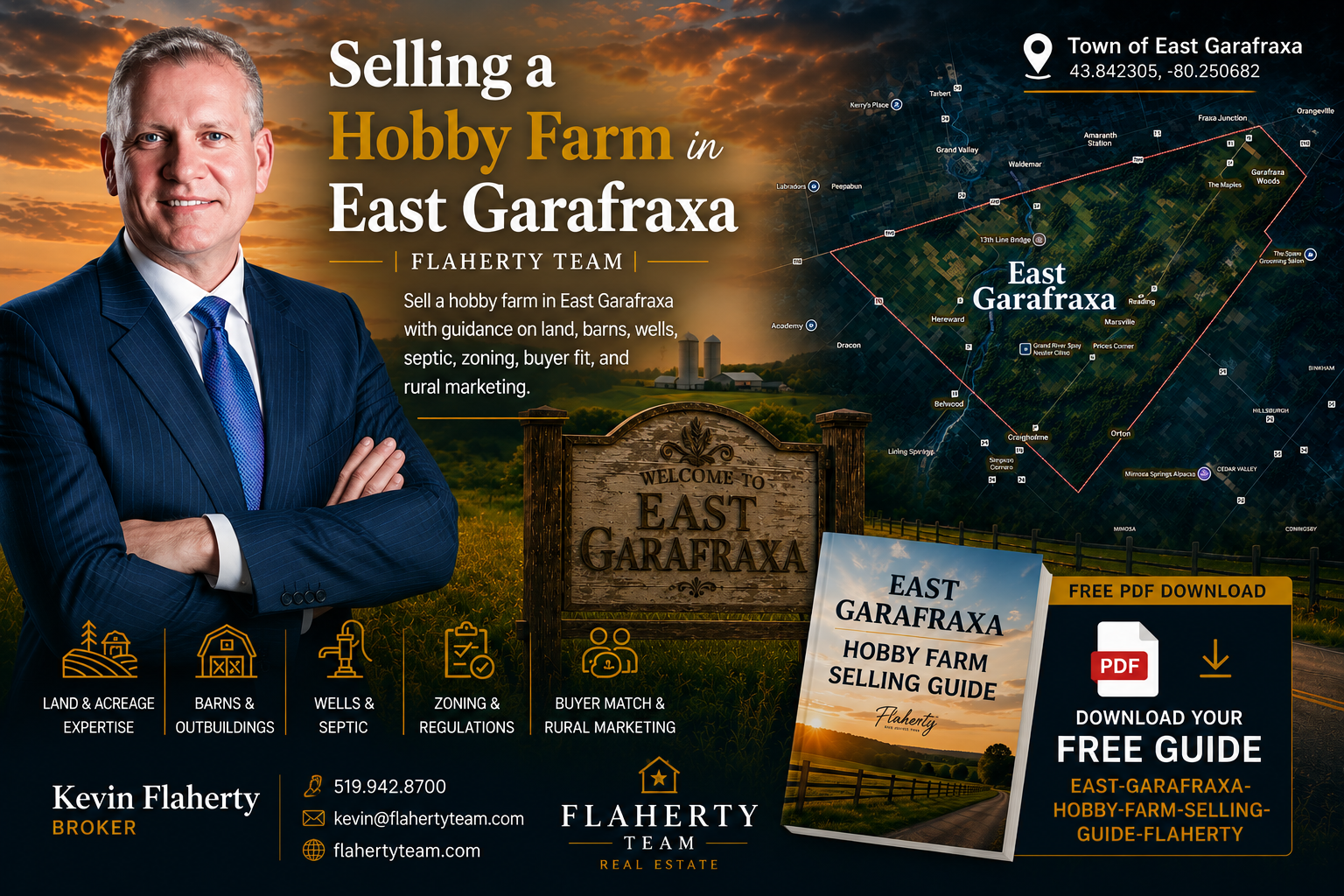
Sell a hobby farm in East Garafraxa by documenting barn utility, fencing, paddocks, water access for animals, septic confidence, and zoning compliance — then marketing to the specific buyer who values horses, poultry, small livestock, or market-garden land at the $933,000 East Garafraxa price frame. Kevin Flaherty has been selling hobby farms in this corridor for 38 years, with an Orangeville office near the east side of East Garafraxa and a family brokerage legacy spanning Caledon, Erin, Hillsburg, and Grand Valley.
Call or text 226-270-6433 for hobby-farm selling guidance from my Orangeville office near the east side of East Garafraxa.
I am separating this page from any Mono hobby-farm strategy by focusing on the East Garafraxa corridor I know through family legacy, location, and buyer psychology. My parents were both real estate brokers who served Caledon, Erin, Hillsburg, and Grand Valley before I succeeded them. I grew up in Caledon right at the Erin and Caledon border, Erin sits directly south of East Garafraxa, and my Orangeville office is very close to the east side of East Garafraxa.
That matters because East Garafraxa is not simply a lower-priced version of Mono. TRREB April 2026 shows an average and median price of $933,000 in East Garafraxa, compared with Mono’s $1.38 million April 2026 average. In my experience, that lower price frame can attract more first-time farm buyers, budget-conscious horse people, poultry and small-livestock owners, and market gardeners looking for affordable land within reach of Erin, Caledon, Orangeville, and Dufferin County.
Selling a hobby farm is about making the property understandable before buyers ever open a gate. A buyer needs to understand whether the barn is useful, whether the fencing makes sense, whether water reaches animals, whether the driveway works for trailers, whether the land can support gardens or livestock, and whether the township zoning and bylaws support the buyer’s intended use.
I have been selling hobby farms in East Garafraxa, Dufferin, and Peel for 38 years. I use that experience to position the property honestly, document the infrastructure, and market the farm to the right buyer pool instead of relying on generic rural copy. If you are comparing this decision with other East Garafraxa seller resources, start with East Garafraxa Realtors, Home Evaluation in East Garafraxa, Selling Rural Property in East Garafraxa, and Selling Acreage in East Garafraxa.
Quick, locally specific answers for East Garafraxa hobby-farm sellers dealing with low sales volume, barn and fencing questions, and buyer-use fit.
You cannot rely on township averages alone. Kevin builds a defensible range using property-specific evidence: barn utility, fencing condition, paddock layout, water access for animals, land usability, zoning confirmation, and active competition across Dufferin County and nearby Erin.
Price frame and buyer psychology. East Garafraxa's April 2026 average was $933,000 compared with Mono's $1.38 million. That lower entry point attracts more first-time hobby-farm buyers, budget-conscious horse people, and market gardeners who want affordable land within reach of Orangeville and Erin.
Fix safety issues, leaks, doors, and lighting. Beyond that, Kevin recommends documenting what the barn offers rather than over-investing in cosmetic upgrades. Buyers want to know stall count, hydro access, water, ceiling height, floor type, and whether the space supports their intended livestock or storage use.
Yes. Kevin's parents were both real estate brokers who served Caledon, Erin, Hillsburg, and Grand Valley before he succeeded them. He grew up at the Erin-Caledon border, his office is very close to East Garafraxa in Orangeville, and he has been selling hobby farms in this corridor for 38 years. That means he understands the buyer pool, the zoning context, and the infrastructure expectations.
Horses, chickens and poultry, small livestock, and market gardens are the most common. Kevin positions the listing around the specific infrastructure that supports the buyer's intended use rather than marketing the property generically as a "farm."
I use TRREB’s local baseline as the starting point, not the whole answer. A hobby farm can outperform or underperform the township average depending on house condition, barn usefulness, fencing, water access, land quality, road context, proximity to Erin and Orangeville, and buyer confidence around zoning and rural systems.
| Metric | TRREB April 2026 East Garafraxa | What it means for a hobby farm seller |
|---|---|---|
| Sales | 2 | A tiny monthly sample means pricing must use property-specific evidence, not averages alone. |
| Average price | $933,000 | This lower price frame can draw first-time farm buyers and affordability-sensitive rural buyers. |
| Median price | $933,000 | Both April sales sat at the same central price point, but individual farm utility still matters. |
| New listings | 13 | Buyers had choice, so your farm must be easy to understand online. |
| Active listings | 18 | Competition can include rural houses, acreage, and farm-style properties with different strengths. |
| Average DOM | 109 | Patience and a deep marketing package are essential in a low-volume township. |
| SP/LP | 97% | Well-positioned listings can still negotiate close to list when the price and buyer fit are clear. |
| Dollar volume | $1,866,000 | The market is thin enough that each sale can shape buyer expectations. |
Source: TRREB Dufferin_202604.pdf. I treat this as market context and then build a farm-specific value story.
A buyer looking at a hobby farm near East Garafraxa may be comparing properties across Dufferin County, Erin, Caledon, and Orangeville rather than searching one municipality only. I use that reality to shape the listing. If the buyer is a first-time horse owner, they may care about paddock layout, water points, hay storage, trailer access, and fencing. If the buyer wants chickens or small livestock, they may care about coops, runs, predator protection, feed storage, manure, and neighbour context. If the buyer is a market gardener, they may care about sunlight, soil, irrigation, storage, driveway access, and seasonal presentation.
I document stalls, paddocks, gates, fencing, trailer turning, hay storage, water access, footing, and safe showing procedures.
I explain existing coops, shelters, runs, feed storage, predator protection, water access, cleanup, and the need for buyer bylaw due diligence.
I highlight garden areas, sunlight, water, access, storage, greenhouse potential, and proximity to buyer demand without promising unverified commercial use.
I connect the charm of the home with practical rural systems so the buyer sees both daily comfort and land utility.
East Garafraxa sellers should not copy a Mono zoning script. The Township of East Garafraxa explains that its zoning bylaw classifies properties into zones such as Agricultural, Rural, and Estate Residential, and each zone has legally enforceable regulations attached to it, including rules about the location and size of buildings. The township also lists commonly requested bylaws for dogs, noise, nuisances, signs, site alteration, site plan control, and other matters that can matter when a buyer is evaluating animals, farm use, buildings, and rural enjoyment.
My approach is to market what exists clearly and then direct buyers to complete their own municipal, insurance, financing, inspection, and legal due diligence. I do not want a seller promising animal counts, commercial use, future building rights, or farm activity that has not been verified for that property.
My rule: I can make the farm understandable, but the buyer must verify intended use. That distinction protects the seller while still giving serious buyers the clarity they need to move forward.
The process below matches the HowTo schema on this page. I use it because a hobby farm has too many moving parts to rely on ordinary listing preparation. The sale needs a pricing strategy, document package, animal-safe showing plan, rural media package, and negotiation plan.
For a hobby farm, buyers need to understand the outside as much as the inside. As I explain it, “Not only do we highlight all the home's key features and benefits both visually and through narration, and not only do we show the rooms vacant and the furniture, but we also detail all the outside of the property through narration, photographs, and drone footage.”
That matters in East Garafraxa because the value may be in the barn, the paddock arrangement, the coop setup, the garden areas, the equipment access, and the relationship between the home and the land. “We even highlight in the video the boundary lines of the property by animating the property lines into the video with a north arrow that continually points north regardless of the direction of the drone.” I also show community context because “The video narrated VR animated online showing details features of the surrounding area as well.”
When the property deserves a dedicated explanation, “That home's custom web page is syndicated to over 57 locations online for maximum exposure.” For hobby farms, that exposure only works if the story is specific enough for the right buyer to recognize the opportunity.
My flagship top-dollar strategy video for sellers who want a structured marketing plan before they go live.
A sample of my Video Narrated VR Animated Online Showing system, especially useful for farms, outbuildings, boundaries, and surrounding context.
Questions East Garafraxa hobby-farm sellers should ask before hiring an agent to market land, barns, animals, and rural systems.
Legal and disclosure guidance for sellers preparing a property with rural systems, fixtures, inclusions, exclusions, and buyer conditions.
A diagnosis video for rural and hobby-farm listings that stall because buyers cannot understand price, condition, land use, or marketing.
Inspection preparation for the house component, outbuildings, and rural systems that affect buyer confidence.
Timing guidance for East Garafraxa hobby-farm sellers considering seasonal demand, buyer activity, and market conditions.
I include these because hobby-farm sellers need confidence that the marketing will do more than place a listing online. The goal is to reduce unnecessary showings, improve buyer understanding, and create stronger exposure for the right audience.
“Kevin's experience and marketing team sold my home over asking price in one day. The house was sold before it even went on MLS. We did not have to go through open houses or multiple viewings. The professional videos his team produces are amazing.”
Brian Masulka
“In my time-sensitive house closing, Kevin and his team created a stellar, high-tech, personalized virtual video. This enabled virtual views with busy schedules for potential buyers. Kevin is professional, knowledgeable, experienced, and reputable.”
Jennifer Zahodnik
“I couldn't believe how fast my home sold at a time when other homes were sitting on the market. Kevin got mine sold quickly and at a price that was top dollar and even more than I expected. His video narrated VR animated online showing gave my home amazing exposure and reduced unnecessary showings. Kevin was a pleasure to deal with. He was always patient and kept me informed every step of the way. I highly recommend his innovative approach.”
Joanne Holding
If your property is more acreage than farm, or if you need a broader valuation plan before deciding how to present the property, I recommend reviewing these companion pages.
Hobby-farm positioning can change by micro-location. I look at how the property sits relative to Brookhaven, Garafraxa Woods, Marsville, Rayburn Meadows, Erin, Orangeville, and Dufferin County roads because buyers compare access, privacy, services, and rural context.

I am Kevin Flaherty, and I have been selling hobby farms in East Garafraxa, Dufferin, Peel, Caledon, Erin, and the surrounding corridor for 38 years. My family history in this area runs deep: both of my parents were real estate brokers who served Caledon, Erin, Hillsburg, and Grand Valley before I succeeded them, and I grew up in Caledon right at the Erin and Caledon border.
My Orangeville office is very close to the east side of East Garafraxa, so I understand how buyers compare this township with Erin, Caledon, Orangeville, and the rest of Dufferin County. When I build a farm listing, I want buyers to understand the whole property: the house, the barns, the land, the systems, the buyer-use possibilities, and the due-diligence questions.
Learn more about Kevin Flaherty here or Call or text 226-270-6433.
These answers are written for East Garafraxa sellers who need more than generic real estate advice. They focus on the questions I hear around barns, livestock infrastructure, wells, septic, buyer qualification, zoning, marketing, and low-volume rural market timing.
Sell it as a working lifestyle property, not just a house with extra land. Kevin Flaherty recommends building the entire strategy around the farmhouse, barns, paddocks, fencing, water for animals, septic confidence, zoning due diligence, buyer fit, and rural marketing that explains how the farm actually works.
The difference is farm function. Acreage marketing explains land, privacy, access, and outbuildings; hobby-farm marketing goes deeper into animal infrastructure, fencing, paddocks, water systems, coops, manure handling, seasonal operation, buyer qualification, and permitted-use questions.
The data means patience and precision matter. Kevin uses the April 2026 baseline of 2 sales, a $933,000 average price, 18 active listings, 109 average days on market, and a 97 percent sale-to-list ratio as context, then adjusts for land, buildings, systems, and buyer demand because two monthly sales cannot define every farm.
The buyer pool is often more budget-conscious. East Garafraxa’s April 2026 average was $933,000 compared with Mono’s $1.38 million, so it can attract first-time farm buyers, horse people watching affordability, market gardeners, and buyers who want rural function without the higher Mono price frame.
Yes. Erin is directly south of East Garafraxa, so many buyers compare both markets when they want country living near Caledon, Erin, Orangeville, and Dufferin County. The marketing should acknowledge that crossover rather than treating the property as isolated from nearby search behaviour.
Kevin grew up in Caledon near the Erin and Caledon border, and both of Kevin’s parents were real estate brokers who served Caledon, Erin, Hillsburg, and Grand Valley before he succeeded them. That legacy matters because East Garafraxa hobby farms often draw from the same rural corridor, not just from one township.
The common use cases include horses, chickens and poultry, small livestock, market gardens, workshops, equipment storage, and rural family properties with a farmhouse plus practical outbuildings. The listing should identify what exists and avoid promising any use the buyer has not verified.
Not necessarily. Prioritize safety, leaks, structural concerns, doors, lighting, access, exposed wiring, trip hazards, and obvious buyer-confidence issues. Cosmetic repairs should be judged by whether they help the likely farm buyer understand value or simply consume money before listing.
Kevin’s Video Narrated VR Animated Online Showing helps buyers understand the whole property before they arrive. It can combine room flow, narrated exterior explanation, drone footage, barns, paddocks, gardens, access, outbuildings, boundary orientation, and surrounding-area context in a way photos alone rarely achieve.
No. Animated boundary lines are a marketing and orientation tool, not a legal survey. Buyers should still rely on surveys, title information, legal descriptions, municipal records, and professional advice when boundaries, easements, or permitted uses matter.
Collect stall counts, paddock layout, fence condition, gate details, arena or riding-area notes, water points, hay storage, trailer access, manure-management details, tack-room information, and any repair or permit records available for barns and shelters.
Kevin recommends showing coops, runs, feed storage, water access, predator protection, cleaning access, seasonal ventilation, and distance from living areas in a practical way. The marketing should describe existing infrastructure while leaving animal-count and bylaw questions to buyer due diligence.
Yes, but carefully. You can highlight existing gardens, soil preparation, sun exposure, irrigation access, greenhouse areas, storage, driveway access, and roadside context, but you should avoid guaranteeing a commercial use unless the buyer verifies zoning, permits, and business requirements.
Check the property’s exact zoning, any site-specific exception, permitted uses, accessory-building rules, setbacks, environmental protection areas, development limits, and whether the township has bylaw amendments affecting rural or agricultural properties. The Township notes that zoning classifies land into zones such as Agricultural, Rural, and Estate Residential, each with legally enforceable regulations.
They affect confidence. Buyers want to understand household water, animal water, treatment systems, pump history, septic records, capacity assumptions, and how farm use is separated from residential systems. Clear documentation reduces fear and helps buyers decide whether the property suits their plans.
Kevin recommends a written showing plan. Decide where animals will be, which gates stay closed, whether electric fencing is active, how dogs are handled, what buyers may touch, where children should not go, and whether boot or biosecurity instructions are needed.
Yes. Brookhaven and Rayburn Meadows may attract estate and custom-home comparisons, Garafraxa Woods can emphasize trees and privacy, and Marsville can draw buyers who value east-side access near Orangeville and Erin. The community context changes which features should lead the marketing.
List them clearly before launch. Portable panels, feeders, waterers, shelters, tractors, implements, hay, appliances, gates, fencing materials, and shop tools can create conflict if buyers assume they are included. Written clarity protects the negotiation.
Listings often stall when buyers cannot understand the value quickly. Common problems include vague land descriptions, weak drone media, unexplained barns, unclear water access, poor exterior cleanup, missing zoning context, overpricing, and showings that feel unsafe or confusing.
Kevin starts with the infrastructure. A barn with stalls may point toward horse buyers, coops toward poultry keepers, open land and water toward market gardeners, and simple outbuildings toward lifestyle buyers who want room for storage, animals, and projects without operating a commercial farm.
Market to all likely pools, but shape the message for each. Toronto-area buyers may need education on wells, septic, and farm operation; Dufferin buyers may compare local value; Erin and Caledon buyers may see East Garafraxa as a nearby affordability alternative.
Community pages help buyers understand micro-location. A hobby farm near Marsville, Brookhaven, Garafraxa Woods, or Rayburn Meadows should connect the property’s land use, access, amenities, privacy, and nearby buyer demand to the right local context.
Download it before pricing, repairs, photography, or buyer showings. The guide helps you organize barns, fencing, water systems, septic notes, animal logistics, inclusions, seasonal presentation, zoning questions, and buyer qualification before the listing goes live.
Contact Kevin Flaherty through the Flaherty Team’s Orangeville office. Kevin has been selling hobby farms in East Garafraxa, Dufferin, and Peel for 38 years, and his office is very close to the east side of East Garafraxa. Call or text 226-270-6433 to start.

170 Lakeview Court; Unit 3A
Orangeville, ON
L9W 5J7

Not Intended To Solicit Properties Already Listed For Sale.
A HoneyCombHub.ca Web Site Solution
Copyright 2026 . All rights reserved.